Five Tips for Hybrid Events
Chicago-based virtual event provider InXpo offers the following tips for holding an effective hybrid event.
1. Promote based on your audience. Plan your marketing schedule strategically. Begin promoting the virtual event to those located farthest away from the physical event location; conversely, promote the physical event to those based near the event site. As the event date draws closer, only locally promote the virtual event to those who haven't responded.
2. Staff properly. Ensure adequate staffing coverage for physical and virtual needs. Don't expect staff members to support both venues simultaneously.
3. Blend the experience. Create ways to bring the physical event into the virtual one, and vice versa. For instance, have presenters acknowledge the camera/virtual attendees for keynotes with a live video stream. For session Q&A periods, allow virtual attendees to submit questions via chat to a moderator.
4. Promote a single event brand. Don't overly emphasize the physical event vs. the virtual one.
5. Create a command center. Set up the virtual support staffers in a command center at the physical event site.
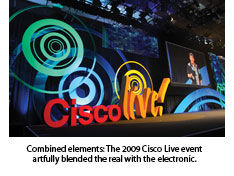 Cisco Live, the technology giant's annual customer conference, is a big production. It consists of programs for technology partners, developers, IT managers and executives, the press, analysts and more -- all meeting under one roof and sharing keynote presentations and an exhibit hall. The latest iteration offered close to 500 breakout sessions. But as of October 2008, the conference planners were getting a little anxious about the following summer's event.
"When things were not looking good with the economy, it became clear to us that there were a lot of customers who wanted to come to the event, but there was no way they were going to get funding for travel and training this year," recalls Kathy Doyle, senior manager, Global Cisco Live & Networkers conferences. "So at that point we decided to move forward with a concurrent virtual event, which we're calling a hybrid event. The goal was really to give our customers the option to attend virtually if they did not attend the in-person event."
Interest in so-called hybrid events is growing rapidly, according to virtual event technology providers InXpo, ON24 and Unisfair. Such shows can be broadly defined as any physical, in-person event that includes a virtual component, from live streaming keynotes to a full virtual environment. Streaming presentations are, at this point, a far more common scenario than events offering a complete online show environment in conjunction with a live gathering, as the Cisco Live team provided.
Together with Chicago-based InXpo, Cisco created a virtual event that took place on the two main days of the June 2009 physical version of Cisco Live, which ran for five days in total. For those two days, Cisco broadcast live webcasts of the keynotes and primary sessions, and offered an additional 40 sessions, some of them live and some on-demand. A virtual exhibit hall was staffed by booth representatives online. Cisco provided additional opportunities for virtual attendees as well.
"It was important to blend the experience," notes Doyle, "making sure there were components at the live event that the virtual attendees had access to. But then there was also unique content, just for those virtual attendees, to make it special to them. One example was a live Q&A chat with executives. That wasn't something attendees at the live event had access to. The customers who participated in that really loved it. That was one of the highest-rated events."
Cisco's virtual event team meticulously designed the online program to
mimic the experience of the in-person event, notes Dannette Veale,
Global Cisco Live and Networkers virtual manager, corporate event
marketing. "I worked very closely with our content manager to make sure
that the experience we were distilling for our virtual audience not
only represented the same breadth and depth of content, but also the
same weighting or percentage within the technical tracks," she says.
Another
virtual-only experience, called "Ask the Expert," combined the elements
of the on-site programs "Meet the Engineer" and "Technical Assistance
Clinic," both of which consisted of one-on-one time with technical
experts. For the live event experiences, attendees scheduled
appointments in advance; for the virtual "Ask the Expert," however,
attendees could enter chat rooms at designated times to consult with
representatives from various technical fields. Customers with
hard-to-solve problems were matched with appropriate experts who
provided additional assistance via instant messaging.
"It was really
one-on-one troubleshooting and design consultation with some of our
known experts in the field," says Veale. Like the executive Q&A,
this was highly rated by virtual attendees.
Boosting attendance
The
virtual component of a hybrid event can take a great deal of planning
and preparation -- as it clearly did in Cisco's case. The cost must be
factored in as well: A virtual event on the InXpo platform ranges from
between $25,000 and $50,000, and up to six figures for highly
customized environments.
"In some cases," notes Bob
Bahramipour, chief marketing officer of InXpo, "our customers are
taking a percentage of their physical event budget and allocating it
to virtual as a way to extend the audience." With virtual, he adds,
"The overall cost per attendee is significantly lower for the organizer
and sponsors."
More than 10,000 people attended Cisco Live in
person in June, and an additional 4,500, representing 28 countries,
attended the virtual event. As Cisco's goal was to increase loyalty
(and, potentially, sales) among customers who were unable to travel to
San Francisco for the physical conference, the addition of the virtual
component was hugely successful.
"We definitely broadened the
reach of our customer base," says Kathy Doyle. "This year we touched
14,000 people, which was a record number. In some cases they were
customers who wouldn't typically attend the live event. So, for
example, 37 percent of our live attendees were first-timers. However,
in the virtual world it was 55 percent. So we think this is a great
marketing funnel for us to make people aware of the event."
Based
on attendee survey feedback, that should translate to increased
in-person attendance. Thirty-four percent of the virtual attendees said
they are extremely likely to attend the live event next year. What's
more, adds Doyle, "of the people at the live event, only 7 percent said
they would attend virtually next year. So it's a smaller number who
say, ‘Oh, now that there's a virtual option we're going to do that
instead.' I think that might be one of the biggest fears that show
producers have -- that a virtual event would take away from the live
conference or possibly cannibalize your paid attendance. And we really
didn't find that that was an issue."
Virtual Platform Providers
InXpo Chicago
Price range: $25,000–$50,000
(up to six figures for highly customized events)
(312) 962-3724
inxpo.com ON24 Virtual Show San Francisco
Price range: $20,000–$50,000 average
(415) 369-8000
on24.com Unisfair Menlo Park, Calif.
Price range: from $25,000; typically $50,000
(866) 354-4030
unisfair.com 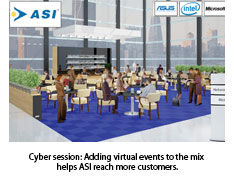 Spreading the net
Because
a hybrid approach is designed, in part, to broaden the reach of a
physical event, it's increasingly being considered by organizers of
traveling "road shows" -- a series of in-person events held in numerous
cities. In these cases, companies are reducing the number of cities to
which they travel by augmenting a city tour with a virtual event that
any customer, regardless of location, can attend.
"We've got
16,000 customers spread out over a large geographic area," explains
Kent Tibbils, vice president of marketing for ASI, a distributor of
computer hardware components based in Fremont, Calif. "If we can only
make it to six cities a year, it's pretty hard to touch all of our
customers and get information out to them. The benefit a virtual show
offers is that we can go nationwide and reach out to all of our
customers."
ASI opted to augment its city tour this year with
two virtual events -- one in the spring and one in October -- using
ON24's Virtual Show platform. This represents the most typical type of
hybrid usage, according to representatives of both San Francisco-based
ON24 and Menlo Park, Calif.-based competitor Unisfair.
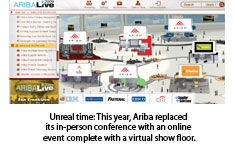
Using
the Unisfair platform, Traci Oziemblowsky, CMP, CMM, senior manager of
global corporate events for Ariba, took a similar approach for the
Sunnyvale, Calif.-based spend management company. "Instead of our
normal conference of about 1,200 to 1,500 people," she explains, "this
year we actually did a large virtual event. And then we went to six
cities globally with smaller events, to get the networking."
Like
Cisco's planners, Oziemblowsky and her colleagues were concerned about
what effect the global economic climate would have on their physical
event. "We spoke with customers and prospects, and we recognized that
there were cost constraints and travel restrictions," she says. "We
also knew that it was more important than ever, because we're a spend
management company, to make sure that people were still coming to this
event that we've become known for." Although marketing had already
begun for the physical event and the space had been booked, it became
clear that attendance would likely be far lower than anticipated.
Oziemblowsky's team made the tough decision to convert that physical
event to a virtual one on the same dates.
"We didn't want to
have a party and have no one show up," says Oziemblowsky, "and we
wanted to find a way to make sure our message got out there, because
it's so important. That's why we chose the hybrid approach; we didn't
want to give up the networking altogether from the face-to-face
meetings, which we do see as important in value to our type of event."
Ariba
used the virtual event as an opportunity to deliver all of the
main-stage presentations and breakout sessions planned for the annual
in-person event, and also marketed the company's smaller, in-person
events. "We were able to say, look, not only are we doing this but
we're also coming to a city near you," Oziemblowsky says. "And now you
can come spend the day with us and our other customers and prospects.
And it worked really well."
Ariba had 2,267 customers and
prospects register to attend the virtual conference; on the day of the
event, 1,571 people participated online. The actual number of virtual
attendees exceeded the company's historical average for the live annual
conference. "The registration numbers are good because those are
considered leads too," explains Oziemblowsky. "These are people who
have expressed interest, even though they didn't show up. And the
advantage to a virtual event is that anyone who registers can still
attend after the fact, because it stays up online."
Ariba's event
originally was slated to remain open for three months following the
live broadcast, but interest remained high enough that it was extended
for an additional three months.
For ASI's Kent Tibbils,
virtual events have allowed his company to provide broader coverage and
additional value for both vendors (the exhibitors) and customers (the
attendees). ASI typically attracts 350 to 400 attendees for each live
show; for its first virtual event, 750 people attended. "The big
driving factor that led us to get into the virtual show to begin with
was to deliver the message to a broader audience," says Tibbils. "By
far, the virtual event is much better attended. It's much easier for
our customers."
Although Oziemblowsky is planning to hold
Ariba's traditional in-person conference in Orlando in 2010, she's
looking to add a virtual component.
Setting the price
One big
question surrounding the virtual component of hybrid events is what to
charge -- and what attendees are willing to pay. Kathy Doyle admits
this was a real challenge for Cisco. Physical attendees pay between
$1,700 and $2,000. While part of the point of the virtual component was
to provide a low-cost option, Cisco recognized the content still had
real value and needed to be presented as such. "In the past," Doyle
says, "we were charging $250 for on-demand content. So we felt that now
that we had this new environment that made it much more interactive for
the customers, it would warrant a bit of a higher price."
Cisco
elected to make two options available: a free registration, which
provided access only to keynote sessions, main "super sessions," the
exhibits and a select number of technical presentations; or the Premier
Pass, for $395, which allowed access to all content, including another
300 sessions, a mix of live streams and on-demand presentations. Based
on attendee feedback, Doyle says, in the future Cisco plans to offer a
few packages in between -- say, for five or 10 selected sessions -- at
lower price points.
 Ariba's team elected not to charge anything
to attend its virtual event, though the company typically has charged a
fee to attend the in-person event. The subsequent six-city tour did
have a fee, but "definitely not what we would have for the big event,"
says Traci Oziemblowsky. The company did take in some revenue from
exhibitors, however. For the in-person annual event, Ariba generally
had 30 to 40 booths in the Partner and Supplier Pavilion.
Ariba's team elected not to charge anything
to attend its virtual event, though the company typically has charged a
fee to attend the in-person event. The subsequent six-city tour did
have a fee, but "definitely not what we would have for the big event,"
says Traci Oziemblowsky. The company did take in some revenue from
exhibitors, however. For the in-person annual event, Ariba generally
had 30 to 40 booths in the Partner and Supplier Pavilion.
"The
cost of the sponsorship, which was normally $10,000 to $15,000 in
person, was $2,000 to $5,000 for the virtual event," Oziemblowsky says.
"But we actually got about 30 sponsors, so that helped us." The cost of
the virtual booths vs. the physical booths, she adds, was proportionate
to the cost of the virtual show vs. the physical event.
ASI
elected not to charge vendors anything for the first virtual event,
according to Tibbils. "As an enhancement for signing up for our live
package, you got a virtual show for free," he explains. "The second one
that we're doing, we are charging for the booth space. They definitely
understand the value, though vendor budgets are tight. But now we can
come back and show them detailed data about what happened at their
booths the first time, and that definitely helps them allocate budgets
through their management for doing this event." ASI doesn't charge
customers to attend, even for the physical events.
Reaping the data One
of the biggest benefits of holding a virtual event is the breadth and
depth of attendee data that's acquired. "When they do take some piece
of collateral or some piece of information, or they click on a link, we
can report that back to the vendor," explains Tibbils. Show organizers
can see exactly who downloaded what information, how much time they
spent in the booth, to whom they spoke and what questions they asked.
And all of that is associated with the attendee's contact information.
That's far more information than can be reasonably collected from a
physical event.
"We have significantly more data about attendees
in the virtual environment," agrees Cisco's Doyle. "We know exactly
what they're doing, what they're talking about, all of their
discussions and exactly how much time they're spending in each area."
Such
insight dramatically increases the value of leads, says Joerg
Rathenberg, senior director of marketing for Unisfair. "The leads that
you get from a virtual event are enormously better than what you get
from a real live event," he says, adding that everything the attendees
do within the environment is being measured. "After a physical trade
show, you usually sit there with your big goldfish bowl of business
cards, and some of them have notes scribbled on them and so on, and
then you hand them off to a temp and have them typed in. That is the
exact opposite of what we provide to our customers."
Unisfair
uses a compound metric it calls an Engagement Index; customers
essentially define what an ideal lead would look like, and those
parameters are applied to every virtual attendee's registration
information and record of what he did during the event. The resulting
index creates a ranking of leads afterward for follow-up. "I think for
some people this is science fiction," says Rathenberg. "But that's what
we do."
The quality of those leads is a big reason that
Rathenberg is convinced that companies will embrace the value of
virtual and hybrid events even long after travel budgets recover. "I
want to make sure that every CMO in every larger company has this in
their marketing budget," he says. "I want them to say, ‘We have to have
a virtual engagement strategy.' That's my goal."