What will a meeting cost, and how will the costs vary in different destinations? It's a common question that has planners doing a lot of time-consuming legwork -- sometimes for a gathering that might not ever happen. The good news for those who commiserate: New tools just coming to market will put answers at planners' fingertips.
"We used to have meeting requesters say to us, 'I don't know which city I want to go to. Start doing research for me,'" recounts consultant Debi Scholar of her days leading a corporate meeting and events team. "Some on the sourcing team would spend days and days putting together estimates -- only to have the meeting get denied in the approval process."
With such a drain on manpower, Scholar, now president of the Scotch Plains, N.J.-based Scholar Consulting Group, instructed her sourcing team not to spend more than four to eight hours researching a meeting before it was approved.
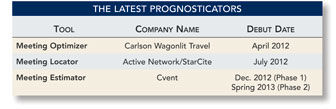
To address this challenge, San Diego-based Active Network debuted Meeting Locator this past summer, as part of the StarCite platform in its business solutions division. In part, the tool streamlines this first step, the preapproval process. "One of the big interests when we started discussing this with our clients was the ability to just approve a meeting right off the bat, using the data delivered by this tool and without having to do further due diligence," explains Mark Johnson, senior director of product management at Active Network.
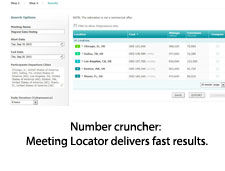 Meeting Locator, developed in partnership with Carlson Wagonlit Travel, is a straightforward cost-estimation tool. (CWT released its version of the tool, called the Meeting Optimizer, last spring to its clients.) The meeting owner or planner need only enter the proposed meeting dates, as well as participants' departure cities and the number of people coming from each location. Preferred meeting cities may also be specified. Then the tool goes to work.
Using an algorithm developed by CWT, based on 36 million of the travel management company's processed hotel and air transactions, the tool crunches several months' worth of transient CWT travel data to estimate airfare and hotel costs by location. Any preferred cities are displayed first, followed by a rundown of global metropolitan areas and their associated costs. By default, those locations are listed beginning with the least expensive -- and the search itself takes only a few seconds.
In addition to air and hotel costs, Meeting Locator displays travel time for the various participants, telepresence options and their associated costs, and carbon emissions related to air travel. "Planners can report that back for any green initiatives within the organization," says Johnson. "It's not always just financial information; it can be about compliance or other initiatives you're trying to support as well."
Unbiased Insight  "This first step in the meetings process, the destination analysis, has always been a very manual process -- and a very subjective one," according to Christopher Kosel, CWT's global product director of meetings products. "What we've done is taken all of the transactional data that we have and created an objective analysis that crunches through a volume of information that an individual simply couldn't do."
Meetings management veteran Terry Miller, founder and president of Travel and Meetings Consulting LLC in Fishers, Ind., agrees that the destination selection process traditionally has been too subjective. "Too many times, decisions have been made based on personal preferences and not necessarily what is best for the meeting and best for the company," he says. "Excessive money is spent to place meetings in locations without regard to the meeting content. I'm very supportive of a technology that can help drive location decisions based on data."
The objectivity offered by these tools is quickly gaining support throughout client organizations, notes Kosel. "That's one of the things that's really appealing to travel managers and procurement purchasers -- the ability to really benchmark," he says.
A Cure for Lead Spam?
"There have been some problems in the marketplace," says Jeannie Griffin, director of product management for Cvent, "and this is looking to address some pain points."
Griffin is referring to the enormous volume of requests for proposal being sent through platforms such as hers and StarCite's, among others. With the click of a button, planners might -- and often do -- send RFPs to as many as 40 or 50 hotels at once (for details, read the recent M&C article, "Online RFPs: A Mixed Blessing,"
bit.ly/JlGAAL).
"We've been hearing from the supplier and planner communities," adds Griffin. "Everyone is looking for better qualified business. Planners want to know before they send an RFP who they should be targeting, and suppliers are saying, 'Give us qualified leads. I don't want to be one of 50 destinations included in an RFP.'"
Both Cvent and Active Network believe new estimation tools could improve matters. "Meeting Locator is designed to reduce the effort required to find a good location to have your event," explains Active's senior director of product management, Mark Johnson. "Instead of sending out RFPs to a bunch of different locations, this gives you a better starting point."
Likewise, Griffin thinks Meeting Estimator could refine the quality of leads coming through Cvent: "We're definitely looking to put this tool in the process before sourcing occurs so that more targeted RFPs result."
Ease of Use While Meeting Locator is now
available for the enterprise clients of StarCite -- those customers
using the platform for strategic meeting management -- the tool
eventually will be offered to anyone using Active's business solutions,
for both managed and unmanaged meetings programs, says Johnson.
Carlson
Wagonlit Travel offers Meeting Optimizer as a standalone product
available to all CWT clients. "It's an incredibly easy product to use,"
says CWT's Kosel. "It doesn't require any particular knowledge about how
to plan a meeting. You can go into the product as a casual meeting
arranger and begin to take advantage of it."
Because of that,
adds Kosel, even clients that have elected not to centralize small
meetings can benefit. "A lot of companies have made a decision to not
try to manage all of their small meetings through a central meetings
department," he explains. "And a lot of people who are making plans for
meetings, whether that's finding the hotel, finding the destination or
helping people arrange travel, are not professional meeting planners. We
want to make sure we can give that group of people tools they can use."
Budgeting Notes
Representatives from both Active Network and CWT acknowledge their
joint platform to be a starting point for the tools, which inevitably
will become more robust according to market demand. Each company is
discussing with clients additional meeting information that might be
used in the calculations.
 Debi Scholar, while enthusiastic about
the potential efficiency benefits of the tools, points out that less
experienced meeting requesters need be aware of what the numbers mean.
"The calculator doesn't take into consideration food-and-beverage costs,
which may be an additional 20 to 25 percent of your meeting costs, or
audiovisual, which can be 5 to 10 percent of total costs, or ground
transportation, which may be another 3 to 5 percent of total meeting
costs. I understand that isn't necessarily the purpose of the tools,"
Scholar acknowledges, "but it's important that everyone recognize that,
especially given the potentially wide user base."
Debi Scholar, while enthusiastic about
the potential efficiency benefits of the tools, points out that less
experienced meeting requesters need be aware of what the numbers mean.
"The calculator doesn't take into consideration food-and-beverage costs,
which may be an additional 20 to 25 percent of your meeting costs, or
audiovisual, which can be 5 to 10 percent of total costs, or ground
transportation, which may be another 3 to 5 percent of total meeting
costs. I understand that isn't necessarily the purpose of the tools,"
Scholar acknowledges, "but it's important that everyone recognize that,
especially given the potentially wide user base."
Already in
development is a product from McLean, Va.-based Cvent that will
calculate costs by destination and also give a total budget estimate.
The so-called Meeting Estimator will take into consideration food and
beverage as well as airfare and hotel room costs, and will offer a
customizable open field to add in expected additional costs.
"Things
such as ground transportation and other ancillary items are hard to do
accurate estimates on globally," acknowledges Jeannie Griffin, Cvent's
director of product management. "So we decided to just allow some
blanket cost type that could augment the estimate and make it more
accurate."
Cvent will roll out Phase 1 of its Meeting Estimator
late this year; the fully functional Phase 2 is set to debut in spring
2013.
Data Quality The meeting cost
estimator isn't a new concept. Griffin, who worked for BCD Travel from
2004 to 2010, says "all of the clients were looking for this type of
product." But the quality of the data used now separates the newest
products from previous attempts, she believes.
"If the planner or
anyone else uses something of this nature and the estimates are way
off, or they don't feel the information is correct, they won't go back
and use it again," says Griffin. "So our key focus has been on
fine-tuning that process and leveraging what we know to be the most
accurate estimate."
Cvent is taking a different approach for its
data sourcing. While CWT's unique algorithm is applied to transactional
data from either the past six months or the equivalent quarter of the
previous year, Cvent will instead partner with a third party that
provides a snapshot of current airfares, updated twice monthly. "We're
not going to be using historical data," explains Griffin. "And that's
really been a driver in the design for this estimator."
To
estimate hotel and F&B costs, Cvent will use proposal data culled
from the Cvent Supplier Network. "That predicts the seasonal future
pricing of what's going on within a particular major metro area," says
Griffin. "We're excited about that, because we have a ton of volume
coming through the Cvent Supplier Network." (Cvent's 2012 monthly total
RFP average is 119,025.) "We'll be leveraging that information to get a
realistic estimate for a particular area."
The Meeting Estimator
also will allow customers to input their own negotiated rates where
applicable -- a nod to third-party planners and larger agencies, as well
as major corporations, that use the Cvent platform. "For our
third-party partners, it is a requirement that they're able to load
their information in," says Griffin. "They do feel that they get better
rates due to the name and volume of the agency in particular areas, and
they want to be able to leverage that data."
Next Steps Phase
1 of Cvent's Meeting Estimator will be a beta version of the tool.
Cvent will provide cost estimate data for only the top 50 major
metropolitan areas in the U.S.; also, clients will be able to load in
their own data for airfare, hotel rates and food and beverage. "Phase 1
is targeted more toward a large agency that will essentially be testing
this for us," Griffin explains, "and putting everything through its
paces." When Phase 2 comes out next spring, it will be the wide-release
version that includes all of the data described above.
Active
Network and CWT are discussing next-step functionality with their
respective clients. "The starting point is CWT's data," notes Active's
Mark Johnson, "but we've already heard lots of requests -- and think
it's a great idea -- to extend this out to including the host of data
that we collect. The logical next step is to include data specific to an
organization, to drive the estimates even closer."
Many CWT
clients, too, would like the tool to become more focused on their own
historical data or contracted rates, says Kosel. However, he's concerned
that this approach could produce biased results. "Will that simply
create a tool that predicts they should travel to where they have always
traveled? By including the data across all of our clients, we really
are able to provide them with a much more objective set of results they
can use."
Likely, the right approach will vary according to each
customer's needs. For the pharmaceutical industry, for example, an
accurate, company-tailored estimate makes a lot of sense. "Regulatory
requirements are driving people to better understand how they're
spending," says consultant Terry Miller, who previously managed travel
and meetings at Indianapolis-based Eli Lilly and Co. "Having some form
of an accurate estimate is extremely valuable."