At trade shows, conferences and most any other kind of meeting today, there's a lot more going on than just what occurs on the show floor, at the podium or in the classroom. A growing number of attendees also are participating in online communities purpose-built to enhance event engagement, and these platforms extend far beyond the event itself.
Case in point: For MPI's 2010 World Education Congress, more than 1,500 attendees elected to join the Pathable online community -- more than 60 percent of the show's total delegates. All but about 100 of these members completed online profiles, and many used the platform's personalized schedule, added contacts and took part in online discussions. Nearly 500 messages were exchanged among attendees using the platform.
Surprising? Not to Pathable CEO Jordan Schwartz. "That type of engagement is typical," he says. "We see that more than half of our events get better than 50 percent adoption, and a third get better than 75 percent. And there's nothing up our sleeves -- we are not opting people in. People are accepting the invitation, filling out their profiles and spending some time on the site. We're offering something that fulfills a critical need."
In fact, it's a niche the more widely used social media don't seem to fill. For MPI's event, just 212 attendees opted in to the LinkedIn group set up for the gathering (Pathable attracted more than six times that number), and a scant 131 joined the Facebook event group.
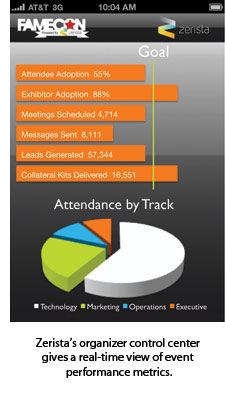 Along with competitor CrowdVine, Pathable has been offering event community platforms for nearly five years. Zerista launched two years later, and Leebug has been steadily growing its business since 2010. A number of registration and other meetings technology providers offer platforms with similar functionality. In every case, the idea is to create a social network specifically for that event's audience -- members, customers and any potential attendees. In some cases, the platform is integrated with the event program and session scheduler. And each offers an accompanying mobile web app.
As more organizations devote time and resources to their event-related social media plans, business has grown for each of these technology providers. Best practices have emerged, and providers can easily guide new clients in establishing effective communities. But the technology niche is still young, and it's still evolving. Here's a look at some trends and how event social-networking providers are responding to them.
The Price You'll Pay
Facebook and Twitter are free, but the cost for event-specific social communities can vary widely, especially for clients who need customization of the platform or a native mobile app. At the same time, ways for clients to generate revenue though these tools are expanding, via sponsorships or exhibitor ads and virtual booths. The following provides a ballpark range of what customers can expect to pay.
CrowdVineSelf service: Free to $800 per event, depending on event size and features
Full service: $3,000 to $8,000 per event, depending on event size
LeebugSetup fee: $350
Self service: Clients who upload all conference material pay nothing more than the setup fee.
Full service: $5 per agenda item uploaded, and $2 per speaker/sponsor listing
Virtual booths/banner ads: $200 each or $2,000 for an unlimited amount (regardless of how much sponsors or exhibitors pay for booths or ads).
Pathable Pricing is based on number of attendees, exhibiting and sponsoring companies, total number of events and communities, and some other details.
Small event: For about 400 attendees, the cost would run about $3,900 per year.
Midsize conference: For about 800 attendees and 100 exhibiting/sponsoring companies, price would be about $9,700 per year.
Enterprise solution: For multiple events with 4,000-5,000 attendees in total, hundreds of sponsoring and exhibiting companies, year-round super community and tools for monetizing, the cost would be about $27,200 per year.
ZeristaConference only: $3,000 setup fee plus $3 per attendee
Conference plus exhibition: $4,000 setup fee plus $4 per attendee
Enterprise solution: $5,000 setup fee plus $5 per attendee. This includes more customization possibilities, as well as more integration options to other technology platforms. For all versions, discounts are available for multiple events.
Making it perpetual While event-community
providers have long touted the benefits of engaging attendees before the
event and, to some extent, continuing that conversation in the days and
weeks after the event occurs, the vehicles for doing so have remained
event-driven platforms. Today, however, many organizations are creating
communities for members or customers that touch on a number of concerns
beyond the events, says Jeff Hurt, director of education and engagement
for Velvet Chainsaw Consulting in Dallas. "We are seeing more
organizations using technology to create a customer or member community
that is available 24/7, 365 days a year, that addresses more than one
event," he explains. "The event community becomes a subset of that
larger community."
Pathable addressed this trend in its version
2, which began rolling out last fall. Now, attendee discussions may be
categorized either by event or as general community forums with
event-specific tabs. "When we first started Pathable," recalls Jordan
Schwartz, "we used the term 'disposable social networks.' We thought we
were creating social communities for the events that would end along
with the events. And as it turns out, that was just wrong. Customers
were saying, 'Hey, we built this great community with engaged, active
attendees, and they loved it. Now the event's over. Now what?' In
retrospect, what people wanted was for us to take that excitement and
spin that out to create year-round engagement."
Keeping it mobile
"The biggest focus for event technology seems to be on the conference
mobile app," observes Jeff Hurt. "Attendees are driving that, and in
some ways the app itself functions as an event community, based on the
specific features involved." Hurt points to itinerary-planning that
makes selected sessions viewable to other attendees, threaded
discussions, one-on-one appointment scheduling, and direct-messaging as
features that foster community engagement and are available in leading
mobile apps.
Planners often want to know how event communities
function together with conference apps. That depends on what features
and functionality are required by the event organizers. Event-community
platforms and customized apps certainly can be used together, but one or
the other might be sufficient. Just as some mobile apps can function as
event communities, these event-community platforms are turning out
increasingly robust mobile apps.
Zerista has invested a great
deal in its mobile app capabilities. Native apps are available for Apple
and Android devices, there's a web app optimized for BlackBerry and a
robust general mobile web app for use with any smartphone. "All the
functionality we have on the web is accessible via mobile," notes
Zerista account executive Taylor Grassby. The company now touts that its
platform negates the need to work with different vendors to get a
native app, website, social networking and navigation tools.
 Pathable
and Leebug both changed approaches last fall, ditching the native Apple
iOS apps each had developed to focus instead on redesigned mobile web
apps. The new apps, designed using HTML5, are faster, more feature-laden
and a lot more inexpensive to produce than the downloadable apps, and
they're compatible with any smartphone. The HTML5-coded design means
constant Internet access isn't crucial for the web app to function, as
most information is downloaded to the device on the first visit to a
page on the site.
Pathable
and Leebug both changed approaches last fall, ditching the native Apple
iOS apps each had developed to focus instead on redesigned mobile web
apps. The new apps, designed using HTML5, are faster, more feature-laden
and a lot more inexpensive to produce than the downloadable apps, and
they're compatible with any smartphone. The HTML5-coded design means
constant Internet access isn't crucial for the web app to function, as
most information is downloaded to the device on the first visit to a
page on the site.
"Mobile technology can be very expensive,"
notes Leebug founder Rob Arthurs, "especially if event producers want a
native app -- which I believe is unnecessary for the average conference,
where all you need is a well-designed web app." In addition to event
schedule, sponsor and exhibitor information, speaker and attendee
profiles, and messaging, Leebug's app allows for ratings and polling --
features many customers were requesting, says managing partner Stephanie
Golden. Pathable's app includes a session and meeting scheduler, too, a
feature Leebug eschewed in favor of "keeping things as simple as
possible," explains Golden.
Later this year, Pathable's app will
be able to completely support offline access. Should a client require a
native app, adds Schwartz, Pathable is prepared to partner with an app
developer to make that happen.
Making connections
In part, event-community platforms act as social media aggregators, too
-- they can display information posted via other popular platforms.
CrowdVine, for example, connects with Twitter, blogs and/or
photo-sharing sites to keep delegate profiles up-to-date. Zerista and
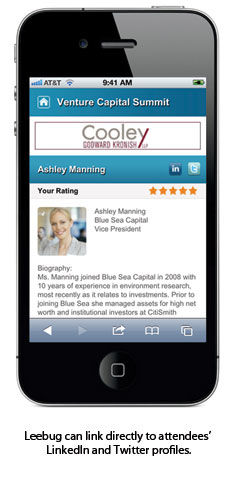
Leebug can prepopulate attendee profiles directly from LinkedIn.
Pathable can compare an attendee's contacts from Facebook, LinkedIn and
Twitter with the Pathable community list and let people know who will be
at the event.
The integration possibilities are constantly
growing as social media platforms allow for more third-party
connectivity. Likewise, integration to registration systems and other
tools is important. Pathable, for example, integrates with Cvent,
RegOnline, EventBrite, Amiando and others. Zerista touts its ability to
work with more than 100 third-party systems.
Doing it yourself
CrowdVine's popularity has come largely by word of mouth, explains CEO
Tony Stubblebine, and the fact that its business continues to grow is
based in large part on transparency and economical pricing (see "The Price You'll Pay"). "In the past, all new business involved a
sales call and demo with me," Stubblebine explains. "Now we have enough
information online that people can make 90 percent of their decisions by
reading our documentation, setting up a trial account, or looking at
our pricing and packages."
Not only was CrowdVine the first to
post all pricing, its user and administrator manuals have been posted
online. Stubblebine says CrowdVine in particular appeals to conferences
that have a very tech-confident person on staff. "Lots of conferences
have tech-confident people now, no matter what the topic of the
conference is," he notes. For those less tech-savvy, CrowdVine assures
organizers that they can be guided through the process.
Leebug
offered a DIY version for free until this year. Now it requires a $350
setup fee to cover the cost of the new mobile app. "Our goal is to
create a powerful app with an integrated online event community that is
price-accessible to any event producer," says founder Rob Arthurs. The
self-service option requires customers to upload all the data for the
platform and app, which is largely a lot of cutting and pasting. The
full-service option involves a small per-item charge for uploading.