 Glenda Stewart, an Annapolis, Md.-based national account manager for ConferenceDirect, remembers one of her first government planning jobs. It was a town hall meeting for President Clinton in 1993, which cost $250,000. "I learned my lesson quickly," Stewart says. "The Wall Street Journal wrote a negative story asking why so much money was being spent on just one event."
Now, Stewart says, she always plans from the perspective of, "Would I be comfortable if the details of this meeting were fully disclosed on the front page of the newspaper?" Stewart believes this is a question every planner should be asking. If the answer is "no," measures must be taken to ensure the event will fly under the radar and avoid negative publicity.
Mark Grenoble, chairman of the board for the Arizona Hotel & Lodging Association and president of the Enchantment Group, which owns the Enchantment Resort in Sedona, Ariz., knows all about avoiding the spotlight -- the resort is in the rugged Boynton Canyon and surrounded by wilderness areas.
"Enchantment Resort has always been a place to go away and not be seen, and we play up that fact now more than ever," Grenoble says. "Whereas before, privacy might have been issue number 10, now it is issue number one."
But choosing a secluded setting isn't the only way to shield a meeting from negative publicity. M&C spoke to planners, hoteliers and industry experts about their best practices for keeping an event out of the headlines.
Have a good reason
Michael Dominguez, Tucson, Ariz.-based vice president of global sales for Loews Hotels, believes the best way to avoid scrutiny is for planners to adhere to the guidelines established by the Meetings Mean Business campaign. This U.S. Travel Association-led effort exists to help justify meetings, events, incentives and business travel to the American public, the federal government and the news media.
As part of the campaign, criteria have been issued for approval of an event and guidelines offered as to what constitutes "legitimate business purposes." Although the guidelines originally were intended for companies that have received TARP funds, they also are being employed by many planners who are not associated with bailed-out firms but aim to ensure that their events are beyond reproach. Examples of justifiable meetings and events, per the Meetings Mean Business guidelines:
• Effective product launches to educate the sales force, channel partners and customers;
• Sales conferences and employee meetings to align vision, strategy and tactics, and
• Corporate-sponsored events designed to further charitable purposes.
Policies for approval include:
• Total annual expenses for meetings, events and incentive/recognition travel shall not exceed 15 percent of the company's total sales and marketing spend;
• At least 90 percent of incentive program attendees shall be other than host organization senior executives, and
• All internal meetings or events attended only by senior executives and/or board members shall be devoted to specific business purposes, and they shall be responsible for any personal expenses.
The complete guidelines are posted at meetingsmeanbusiness.com.
Prove ROI
 Theresa Breining, CMP, CMM,
and president and founder of the Carlsbad, Calif., event planning firm
Concepts Worldwide, believes the best way to prevent negative publicity
about a meeting or event is to educate the CEO, senior management and
the media about the value of a meeting -- and not just broadly.
Theresa Breining, CMP, CMM,
and president and founder of the Carlsbad, Calif., event planning firm
Concepts Worldwide, believes the best way to prevent negative publicity
about a meeting or event is to educate the CEO, senior management and
the media about the value of a meeting -- and not just broadly.
"Rather
than anecdotal, feel-good stories about meetings," Breining says,
"planners can and must measure their meetings and have clear
objectives."
Breining, who along with Jack J. Phillips is
co-author of Return on Investment in Meetings and Events, believes the
best way to prove the real-world value of a meeting is with
return-on-investment methodology. "If a meeting doesn't warrant that
level of financial measurement," she says, "ROI can help a planner
measure other things, such as if learning is applied."
Breining
adds, "This economic time we're in provides a mandate to measure
meetings to a degree we just haven't had to before -- and ultimately
that's good for business. Meetings must be justifiable, or they
shouldn't happen."
To learn more about proving ROI, read M&C's May feature, "Defending Your Event."
Tone down the fun
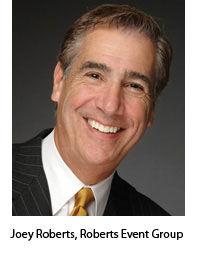 Joey
Roberts, CEO of the Roberts Event Group in Philadelphia, perceives the
current heightened sensitivity to the appearance of frivolous or
wasteful spending as a "180-degree change" since last fall. "Before
that," he says, "there were plenty of serious meetings and agendas
going on -- these have never been just junkets. But they were wrapped
in what people perceive to be an environment of fun and games." Now,
such an environment can be seen as a liability.
Joey
Roberts, CEO of the Roberts Event Group in Philadelphia, perceives the
current heightened sensitivity to the appearance of frivolous or
wasteful spending as a "180-degree change" since last fall. "Before
that," he says, "there were plenty of serious meetings and agendas
going on -- these have never been just junkets. But they were wrapped
in what people perceive to be an environment of fun and games." Now,
such an environment can be seen as a liability.
Accordingly,
planners need to consider what might be viewed as excessive. Is a
string of limos greeting VIPs at the airport? Has a glitzy gala been
planned?
Ways to ameliorate such elements include switching to
town cars or shuttle buses for airport pickups; staying in properties
that emphasize their conference center or meeting facilities, rather
than their leisure appeal; arranging more modest meals, and choosing
destinations that are seen as more businesslike (such as those
highlighted in "Meeting Cities Whose Names Won't Cause a Stir").
Debbie Wardrop,
director of event management for the Phoenician in Scottsdale, Ariz.,
notices more planners cutting back on anything that might appear
lavish. "For example, we're seeing fewer dine-arounds, with more groups
staying on-property for meals," she says.
One planner for a
financial services company (who wished to remain anonymous) agrees with
Wardrop: "Instead of a full-on, sponsored dine-around, we've been
giving participants a cash allowance for an evening of leisure. That's
much more low-key than seeing a big coach bus pull up to the hotel with
our company's sign in its window."
Even when groups stay at the
hotel for meals, they increasingly are choosing more frugal F&B
options -- perhaps a three-course meal rather than four or five -- and
opting for pitchers of water over bottled. "That kind of plays into the
sustainability aspect as well," says Wardrop. "It's a perception issue."
Julie
Finn, senior conference services manager at the Inverness Hotel and
Conference Center in Englewood, Colo., recommends holding a
community-oriented activity rather than, say, an elaborate reception.
In the past, Finn has had groups break into competing teams to help
build tricycles for children living in poverty. The aforementioned
finance company planner suggests donating unused, prepaid spa
appointments to a local charity auction. (For more on adding
volunteerism to the agenda, see "Sweet Charity.")
Finn also
emphasizes the importance of not engaging in anything that could be
viewed as wasteful. "We are not doing fireworks or burning our
company's logo into the lawn," she says, somewhat ironically. "People
will just see that as dollars not being spent frugally."
Keeping it private
While
there should be no reason to hide the fact that you're holding a
meeting -- particularly if business purposes are clear and excesses
have been avoided -- some planners still feel more comfortable taking
measures to avoid media attention.
Some planner-tested tactics:
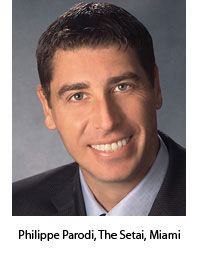 •
Choose a property with good security and extensive experience at
ensuring the privacy of its guests. The Setai, a small, upscale
property in Miami, is accustomed to such requests. Philippe Parodi,
director of marketing, says a majority of the property's groups request
to meet incognito. The hotel can establish a code name for the group
throughout the booking process, as well as register high-profile guests
under an alias. At a small, exclusive property, such measures are
relatively easy, says Parodi. However, "this becomes more complicated
as meetings become larger," he cautions.
•
Choose a property with good security and extensive experience at
ensuring the privacy of its guests. The Setai, a small, upscale
property in Miami, is accustomed to such requests. Philippe Parodi,
director of marketing, says a majority of the property's groups request
to meet incognito. The hotel can establish a code name for the group
throughout the booking process, as well as register high-profile guests
under an alias. At a small, exclusive property, such measures are
relatively easy, says Parodi. However, "this becomes more complicated
as meetings become larger," he cautions.
• For a larger group,
an expansive, somewhat secluded property might be a better fit. The
Phoenician, for example, is on the border between Phoenix and
Scottsdale; on one side of the resort is a mountain, making access from
that direction difficult, while on the other side is a security gate.
Anyone wishing to enter the grounds -- members of the news media,
perhaps -- must first be cleared by security.
The Inverness
offers a similar advantage. "You want lots of space," says Julie Finn.
"Unlike at urban properties, public space does not begin right outside
our front door." That buffer zone helps keep prying eyes away from a
meeting.
• Choose a pseudonym for the company, to be used
on-site. "The name can be all sorts of things," the Phoenician's
Wardrop says, "from something relating to the content or theme of the
meeting to the conference title itself." For example, it's quite common
to see "President's Club" listed on hotel reader boards, providing
agenda details but protecting the group's identity.
• Work with
people you trust. Partner with a hotel and other meeting suppliers with
which your company has strong, long-standing relationships.
•
Collect meeting materials -- especially branded items and sensitive
documents -- that have been left behind after the day's sessions have
ended.
• Keep A/V and stage setups simple, and reuse the same stage setup for the daily program as well as for the evening meal.
•
Project the name of the conference or meeting onto a screen or meeting
room wall, rather than having banners and other signage specially
printed.
• Use color-coded or graphically themed name badges
that will prove obscure to outsiders but will allow fellow attendees to
identify one another.
• Flag names of VIPs in the hotel's
system, so as to facilitate the switchboard blocking any calls that
might come in from members of the media.
• Don't provide
customized bag tags. As one planner says, "You don't need 300 pieces of
luggage with the company name on it spinning around the airport baggage
carousel."