(Pictured) The Cvent team celebrated becoming listed on the New York Stock Exchange on Aug. 9, 2013.
The temperature outside was pushing 108 degrees Fahrenheit, but the 2,500 attendees gathered at the MGM Grand Hotel & Casino in Las Vegas this past June hardly noticed. They were there for Cvent Connect -- four days of standing-room-only sessions, powerhouse speakers and intense networking. They also were eager to learn about the latest innovations from Cvent, the Tysons Corner, Va.-based meetings-tech juggernaut, including Cvent Express, a new streamlined version of the platform for smaller, less complicated events.
Cvent's rise in the meetings world, from bit player to game changer, has been dramatic. The company, which launched in 1999, has grown from a modest software registration service to a public corporation with 1,800 employees and offices in Austin, Texas; Los Angeles; Portland, Ore.; London; and New Delhi, India. The total number of electronic requests for proposal sourced through the Cvent Supplier Network in 2014 alone came to 1.6 million, representing a staggering $8 billion in meetings spend.
Every month, Cvent attracts some 1,300 new users, each of whom sends at least one eRFP. This year, the company estimates it will be approaching $10 billion in group hotel business -- a steep rise from $50 million in 2001, when the online RFP platform was introduced.
What follows is the story behind this remarkable company and its impact -- some would liken it to a tidal wave -- on the meetings industry.
In the beginning
Ask Cvent employees what their company's mantra is, and they all say the same thing: "Find the customer's pain point and solve it." In fact, solving their own pain points led Cvent's founders to start their business.
While pursuing a law degree at Georgetown University, Reggie Aggarwal, now the company's chief executive officer and chairman, founded the CEO High Tech Council, a networking group for senior executives of Indian descent in the Washington, D.C., area. It eventually swelled to 1,000 members, with as many as 600 participating in some 40 events a year. Meanwhile, Aggarwal's friend, Chuck Ghoorah, who served as class president and special-events chair at Duke University in Durham, N.C., spent his free time running meetings for the college.
Both managed their events the old-fashioned way: sending out email invitations and then tracking responses on an Excel spreadsheet dotted with notes, in a desperate effort to get a handle on registration numbers. "That's how we zeroed in on our first pain point," says Ghoorah, now president of worldwide sales and marketing for the company. "Back then, I would have paid good money to solve that problem."
Instead, the two, along with Dave Quattrone (current chief technology officer) and Dwayne Sye (chief information officer), started their own company, though the fledgling Cvent had its share of woes. The enterprise almost went under when the dot-com bubble burst in the early 2000s, leading to a payroll cut that eliminated 101 people from a staff of 126. For a while, Aggarwal found himself living out of his parents' basement. "We went from $17 million in the bank to not being able to make payroll. I had never been knocked off my horse before," he recalls. "It was the worst time of my life."
The company battled back, and in recent years Cvent has taken a holistic approach to the meetings industry, launching a dizzying array of online products across the Cvent Supplier Network that allows planners to source, track and manage meeting spend, as well as ascertain the return on investment of every event on a seamless, integrated platform.
"We were a one-trick pony for many years," admits Ghoorah. "We kept listening to our meeting-planner customers, though. When we heard them talk over and over about the pain of sourcing hotels, we decided to build something, make it user friendly and tie it into our registration platform."
A model for success
The basic service is free to all users -- planners and hoteliers alike. Properties can apply for a free listing on Cvent's search engine, and many are added to the rolls by Cvent itself due to their prominence, amount of business, etc. "By not charging a commission for hotels to use their RFP system, Cvent has a business model that is sustainable and will allow them to grow," notes Richard Rheindorf, vice president, meetings and events, at Paris-based AccorHotels.
But of course there's much more to Cvent's business model than complimentary listings. Hotels have the option of buying advertising on the company's site, paying for factors such as size of ad and elements like photos and floor plans, and placement on the page. Cvent also makes money by customizing its meetings management technology for clients and for other services.
Additional forces driving Cvent's success, say users, include customer-friendly technology and straightforward integration with other corporate enterprise technology. "They designed a better tool that felt and smelled like the industry and won over a lot of people," says David Sachs, director, strategic meetings management, analytics, at Caledonia, Wis.-based planning firm Meetings & Incentives Worldwide.
"Cvent is the largest and best-funded of all the meeting-technology companies," notes prominent industry consultant Corbin Ball, CSP, CMP, DES, president of Bellingham, Wash.-based Corbin Ball Associates. "They have worked hard and deserve the success they are having. They have given the industry a strong set of tools."
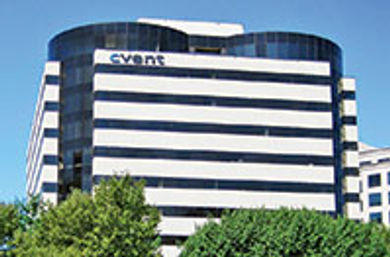 Cvent headquarters in Tysons Corner, Va.
"With the market share that Cvent now carries in this space, the ability to have a solid cross section of visibility into trends in the marketplace are beneficial to the industry as a whole," says Michael Dominguez, senior vice president and chief sales officer for Las Vegas-based MGM Resorts International. Yet, he adds, it can't hurt for the company to face some pressure from rivals: "Competition traditionally continues to drive innovation, attention to the customer and a competitive landscape in any market."
Ball agrees. "The global procurement space is a huge pie," he says, "and I think there certainly are pieces for competitors."
Indeed, while few companies offer Cvent's sheer range of services, from sourcing to registration to strategic meetings management tools, many suppliers focus on one or several aspects of meetings management. (See "Marketplace Alternatives.")
Is it too easy?
Cvent seized on an industry pain point with its Supplier Network, but some question whether the technology made sourcing a little too easy. Specifically, it's simple to send bids to many hotels at once, which critics say has contributed to the paralyzing "eRFP overload" bedeviling the hotel industry. (See related story, "Building a Better eRFP.")
This past June, the Global Business Travel Association and the Convention Industry Council jointly issued a white paper on eRFPs, noting, "there is no question that their rapidly growing use has created significant challenges," adding that their sheer volume "has created bottlenecks for hoteliers and delayed responses for planners."
Deluged by the growing wave of eRFP volume through online sources such as the Cvent Supplier Network, some hoteliers have been looking at more effective ways to convert potential leads into business. In 2014, Omni Hotels & Resorts added an option to its website that lets planners submit RFPs directly to the company, rather than through Cvent or another third-party platform. According to Tom Santora, Omni's chief marketing officer and senior vice president, not only has the number of group leads the company receives increased annually, the conversion rate of the leads coming directly to Omni has doubled compared with those from other sourcing companies.
Looking to stem the tide of dissent among hoteliers struggling with lead volume, in June Cvent launched Lead Scoring, a new technology that came from its acquisition of Atlanta-based Decision Street, a sophisticated hotel sales-intelligence software provider, in late 2014. Now, when a hotel that pays for the service receives a group lead, the RFP is prioritized based on size, profitability and best fit for the hotel, depending on inventory and demand.
Some hotel salespeople, like Linda Simpson, vice president of sales and marketing for the San Francisco-based Stanford Hotels Group, which owns and operates 13 full-service hotels, think it's a step in the right direction. "We're eager to leverage Lead Scoring to buy back precious hours lost in the RFP evaluation process," says Simpson.
Others, however, demur. "I am not a fan of Lead Scoring," says one sales executive from London-based Belmond, formerly Orient-Express Hotels. "I want to touch every RFP that comes to my inbox, without anyone telling me what they think is a good fit for my hotel."
Getting the job done
One of Cvent's earliest clients was Meetings & Incentives Worldwide, now with a staff of 180 employees executing more than 2,000 annual events globally. In 2008, Cvent asked the company, which had been using StarCite (now part of Lanyon) for seven years, to beta test a new online RFP it was preparing to launch. "They really got our attention," recalls Tina Madden, CPA, partner and chief financial officer for M&IW. "Today, we run our whole business, for each client, across the entire Cvent platform, which gives us tremendous visibility into what each customer is doing, including meeting spend, budgeting and satisfaction scores."
Another user is Sarah Muschler, CMP, meeting manager for Illumina, a San
Diego-based medical-device company with 3,750 employees in 10 global offices. She was familiar with Cvent's eRFP system when she was hired last November -- experience her hiring manager required of all candidates -- and she has begun to implement the platform's strategic management tool. "We have a team of Cvent people we meet with weekly to work on work flow, tweaking and customizing it for us," she says.
Where it's all going
Cvent's ultimate objective, Chuck Ghoorah told attendees in closing remarks he made at the Cvent Connect conference in June, is to elevate the meetings industry in the eyes of corporate leaders. "Meetings and events are essential to the growth of companies," he said. "When you return to your offices, I ask you to take your rightful seat in the corporate boardroom."
 A general session at the 2015 Cvent Connect
The company has still more on its to-do list going forward. "In 2016 we are going to focus on exhibitor management," says Reggie Aggarwal, "and over the next 12 months we are going to be looking at addressing the multiple layers of sourcing international meetings."
According to Eric Eden, Cvent's senior vice president of marketing, "Our research shows that, globally, meetings generated $100 billion in spend for hotels in 2014, which means we've captured only 10 percent of total volume. What we see is a lot of green-space opportunity out there."
It's the magnitude of that opportunity that will keep Cvent -- and the entire meetings industry -- on its toes, according to Corbin Ball. "We are going through a time of huge technology innovation," he says. "There are startup companies emerging with new, more efficient code and fresh ideas that could change everything."
Cvent's Major Milestones
> 1999: Reggie Aggarwal and Chuck Ghoorah together develop and launch Cvent, a meetings registration platform.
> 2008: The company achieves $50 million in group business sourced via its member hotels.
> 2008: The Cvent Supplier Network (CSN) is introduced, now a database of more than 200,000 hotels, suppliers and destinations.
> 2011: $136 million in seed money is raised from investors.
> 2012: The first Corporate Meetings Summit is held. Close to 125 meeting planners and suppliers are in attendance.
> 2012: Cvent acquires two event mobile-app firms -- Seed Labs and CrowdCompass.
> 2013: Cvent becomes a publicly traded firm on the New York Stock Exchange, raising $136 million in the first day of trading.
> 2013: OnSite, a mobile check-in app, is launched.
> 2014: The first Association Meetings Summit is held in conjunction with the Corporate Meetings Summit in Las Vegas (both are now part of Cvent Connect). Close to 1,000 people attend.
> 2014: Cvent acquires Decision Street, an Atlanta-based hotel-sales-intelligence software firm.
> 2014: $8 billion in group business is sourced on the CSN.
> 2015: Cvent acquires the Elite Meetings Institute, an online venue-sourcing tool, and SignUp4, a travel- and event-management and spend-control system.
> 2015: More than 2,500 people attend Cvent Connect, held in Las Vegas.
> 2015: Cvent Express, an eRFP designed for smaller events, is launched on the CSN.
MARKETPLACE ALTERNATIVES
By Michael J. Shapiro
While the massive volume of eRFPs passing through the Cvent Supplier Network is without equal, other companies offer solutions and services that compete with Cvent's. But only a few suppliers offer a similarly broad range of event technology.
Dallas-based Lanyon is the biggest, with a comprehensive meetings-management solution as well as hotel-focused technology. Lanyon has long provided hotels with tools to serve the independent business travel market. As of last year, the company was merged with Active Network Business Solutions, including its StarCite sourcing and strategic meetings-management platform; the combined Lanyon now offers visibility into complete hotel spend, including both group and transient, across its platform. Lanyon Meetings (formerly StarCite) boasts many large enterprise clients, among them more than 80 percent of the Fortune 100.
On a smaller scale in terms of volume, San Francisco-based Lenos Software and Boca Raton, Fla.-based Cendyn Arcaneo each offers a complete strategic meetings-management platform that includes venue sourcing. Chicago-based Eved, meanwhile, is a procurement-driven platform with a sourcing tool that includes a wide variety of event suppliers; Eved aims to facilitate reconciliation and back-end financial tasks.
The biggest players, Cvent and Lanyon, allow hotels to advertise, via marketing packages that favor them in venue search results. Orlando-based Zentila, a more specialized sourcing and booking solution, does not allow advertising, instead collecting a commission from hotels only when business is booked. That allows Zentila to offer more targeted search filters, which in turn lets planners source by factors such as last-renovated date, for example.
Zentila, which powers M&C's facility search at mcvenues.com, strives to make eRFPs more conducive to quick and efficient hotelier response by including details such as the number of competitors and a short-list date (the date by which meeting planners intend to narrow down the field to a few finalists). Such functionality has led to Zentila's reported 98 percent response rate from hoteliers and an average response time of less than six hours.
Hundreds of smaller companies offer event-tech tools that compete with portions of what the biggest companies offer, and many strive to provide integration with other tools. San Francisco-based Certain, for example, has recently partnered with Zentila to offer integration with Zentila's sourcing platform. Meanwhile, last month Norwalk, Conn.-based event-technology supplier etouches purchased hotel-sourcing platform Inevention, adding that element to its extensive meetings-tech toolbox.