 All associations should be so lucky. The Biotech 2009 conference, sponsored by the Research Triangle Park, N.C.-based Council for Entrepreneurial Development and held Feb. 16-17 at the Raleigh Convention Center, lured 1,000 attendees, shattering the previous record of 650 drawn to the regional event in 2007. The agenda was brimming with topics such as "Biotechnology and the New Administration," and the hallways buzzed with the sounds of people busily networking.
"We attribute the rise to a good program," says Joan Siefert Rose, president of the CED, a 5,500-member entrepreneurial support organization. "We had the newly inaugurated governor, Beverly Perdue, open the conference, and both of our U.S. senators spoke. People wanted to hear what they had to say on health care." She also points out that attendees were interested in checking out the convention center, which had opened only the previous September.
If one accepts the commonly held belief that people aren't willing to travel very far these days for business, this should be a boom time for many local chapter meetings and regional events, much like the CED's. But planners report a decidedly mixed picture.
A number of local organizations told M&C that while their attendance hasn't declined, it's not growing, either. Such is the case at the Dallas CPA Society, according to Gala Rowlett, director of member and staff services for the association, which holds three to four member events each year outside of its monthly board of directors meetings.
In some hard-hit industries, association members have dropped out to handle more immediate needs, and attendance numbers have suffered. Case in point: the moving and storage business. As the housing market tanked, fewer people moved, and those who did saved money by packing their furniture themselves and not hiring a commercial vendor to do the job. "Our members have been severely hit by the times," says Bob Russo, executive director of the New Jersey Warehouseman's Association, which is affiliated with the American Moving and Storage Association. "We're definitely down."
To try to attract more people to his events, Russo has developed a number of marketing programs this year. So far, he's garnered a lot of enthusiastic interest, but not much additional buy-in. "It always seems that the same people who participate always participate," he notes. "I only get a couple of new ones here and there."
For his part, John H. Graham IV, CAE, president and CEO of ASAE and The Center for Association Leadership, says there's no mystery to what makes for a successful chapter meeting. "There are a couple of behavioral attributes that are true," he notes. "One is that people still like the human touch and the ability to network. If we make it affordable and attractive for people to do that, they will attend meetings."
Anatomy of success
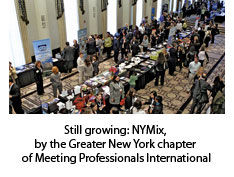
For the past three years, the Greater New York chapter of Meeting Professionals International has hosted a full-day networking and education event called
NYMix, which also offers a trade show. In some ways, it's a microcosm of the parent organization's global conventions. This year, about 400 people were in attendance at New York City's Waldorf Astoria on April 13 -- including 153 planners -- up from 370 attendees last year and 309 in 2007.
"This was a very positive thing for us and for all the people who exhibited," says Kathie Stapleton, executive director of MPIGNY, who wears a second hat as executive director of the Greater New York chapter of the Hospitality Sales and Marketing Association International. Her HSMAI meetings also are going well, attracting about 150 of the 500 members to monthly luncheons.
Stapleton credits the national headquarters of these groups with helping members stay connected locally. "Both organizations are trying to work with people in terms of how they pay their dues, and allowing them to pay over time," she says. For instance, the New York HSMAI chapter offered a "member bailout program," which allowed people with money troubles to attend three events for free and another three events at 50 percent off. "We did it on the honor system," says Stapleton. Members were asked to send her an e-mail explaining why they needed assistance. MPI, meanwhile, has offered scholarships for members without jobs to attend events for free and waives membership dues for six months for unemployed members through the MPI Cares program.
"We are trying to accommodate people who are trying to find jobs," adds Stapleton. "We're doing our best to make it easy for them to continue networking."
To help local affiliates put on events, the MPI Foundation has increased chapter grants by 33 percent. "They use the money for various things, offering registration for their events, increasing the level of education they offer at the chapters, and offering pre-events or webinars," says Junior Tauvaa, vice president of member care and chapter business management at MPI's Dallas headquarters. About 75 percent of the organization's 68 chapters receive grants.
The changing nature
While the economy is driving many of the trends at local and regional meetings, the morphing of face-to-face events is having an effect, too. "When people are able to attend a meeting, it tends not to be a multiday event," says Graham of ASAE. "If they don't have to get on a plane, they certainly seem to be willing to go if the value is there."
Siefert Rose of North Carolina's CED feels this theory explains why another of her programs, Medtech, grew from 350 participants at last year's inaugural event to about 500 people this year. "We had it at Duke University, and it was a one-day affair," she says of the medical devices conference. "It was convenient for people to get to, and we had a really strong lineup."
Technology also is affecting attendance at local meetings. "Online learning is growing," says Graham. "The trick is to determine what meeting types and content lend themselves to online events and what types and content lend themselves to face-to-face. It may be that a combination of technology and face-to-face achieves optimal results, even on the local level."
Graham adds that associations need to recognize that the chapter model of old is changing. "I've been doing this for 38 years," he says. "When I started, we had local entities, state entities and a national entity. Over time, the local have become state entities, or local entities have merged, cutting the number of affiliates in half. That trend will continue up to the point where the organization is the right size for effectiveness and efficiency."
Growing Affiliates
At least two industry groups are adding chapters this year. The Trade Show Exhibitors Association announced in May that three local offshoots have sprouted: the New England Chapter in Boston, the Rocky Mountain Chapter in Denver and the DFW Chapter in Dallas, which held its first gathering on July 9. The groups join TSEA's five other chapters in Chicago, Georgia, Toronto, Vancouver and Washington, D.C.
Five more TSEA chapters are set to launch by the end of the year in Houston, Michigan, New York, Philadelphia and Southern California, and the organization hopes to have 25 in place by the end of 2010. A TSEA spokesperson credits president and CEO Margit Weisgal, CME, with the push to expand. "Our members want it and are leading it themselves," the spokesperson added.
Also expanding is the fledgling Green Meetings Industry Council, which was founded in 2003. Last month, the organization announced the formation of the Oregon Chapter, based in Portland. Other chapters currently in the formative stages will be based in Atlanta, Chicago, Denver, Florida, and Northern and Southern California.
Thoughts on pricing
 Although it's tempting to drop dues or registration fees as a way to boost attendance, Graham warns against cutting prices too much. "On the one hand, you want to make the meeting affordable," he says. "On the other hand, you don't want to make it appear that the value is not there."
Couching discounts in promotional terms -- such as pay for one registration, get the second at half price -- can preserve the image the chapter projects. "This boosts attendance but doesn't affect the perceived value of the meeting," notes Graham.
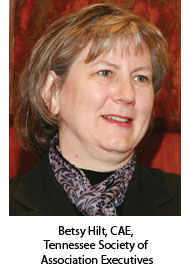
Some groups are adding more meetings while trimming the frills to bring costs down. "We've almost doubled our number of educational offerings at half the price of our regular program," says Betsy Hilt, CAE, executive director of the Tennessee Society of Association Executives in Nashville, who has seen declining numbers at her established events. "It's a little more bare-bones; we don't have any meals or networking built into it. We're just hoping to give people a way to get education without spending a lot of money.
"Breakeven is the new profit, as far as our programming is concerned this year," Hilt adds. "If we can do that, I feel like we'll be ahead of the game."