To paraphrase Yogi Berra, it's starting to look like déjà vu all over again. Picket lines are being organized in San Francisco and Los Angeles. Attendees are being asked to boycott union hotels. Can slow-downs and strikes be far away?
The shadows of labor unrest have started to lengthen again as a series of agreements, forged during difficult contract negotiations between hotels and hospitality workers' union Unite Here from 2003 to 2007, expire in major convention cities around the country.
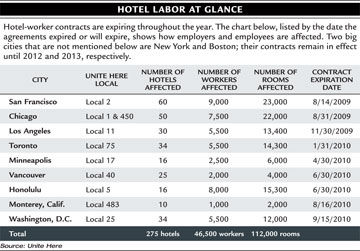
Contracts ended in San Francisco and Chicago last August, in Los Angeles last November and in Toronto in January. The Minneapolis agreement is up at the end of this month; Vancouver, B.C., and Honolulu expire in June; Monterey, Calif., ends in August, and Washington, D.C., in September. While some negotiations have taken place, the two sides are, for the most part, barely communicating, and their positions are disturbingly far apart.
On the table Wages and benefits, of course, are the main negotiating points in each contract go-round. Starwood Hotels & Resorts, for instance, has proposed a lump-sum cash bonus to union members for the first two years of a new contract, followed by a 3 percent wage increase in year three and a
4 percent increase in year four.
But the real sticking point this time -- as evidenced so far in Chicago, Los Angeles and San Francisco -- is the rising cost of health care, creating a contentious stalemate.
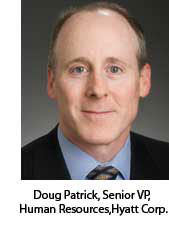 "All of the hotel chains want and need to provide health care for our workers," says Doug Patrick, senior vice president of human resources, North America, for Hyatt Corp. "What doesn't get discussed are the specifics. In Chicago, for example, if an employee works one hour per month, that employee is entitled to full health-care coverage for that month. We're trying to continue to provide coverage for those individuals who are full-time, while trying to find ways to reduce unnecessary expenses."
Patrick is frustrated by Unite Here's response throughout the country. "There is no tolerance for change, or what they call takeaways," he says. "What they would like to see is only enhancements to the agreements."
The union, however, maintains it has been reasonable. "We're willing to take smaller wage increases in order to maintain affordable health care," says a spokesperson for Local 11 in Los Angeles. "We get caught up in this idea that workers get free health care, but we negotiate so that they don't have to pay [medical expenses] out-of-pocket."
The spokesperson notes that part of the workers' compensation is allocated to health-care coverage. For example: A housekeeper might make $16 per hour in wages, but $3 from that goes to the health-care plan. The union could negotiate higher wages, the spokesperson adds, without raising the amount going to health care, "but then workers would have to pay more out-of-pocket for care, and they'd be subjected to those costs going up more significantly over the course of the contract [when insurance companies raise rates]."
In most cities, union workers are offered several health plans, with the high number of members in the pool allowing Unite Here to bargain for decent premiums with the insurance companies.
But rates are rising. In San Francisco, for example, Kaiser Permanente is the insurer for the majority of hotel workers. "This year, there is an increased cost of 5 percent from Kaiser," notes Mike Casey, president of Local 2 in San Francisco. "Right now there are no employers who are paying that increase."
Extra monies for such contingencies are coming from a Taft-Hartley fund that is paid into by both the workers and the hotels. But the hotels would like to dip into that fund even further to help offset health-care costs, according to Richard Curiale, managing partner of Curiale, Hirschefeld, Kramer LLP, the chief negotiator for Starwood Hotels in San Francisco. It's an idea that doesn't sit well with Casey, who would prefer the fund be saved for acute emergencies.
Also playing into the health-care debate is the question of overwork, which can lead to more on-the-job injuries. In Chicago, "staffing has dropped dramatically over the years," says a spokesperson for Local 1. "That intensified over the peak years of the recession. Members are doing the work of two people with no end in sight."
As an example, Local 1 points to the Hyatt Regency Chicago, where almost 20 percent of the workers were laid off from November 2008 to March 2009, while 46 percent of its staff worked overtime between January and April 2009. While Hyatt acknowledges the layoffs and the overtime, Patrick notes, "At all times, we are committed to the safety of our employees. During the time in question, we saw a decline in the number of injuries."
"We are seeing proposals in the three cities that are looking for permanent concessions, using the temporary climate, bad as it was, as the rationale," says Courtney Alexander, deputy director for research with a focus on hotels for the national office of Unite Here. She adds that the hotels, while telling stockholders that recovery is just around the corner, are stalling raises and cutting health care, asking workers to pay long-term even though they've been required to work so much harder over the past few years.
Labor Update: Chicago
Chicago's convention and trade show market recently
experienced an upheaval after two major shows moved their 2012 events
from the city's major convention center, McCormick Place, elsewhere due
to high labor costs. In response, a task force of government,
hospitality and trade show officials was convened and led to
controversial proposed legislation that would essentially turn union
workers at McCormick Place into public employees and prohibit strikes at
its facilities.
While the proposal was being haggled over by
parties on all sides, in late February, news broke of confidential
research conducted by exhibition companies Freeman and GES at the
request of the Chicago Mayor Richard M. Daley and the Metropolitan Pier
and Exposition Authority, which overseas McCormick Place. Among the
reported findings: Average straight-time fixed rate labor cost to hold a
trade show in Chicago, including taxes and worker wages and
compensation, is $66.30 per hour, whereas the cost in Las Vegas is
$42.62 and in Orlando, $26.83. Moreover, a show in Chicago requires a
minimum Teamster crew of three, whereas Las Vegas and Orlando require
just one.
Stay tuned for further developments in this story.
By
Kaylee Hultgren
Splitting up During the heated
negotiations of 2003-'07, the hotels banded together in bargaining
groups in many cities, working as one to come to agreements with the
various locals. This year, the hotel chains are negotiating
individually, which could be serving to slow down the process.
The
labor relations committee of the American Hotel & Lodging
Association, which previously helped move negotiations, isn't helping
this time. "We were very involved in 2003-2007," says Joseph A.
McInerney, president and CEO of the organization. "We provided a
platform for [conversations among hoteliers] in a way that was not a
violation of antitrust laws." This year? "Nobody has asked us."
In
Chicago, the Hotel Employers Labor Relations Association, a
multi-employer bargaining group, traditionally handled the negotiations,
selecting a committee from representatives of the 30 or so union hotels
to sit down with Unite Here. "There are three separate negotiations
going on now, representing about 12 hotels of the major brands,
Starwood, Hilton and Hyatt," says Arnie Karr, CEO of the HELRA. He has
sat in on some of the sessions, since he will be involved in the
negotiations that will be conducted with the rest of the properties once
the three chains sign new agreements. "We will probably adopt their
terms for the remaining union hotels," he says.
A multi-employer
group was dissolved in San Francisco, and the chains are bargaining on
their own. "I don't think it's any more or less effective this way,"
says Starwood attorney Curiale, who is representing the St. Regis Hotel,
the W, the Palace Hotel and the Westin St. Francis. "A lot of hotels
have separate issues that might not be of interest to others."
On
this, the union agrees. "We prefer right now to bargain this way," says
Casey of San Francisco's Local 2. "We don't feel that these guys are
all that cooperative with each other. Until this industry settles
management-wise -- people move around so much, there's no institutional
memory -- working with a multi-employer group is fraught with
peril."
Hyatt's negotiators would prefer bargaining as one with
the other hotels. "However, by law, the union must agree to that," says
Patrick. "The union has made it clear that they do not wish to engage in
multi-employer negotiations."
Incidents
rising Over the past four months, Unite Here locals have been
making their voices heard on the sidewalks, particularly in San
Francisco and Los Angeles.
The actions so far have seen union
workers on picket lines, calls for hotel boycotts, and notices to
potential attendees and exhibitors asking them not to use affected
hotels. Union incidents in San Francisco have pushed the convention and
visitors bureau to reprimand Casey and threaten to revoke Local 2's
membership from the CVB.
"As our city continues to suffer from
lost tourism and business travel due to the recession, we should add no
more insult to injury with labor strikes and contract delays in an
industry that offers one of our best opportunities for economic
recovery," Steve Falk, president and CEO of the San Francisco Chamber of
Commerce, and Joe D'Alessandro, president and CEO of the SFCVB, wrote
in the San Francisco Chronicle.
Casey, threatened with being
booted from the CVB, laughs at that statement. "What a surprise that the
bureau, comprised of hotel executives around the city, didn't like the
boycott," he says. "It's a nonissue in my view. It's actually rather
comical that these guys think that issuing a reprimand will impact us."
Meanwhile,
negotiations are stalled in San Francisco, while Hyatt was scheduled to
sit down with Unite Here at the end of March in Chicago and this month
in L.A. The last meeting in San Francisco was held in December, and
Casey says the bargaining was cordial but ineffectual. "We have our
respective proposals on the table," he notes. "There is no bargaining
scheduled right now."
Curiale, Starwood's negotiator in the city,
is ready to deal now. "If we got a letter tomorrow from the union that
they want to get back to the table, we'd be there," he says. "But they
maintain that there's nothing to talk about unless the hotels change
their position."
Still Sparring
The hotels at Disneyland Resort in Anaheim, Calif., and the Congress Plaza Hotel in Chicago are embroiled in their own dramas with Unite Here. At Disneyland, where contracts expired Jan. 31, 2008, the two sides have entered mediation. In February, the union marched at the Paradise Pier Hotel, and 10 members held a brief hunger strike at the Grand Californian Hotel.
"They want to take a knife to the health-care program," says a spokesperson for Unite Here Local 11. "We are millions of dollars apart." Disney wants union members to join a health plan that includes some cost-sharing. For more on Disney's stance, go to mcmag.com/webexclusives.
In March in Chicago, the Congress Plaza Hotel sued Unite Here Local 1, alleging that union representatives sent heart-shaped packages of cow manure to scientists who were to attend a convention at the hotel. A spokesperson for Local 1 calls the allegations ridiculous and says the lawsuit is an attempt to get back at the union for successfully moving business from the hotel.
This fight is almost seven years old: Workers at the Congress Plaza went on strike in June 2003 over wage freezes and loss of benefits; they were subsequently locked out and replaced. The union had until the beginning of this month to respond to the lawsuit.
Written strike
protection Planners bringing their groups into a city where the
contracts have expired can work some protection into their agreements.
Such clauses, as long as the property signs on, allow groups to pull out
if there is a work slowdown or a strike. Or they give assurances that
the hotel's work force will be at full strength, either by union
members, managers filling in or temporary workers. Planners also can
write into the contract that the property must help prevent the
harassment of attendees outside the hotel, including enlisting local law
enforcement to keep guests from being impeded by picketers.
"Unite
Here is very aggressive," says Jonathan T. Howe, Esq., a founding
partner of the hospitality law firm Howe & Hutton and M&C's
longtime legal columnist. "You face a very hostile environment." He
advises that, beyond the contract clauses, planners otherwise should
stay neutral, unless their group includes union members who might be
sympathetic. "Show you are not involved in this issue and that you take
no sides," he advises. He adds, however, that planners whose groups are
highly sensitive to labor situations need to have ironclad clauses to
address the circumstances under which they can cancel their events.
Venue
contracts for the American Library Association, some of whose members
are associated with unions, have the appropriate paragraphs in place.
"Our contract says that if there is a strike, we can leave," says Deidre
Irwin Ross, MHA, CMP, CAE. "It has to be a strike, though, because
hotels won't accept vague language; we can't just say ‘union action.' "
Ross tries to keep up with the union's contract deadlines and watches
for incidents in cities where she has events planned. But she's already
booked hotels as far out as 2017. "Sometimes we don't know what will
happen," she admits."
Ross' attendees get very active if there's
union rumblings at hotels they'll be using, calling the organization to
voice their concerns and sometimes refusing to cross picket lines. She
adds, "You've got to see how your members feel about this. That's the
key."
What to expect The last
time the hotels and the union went head-to-head, there were strikes,
lockouts, even arrests. Boycotts and picketing, plus some communications
with potential attendees, have been the modus operandi this time, but
it's still early.
Hotel representatives, however, don't think the
situation will get out of hand; they're convinced that union members
are just happy to have jobs. "Employees in general don't want to strike;
they don't see it as valuable," says Patrick of Hyatt.
Unite
Here, however, is ready to rumble. "I can assure you now, if groups are
going into certain hotels, there's going to be trouble," says San
Francisco's Casey. "There will be some strikes down the road, I would
anticipate."
Workers in L.A. are willing to be very patient.
"We're ready to wait it out to get what we deserve," says the
spokesperson for Local 11.