Fighting Long-Term Damage

Hurricane Sandy, expected to be the most costly storm in U.S. history,
will likely continue to take a toll on regional tourism, especially at
the Jersey Shore and Long Island, in the months to come -- particularly
during peak season from May through September.
As tourism professionals know, the cost of business lost is not limited
to booked business that gets canceled; it also includes the loss of
potential future business, which can be influenced by negative images
and lingering perceptions of apocalyptic ruin.
Following the Gulf Coast BP oil spill, a 2010 analysis of previous
disasters by Oxford Economics for the U.S. Travel Association found that
impacted regions experience below-normal traveler levels for an average
of 10 to 27 months, which leads to sustained job and revenue loss for
travel businesses.
While federal Sandy funds have yet to be earmarked for a specific
purpose, the Jan. 15 congressional passage of the hurricane relief bill
was applauded by Roger Dow, above, president and CEO of the U.S. Travel
Association. "Travel is a key driver of the economy in many of the areas
devastated by the storm," he said. "Previous disasters such as
Hurricane Katrina and the Deepwater Horizon oil spill have taught us an
important lesson: One of the fastest roads to recovery is to restore
travel and send a clear message that an impacted region is open for
business." -- L.A.G.
Four months after Hurricane Sandy struck, much of the New York and New Jersey coastline remains devastated. Damage from the storm is still being assessed, but officials estimate the toll for the Garden State alone will be just shy of $37 billion, while New York's tab is expected to reach about $32 billion.
At press time -- and after much drama -- Congress finally approved a $50.5 billion aid package for relief and recovery efforts. In the meantime, a number of communities and organizations have been working to restart the local economies and restore the public image of hard-hit towns, attractions and event facilities. Among these proactive agencies are the region's four largest destination management organizations: the Atlantic City Convention & Visitors Authority, the Jersey Shore Convention & Visitors Bureau, NYC & Company and the Long Island Convention & Visitors Bureau and Sports Commission.
Following is an account of how these DMOs are striving to quash misconceptions and lure group business back after the storm.
Atlantic City:"When you are ready, we are here"
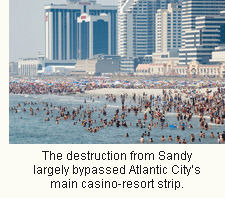 One of the most haunting images of Hurricane Sandy's impact on New Jersey was that of Atlantic City's famed Boardwalk being swept away by the surging Atlantic. The footage certainly was dramatic, but it also was misleading, according to Jeff Vasser, president of the Atlantic City CVA. Only a very small portion of the Boardwalk north of the casino resorts was affected -- a section that had been weakened by previous storms and closed to pedestrian for several years.
"The rest of the Boardwalk was fine," Vasser says. "The beach was OK, the casinos were OK -- in fact, when Gov. [Chris] Christie lifted the evacuation order and mandatory closing of the casino resorts just five days later, we were open for business."
However, the damage to the seaside mecca's image was done. Not long after the storm, a national poll commissioned by the Atlantic City Alliance, a nonprofit marketing entity funded and overseen by the city's casinos, showed that 41 percent of Americans believed the Atlantic City Boardwalk had been destroyed.
Though little physical damage was recorded, the storm dealt the city a major financial blow, particularly in the meetings and conventions realm: Nine events scheduled at the Atlantic City Convention Center, including the New Jersey League of Municipalities and the New Jersey Education Association conventions, and 90 meetings booked at the city's 12 casino resorts, were canceled within days after the hurricane.
The city ended up losing 13,000 room nights and $30.7 million in delegate spending at a time when it could least afford it. Atlantic City concluded 2012 with its casino earnings down 8 percent from 2011 figures, perpetuating a six-year slide in gaming revenues.
But the storied entertainment district didn't fold up shop. Almost immediately, the ACCVA, along with other industry groups, went into overdrive to recoup some of the lost business by getting the word out that area attractions and meeting facilities were open and running.
For starters, the Atlantic City Alliance relaunched its sleek "Do AC" ad campaign on East Coast radio and TV stations, tweaked to include new images of unharmed stretches of the Boardwalk and casinos, reinforcing the message that the city's landmarks were not affected by Sandy (view a promo at bit.ly/VOrurw).
To boost events business, the ACA and ACCVA debuted a program to attract business for 2013. The campaign, funded by the destination's 12 casino resorts, pledges to give a total of $1 million to planners to help defray event expenses such as transportation from the airport, receptions, rent and electric bills. To qualify, new group or meetings business booked must take place in 2013 and generate a minimum of 1,000 room nights.
Jeff Vasser also is betting that, with the increased focus on post-Sandy Atlantic City, two new developments will catch clients' attention: the newly opened (and unharmed) Revel Resort, with 1,800 meeting rooms and 160,000 square feet of meeting space, and the recently approved new conference center at Harrah's Resort Atlantic City, which will add 100,000 square feet of meeting space to the property by 2014.
"These developments are huge for us," Vasser notes. "They give us more in our toolkit to offer corporate groups."
Still, recapturing Atlantic City's biggest tourist segment -- leisure visitors from New Jersey and New York -- remains the primary challenge. Vasser has a message for these elusive customers: "We realize visitors and supporters are still suffering and, in some cases, repairing damage to their own homes. We know coming to A.C. is not your priority, but when you are ready, we are here."
Jersey Shore: "Come down, visit our beaches"
The northern stretch of the 112-mile New Jersey coastline took the brunt
of Sandy's impact on the Garden State. Stark images of debris-strewn
beaches, collapsed homes, boarded-up restaurants and stores, along with
an iconic shot of the forlorn, half-submerged roller coaster in Seaside
Heights, were broadcast for weeks both here and abroad.
"A few local television stations, even to this day, have been showing
footage from just after of the storm, when water was up to the ceiling
in people's living rooms," says Robert Hilton, director of the Neptune,
N.J.-based Jersey Shore Convention and Visitors Bureau, the DMO that
promotes tourism in 87 shore communities, from Keyport to Barnegat.
While many structures directly on the water were obliterated or nearly
so, Hilton says that's not the complete story. "The major downtown
districts were well-protected and sustained little damage," he notes.
"Once the power came back, they were up and running."
With a tourism base that peaks in summer, the region did not lose much
business in the immediate aftermath of Sandy, says Hilton, who
calculates that the Jersey shore is responsible for about $19 billion in
annual tourism revenues, slightly less than half of New Jersey's $39
billion tourism business.
As with Atlantic City, the challenge has been to get the word out that
regardless of the shocking images of destruction, many shops,
restaurants and theaters along the shore have remained open or have
reopened. The JSCVB, with virtually no budget, created a crisis campaign
with the slogan, "The Jersey Shore Is Open for Business!" Hilton calls
the measure, which includes new logos, signs and an interactive website
(bit.ly/WhV1H3), "a call to arms designed to show positive images to
counteract some of the negative publicity and help get the word out that
we are stronger than ever."
The website includes home pages for each of the 87 communities in the
region; they are updated almost daily as local shops, services and
attractions come back online. In the second week of January alone, 11
Seaside Heights businesses reopened, and at press time, two Shore towns
-- Ocean Grove and Asbury Park -- had new, updated videos on the site.
The bureau also has partnered with New Jersey Transit on a campaign to
bring day-trippers to the shore via rail from New York City and Northern
New Jersey. "We lost rental homes, which will take a while to get
rebuilt," notes Hilton, "but we want to encourage guests to still come
down, visit our beaches."
Hilton says the JSCVB will attend up to seven travel trade events this
year, beginning with the New York Times' travel show, held in Manhattan
last month, as well as two shows in Canada, which is a growing market
for the Jersey Shore (inquiries from Canadians grew by 40 percent from
2011 to 2012). The bureau also will, for the first time, participate in
the Philadelphia Flower Show in March.
As the bureau is funded in part by the state, and since the federal
relief package was just passed, Hilton is not sure if his organization
will get any special funding for further post-Sandy tourism marketing.
"I think the state will give us some dollars; hopefully we will get some
of the $50 billion in federal aid money to fund our outreach efforts,"
he says.
While leisure travel is the region's bread and butter, the Northern
Shore has about 30 properties that handle large groups, including Ocean
Place in Long Branch, with 254 guest rooms and 40,000 square feet of
meeting space, and the 208-room Sheraton Eatontown, with 18 meeting
rooms. According to the DMO, all the larger meeting venues reopened
shortly after the storm.
Hilton is optimistic that, by the time peak season hits, the shore will
be able to accommodate an influx of visitors. "We have two to three
months to get it ready; we are making it better than ever."
In the Boroughs
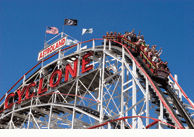
The Big Apple's worse-hit regions were in residential shorefront
communities in the boroughs of Brooklyn, Queens and Staten Island, areas
off most visitors' radar. In Brooklyn's Coney Island, a tourist
attraction in the warmer months, the boardwalk sustained some damage,
but amusements such as the landmark Cyclone roller coaster (above) were
unharmed. -- L.A.G.
New York City: "We are open for business"
 Just weeks after Hurricane Sandy hit, the borough of Manhattan, the main
magnet for tourists and meeting attendees in New York City, bore few
visible scars from the storm. As of press time, 98 percent of hotels,
attractions and retailers affected by the storm had returned to normal,
according to George Fertitta, president of NYC & Company, the DMO
that represents the Big Apple. Just one tourist property (the Holiday
Inn Express Wall Street) and some restaurants and shops immediately
surrounding the downtown South Street Seaport -- which suffered flooding
and damage when the East River breached its banks -- remained closed
for repairs.
Just weeks after Hurricane Sandy hit, the borough of Manhattan, the main
magnet for tourists and meeting attendees in New York City, bore few
visible scars from the storm. As of press time, 98 percent of hotels,
attractions and retailers affected by the storm had returned to normal,
according to George Fertitta, president of NYC & Company, the DMO
that represents the Big Apple. Just one tourist property (the Holiday
Inn Express Wall Street) and some restaurants and shops immediately
surrounding the downtown South Street Seaport -- which suffered flooding
and damage when the East River breached its banks -- remained closed
for repairs.
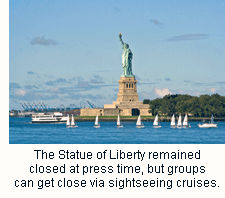
Two key attractions, Ellis Island and the Statue of Liberty, also are
closed due to storm-related damage. For a close-up view of those
landmarks, NYC & Company is advising meeting planners to book a
cruise on one of the private vessels that tour New York Harbor.
Despite these few closings, Fertitta says there's a general perception
that Lower Manhattan is off-limits to visitors, partly fueled by images
of the damage sustained in residential areas of Brooklyn, Queens and
Staten Island.
In response, the bureau has gone into full-court press mode. In the
immediate aftermath of the storm, Fertitta's team began a running
inventory of what hotels and attractions were open or closed and
communicated the details to tour operators, meeting planners and the
bureau's partners via electronic newsletters and social media outlets,
including Facebook and a LinkedIn page specifically designed for
planners.
Since the United Kingdom is the number-one international market for New
York, the bureau sent a larger-than-normal contingency to attend the
World Travel Market in London a week after the storm. "We communicated
that we are open for business," says Chris Heywood, NYC & Company's
first vice president of communications. "Normally I would have canceled
after such a major crisis here, but we felt it was crucial to go."
While the bureau doesn't have statistics on how much tourism and meeting
business has been lost due to the storm (the city sustained about $19
billion in overall damage), it reports a "slight loss of visitors" in
November 2012, along with the last-minute cancellation of the Nov. 4 New
York City Marathon, which generated $340 million in revenue in 2011.
(The storm did not prevent the Big Apple from welcoming a record 52
million visitors in 2012, bringing some $55.3 billion to the city's
economy.)
In terms of meetings, the storm forced the postponement of two events
that had been scheduled at the Jacob K. Javits Convention Center -- the
International Security Conference & Exposition and the American
Diabetes Association Diabetes Expo -- yet a total of 5.2 million
delegates visited the Big Apple last year, an increase of 2 percent over
2011. The bureau anticipates another strong year for meetings and
conventions in 2013.
Long Island: "We were blessed"
Although Hurricane Sandy destroyed 95,000 homes and businesses in New
York's Long Island, R. Moke McGowan, president of the Hauppauge-based
Long Island Convention & Visitors and Sports Commission, says, "We
were blessed on the tourism and economic front; only one hotel that does
a lot of group business, the 143-room Allegria in Long Beach, closed
due to Sandy, and our museums, mansions, etc., made it through
unharmed." Long Island has 300 full-service hotels and 29 large group
properties; the Allegria reopened in December.
The main tourism issue for the region is beach erosion along the 118
miles of coastline. "The worst are resident-only beaches," notes
McGowan. The major tourist beaches, Jones Beach and Robert Moses State
Parks, suffered some erosion and damage to their boardwalks, but they
are expected to be fully repaired and open for use by Memorial Day.
Post-Sandy, the bureau has focused on letting tour operators and
planners know how little the storm affected Long Island's offerings. To
assuage clients' worries, the LICVSC and several of its partners
attended last November's World Travel Market in London, prepared with
press statements and assessments of damage. For meetings, the sales
department has been proactively reaching to clients since November,
letting them know that venues and facilities are operating as usual.
"Most of the concern is from the international market, mainly from
planners whose attendees are interested in pre- and post- visits here
following their conventions and events in New York City," says McGowan.