Once primarily built to showcase their sprawling exhibit halls, today's convention centers are flexible, multipurpose complexes with plenty of breakout rooms and comfortable networking areas. They're environmentally friendly, with robust Internet connectivity and creative design elements. Here we profile eight noteworthy facilities, all in progress, newly opened or revamped.
Music City Center Nashville
Opening: May 2013
The new Music City Center will take ecology-minded facilities to a new level thanks to a 175,000-square-foot green roof covered in sedum, a short flowering plant, and designed to mimic the rolling hills of Tennessee. Rainwater that seeps through the rooftop garden will be collected in 360,000-gallon-capacity tanks, which eventually will be used to flush toilets and for landscaping purposes. The garden is just one of many sustainable practices that will help the 1.2 million-square-foot center become LEED Silver-certified when it opens next spring.
The roof won't be the only thing piquing planners' interest. The venue's 350,000 square feet of exhibit space will employ a cutting-edge design that allows columns to be fewer and farther apart, giving organizers more flexibility and exhibitors more visibility. Where other convention centers might offer exhibit halls with columns in 90- by 90-foot grids, three sections of Music City Center's exhibit hall will feature columns along a 240- by 360-foot grid, says Seab Tuck, principal with Tuck-Hinton Architects and an architect on the project. "Visitors will be able to walk into these halls and see everything," he notes.
Other spaces within the center will include a 57,000-square-foot ballroom, an 18,000-square-foot junior ballroom and 60 meeting rooms. In all, the venue will more than double the current available meeting and exhibit space in downtown Nashville.
Just under a year from opening day, business at Music City Center already is off to a promising start with 617,151 total room nights and 71 contracts already on the books as of press time.
 Cobo Convention CenterDetroit
Renovation debuts: 2015
The Motor City's 2.4 million-square-foot Cobo Convention Center will complete a $299 million renovation just in time to host ASAE & The Center for Association Leadership's annual meeting and exposition in 2015, which will be the first time the annual event comes to town.
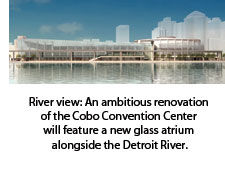
The conference will be a good chance for officials to show off the convention center's new additions, including a three-story glass atrium linking to a new entrance that faces the Detroit River, as well as a new 40,000-square-foot ballroom that will feature floor-to-ceiling windows facing the river and open-air prefunction areas with views of downtown Detroit.
"When you came here before, you couldn't see the city anymore. There was no feel or flavor of Detroit," notes Tom Connors, general manager of the complex. "By integrating the city into the design, we're making Cobo more a part of the urban fabric."
Indeed, the center, which received its last upgrade in 1989, is part of a local renaissance, says Connors. "There are a lot of different things happening right now in Detroit: new business, new residents, urban farming, entrepreneurial activity. The transformation of Cobo is a reflection of the transformation going on downtown."
The renovation is adding a total of 150,000 square feet of function space, including 25,000 square feet for meetings and 22,500 square feet for exhibitions, and is expected to be LEED-certified. The center offers free Wi-Fi throughout.
Jekyll Island (Ga.)Convention Center
Opened: May 2012
For
planners interested in exposing their attendees to nature, the new
oceanfront Jekyll Island Convention Center just offshore in Southeast
Georgia is ideal. Known for its beautiful beaches and varied wildlife,
Jekyll Island is a state park that allows development on only 35 percent
of its acreage, allowing convention-goers to take advantage of
unspoiled terrain.
The $40 million, 128,000-square-foot center
features beach access and expansive views of sea turtle nesting areas,
along with fire pits so attendees can enjoy the island at night without
violating area light ordinances.
"We are surrounded by such a
natural landscape that we wanted to build something that was sensitive
to the environment," notes Anna Hall, communications specialist for the
Jekyll Island Authority. To that end, the center uses solar panels to
generate much of its energy and an 80,000-gallon cistern to store
rainwater for landscaping, among a slate of other green features geared
to garner LEED Silver certification.
For events, the center's
45,000-square-foot ballroom can be divided into smaller spaces, and
there are 11 dedicated meeting rooms totaling approximately 7,800 square
feet of space. Free Wi-Fi is available throughout, and plenty of
electrical outlets are scattered around so attendees can stay charged
up.
Cleveland Medical Mart and Convention CenterOpening: Summer 2013
When
the building is up and running, facility operators at the Cleveland
Medical Mart and Convention Center will be able to adjust things like
heating and cooling, window shades and even individual light fixtures
via iPads, giving planners instantaneous flexibility and customization.
"This means we can be right in front of the organizer or exhibitor and
dim the lights exactly how they want them," says Brian Milner, director
of operations for the center.
Being able to control such settings
on the fly will come in handy at the mammoth (more than one million
square feet) two-level venue when it opens next summer. The Medical
Mart, which will sit above street level, will be a 235,000-square-foot
space with permanent showrooms where health-care organizations can
display and demonstrate their products and devices. Below that will be
the convention center, which will offer some 230,000 square feet of
meeting space, including 90,000 square feet of flexible meeting rooms
and a 30,000-square-foot ballroom with 30-foot-high floor-to-ceiling
windows and views of Lake Erie. The complex is expected to receive LEED
Silver certification and hopes to achieve zero waste shortly after
opening.
Whether above or below ground, attendees won't have to
worry about wireless connectivity. The entire building will be covered,
and service will be fast. "If you get Road Runner speed at home, this
will be a whole flock of Road Runners," says Milner.
 Long Beach (Calif.) Convention Center Renovated: February 2012
Hip
enough to attract the forward-thinking TED conference every year, the
Long Beach Convention Center has further upped the ante in trendiness,
thanks to a new $20 million redesign.
Just as TED celebrates the
sharing of ideas, the center's new layout has resulted in the creation
of myriad mini-meeting spots or "pods," which are equipped with various
combinations of sleek, contemporary couches, armchairs, coffee tables
and high tables with bar stools, all strategically placed to form
intimate, café-style lounges designed to allow spontaneous networking
sessions throughout the venue.
"We wanted to create an
environment for people to meet, collaborate and connect, and these
spaces allow them to go anywhere around the center, find a place to sit
down and talk with a colleague," says Steve Goodling, president and CEO
of the facility. He acknowledges that the pods also reflect the impact
of "younger attendees who are used to the Starbucks concept" of hanging
out, working and socializing all at the same time.
In addition to
new seating areas, the center has replaced all 3,000 seats in its
Terrace Theatre; upgraded its lobbies, meeting rooms and hallway areas;
and installed free Wi-Fi.
 Moscone Center San Francisco
Renovated: May 2012
Designers
at the Moscone Center brought the big-city atmosphere of its location
indoors, allowing convention-goers to experience the City by the Bay
even during sessions.
Following a $56 million, two-year
renovation, public spaces and meeting rooms inside the convention center
complex now feature a new San Francisco-centric design, including
images of iconic city landmarks and colors, such as the Golden Gate
Bridge's "international orange."
"A building can be just a
building, but we wanted the Moscone Center to deliver attendees a sense
of place and have some personality," says Joe D'Alessandro, CEO of San
Francisco Travel, the city's official visitor organization. "At one
point convention centers just had blank walls and it didn't really
matter where you were, but it's important for a meeting to talk about
the destination and its surroundings."
As attendees move
throughout the center's buildings, they pass a stream of images that
change to reflect different Bay Area environments. In the South
building, which faces the Silicon Valley, visitors will be reminded of
the tech industry with metallic ceiling finishes and LED screens, while
in the North building, visions of redwoods and wine country abound.
Appropriately, in the space that connects the two buildings, attendees
will find themselves walking alongside dramatic images of the Golden
Gate Bridge.
Though such imagery might be the most noticeable
upgrade, every surface in the facility has been refurbished, from new
elevators, airwalls and wood ceilings in the lobby to the back of the
house, according to D'Alessandro.
One major new amenity is the
addition of a $4.5 million wireless Internet system that can provide
high-speed service to as many as 60,000 devices at one time. "We really
needed to increase the capabilities of the center, considering how close
we are to the Silicon Valley," says D'Alessandro. "So we wanted to make
it the best in the country."
The center is aiming to achieve LEED Gold certification.
 San Jose (Calif.) Convention CenterExpansion debuts: Fall 2013
When
the San Jose Convention Center began work on a $120 million expansion
project, officials enlisted a 30-person client advisory board to help
guide design decisions. One of the most notable results to come from the
group was a unanimous vote for a ballroom that could be divided into
eight sections, instead of four, opting for more flexibility even though
it was against the recommendations of some of the other agencies
involved in the project.
"Planners want flexibility with meeting
spaces that can be used for breakouts, larger sessions or
multipurpose," says Peter Green, vice president of Conference Direct and
a member of the client advisory board. "San Jose's expansion and
renovation project addresses these trends and provides the utmost
flexibility, which is critical for today's meetings."
In all,
the center is adding some 125,000 square feet of space by fall 2013,
including the above-mentioned breakout rooms that will span a total of
25,000 square feet, 35,000 square feet of ballroom space, 51,000 square
feet of prefunction space and more. The project will increase the
venue's total usable capacity to 550,000 square feet.
Catering
to its nearby Silicon Valley clients, the center also will offer free
high-speed wireless Internet that will be able to support thousands of
devices at a time. Attendees won't have to worry about speed, says Bill
Sherry, CEO of Team San Jose. "Early on, we concluded that free Wi-Fi
was an amenity that we wanted to give our clients, and we wanted it to
be free, fast and everywhere."
 Utah Valley Convention Center Provo, Utah
Opened: May 2012
The
Utah Valley Convention Center makes the most of its majestic
surroundings. Floor-to-ceiling windows are abundant at the facility,
offering dramatic panoramas of the Wasatch Mountain Range as attendees
walk through pre-function areas on their way to appointments. Several of
the meeting rooms also have glass walls with inspiring views, though
for fresh mountain air, the 5,500-square-foot rooftop terrace is the
place.
The venue's outdoor space provides views of Mount
Timpanogos, the second highest peak in Utah, and is hooked up with gas,
so organizers interested in holding a rooftop barbecue or bringing out
heat lamps during colder temperatures won't have a problem.
Throughout
the design process, functionality was a priority, says Tenille Wanner,
director of sales and marketing for the center, giving the impetus to
features like the 19,620-square-foot exhibit hall that can be divided in
half or into thirds, depending on need. The increased interest in
flexible space, says Wanner, is a reflection of planners continuing to
be cautious of how they spend their money and wanting to make sure
they're getting the best value for the buck.
The convention
center, which is shared by Brigham Young University, also offers a
16,894-square-foot ballroom and 10,226 square feet of breakout space,
and expects to receive LEED silver certification.