Facilities like the John B. Hynes Veterans Memorial Convention Center (pictured) in Boston are beginning to host their own events.
As chief financial officer for the Massachusetts Convention Center Authority in Boston, Johanna Storella typically focused on the numbers: fiscal management, sales reporting, etc. for the Boston Convention and Exhibition Center and the John B. Hynes Veterans Memorial Convention Center. But in 2008, plagued by a raging recession, Storella and her colleagues at the MCCA, along with many other convention executives, were challenged to find new methods of filling their facilities and generating revenue.
Some looked outside the United States for inspiration. "Convention centers in Europe, Asia and Mexico are not only focused on the economic impact for the host city, but also on starting their own events to break even or even get some kind of financial return," Storella notes. "We wanted to adopt a global mindset and work toward another product line that might help generate revenue."
This effort would bear fruit in June 2014, when, on behalf of the MCCA and its partners, Storella helped launch a new event, the Culinary Intelligence Summit, at the Hynes Center. It also proved part of a trend slowly catching on in several destinations across North America.
Seeking a new economic model
Convention centers traditionally have been known as loss leaders, says Vicki Hawarden, president and CEO of the Coppell, Texas-based International Association of Venue Managers. "The facilities primarily are there to serve whoever needs the space, and their job is to maximize revenue for the convention organizer," she says. The venue's city benefits from event participants via booked hotel rooms, taxes and other expenditures, though the venue itself seldom turns a profit.
"For a long time, if convention centers themselves were losing money, that was just the cost of doing business," Hawarden notes. "But in 2008, when the floor fell out, there was a lot of pressure to change that."
Several other factors were at play. As the economy sputtered and event budgets were cut, client expectations began to change. Fewer events meant venues were competing for business, and that meant more negotiating power for show organizers. "Clients wanted more and more for free at the same time that convention centers were trying to lose less money," says Hawarden.
If the goal was to balance the budget, charging clients more, especially in such a competitive market, was not the answer. It was clear that convention centers would have to begin looking at different models if they wanted to generate revenue, as happened in Boston.
Let's put on a show!
Along with several key colleagues, Johanna Storella began the process of determining whether starting an event from scratch was viable. "We hired consultants to help us, and we talked extensively with international convention centers to see what kind of infrastructure was necessary." It took meeting with dozens of sources and a few years of discussion and research before the team was ready to present a plan to the MCCA board, which gave its consent.
"There was a lot of excitement, but also a feeling of pressure to pick the right events, even with the expectation that the first few years would be a learning process," says Storella.
An early move made by the MCCA was to set up a new strategy and development department. Storella stepped in as chief strategy officer, shedding her old role as CFO, and Mark Michaud, the MCCA's former director of technology business development, was brought on as the director of business strategy and innovation.
The team decided to start small by partnering with organizations or people that could help co-produce shows, rather than take on the task of producing an entire show on their own. But finding the right partner with the right idea took months of evaluation. How much would a show cost? What kind of content would be provided? How many attendees could they draw, and how much would they be willing to pay?
Potential show concepts were carefully researched and discussed before being brought to the MCCA's 10-person event-review committee. Eventually, two concepts passed muster and were green-lit: the Advanced Audio Applications Exchange, a technology show for musicians and audio professionals, and the Culinary Intelligence Summit, a full-day conference about gluten-free food production in college settings. For the latter, the MCCA partnered with Santa Barbara, Calif.-based John Wilczak, who had started his own gluten-free dough company. With his knowledge of and connections within the industry, he was tasked with creating the content, finding speakers and working with exhibitors. Meanwhile, Storella and her team would handle the bulk of other operational responsibilities.
"We were in charge of all of the logistics -- finding and marketing to attendees, getting registration set up and executing the event itself," says Storella. "I learned so much about the other side of the meeting-planning process and about how many moving pieces there are when you're getting ready to execute an event."
The organizers had about six or seven months to execute. "We wish we had more time to bring it together, but we wanted to do the event in June because it's the best time for college and university workers to attend," says Storella. "Luckily, our knowledge of the facility operations helped us streamline that process." The MCCA, which manages both the Boston Convention and Hynes centers, ultimately chose to hold the show at the Hynes after considering the available space and dates, the flow of the event and how they wanted their attendees to experience the event. "We approached choosing the building just as any other event planner would," says Storella.
Fine-tuning the plans
Once the concept was finalized, Storella established the show as a separate limited-liability company (LLC). "Every event has a certain set of intangible assets associated with it," like exhibitor and attendee databases, notes Storella. "The LLC helps us formalize the assignment of those assets to a particular event." It also helps separate the financial interest of the event from the MCCA.
Other decisions had to be made. For example, would the show be offered lower rates on operations or facility costs to help ensure its success? The simple answer: no. "We did not ask them to give us any kind of discount," says Storella. "If the whole idea behind creating our own events is to move the MCCA closer to financial self-sufficiency, we have to generate positive profit from the event, while generating revenue for the convention center. When you start discounting products, services and labor, that undermines this goal."
Storella says another important reason for paying full price was to make sure the event was successful regardless of where the show was held. She and her team had pondered: If there was demand in another market for a conference like this, would it be profitable? Charging themselves full price in their own building was the only way to know for sure.
When it came to working with A/V, rigging and general-services contractors, the team reached out to partners they already had relationships with and "negotiated with each supplier the same way that our clients negotiate with them for rates," says Storella.
Logistics planning came easy ("We are a convention center, so logistics are what we do best," notes Storella), but other issues proved daunting. "Marketing and sales are the most important aspects of the event," Storella says. "You need to make sure you have qualified and dedicated resources both human and financial -- to support these activities." Because Storella's team was so small, she had to borrow from the MCCA staff as needed. For example, Katie Hauser was tasked with handling the show's PR, marketing and social media on top of her normal day-to-day responsibilities as director of communications for the MCCA.
Storella compared the whole process to launching a small business. Working with minimal resources in the early stages can be a challenge, she acknowledges, but that's all part of the learning process and will eventually lead to growth and success.
The Culinary Intelligence Summit brought in 110 attendees, 12 exhibitors and $22,000 in revenue. As with most first-time events, the show was expected to lose money -- and did.
Undaunted, within the next three to four years, the MCCA hopes to have six events in its portfolio. In five years, the organization anticipates it will break even on self-produced events, and in 10 years, Storella expects the MCCA's events to be generating $5 million in profit. "While we are still learning from this entire process," she says, "we now have much stricter metrics in place for partnerships moving forward."
"Between-Peak" Business
In Kentucky, the Owensboro Convention Center has made an art out of self-producing trade shows. The venue has held 26 such events, attracting some 32,000 attendees and generating $447,000 in revenue since it opened in February 2014.
"As a company, Global Spectrum [the center's management firm] has been very entrepreneurial," says Dean Dennis, general manager of the convention center. "We're not just traditional managers, we're looking to connect with the community and feel its our role to create events for locals. We know the importance of these buildings to the surrounding community, especially in secondary and tertiary markets."
Many of these homegrown events cater to nearby residents, such as a recent Easter Brunch or a live stream of the University of Kentucky vs. University of Louisville NCAA basketball game. The convention venue also produces several larger shows that bring in a few out-of-towners, such as the Outdoor Owensboro Hunting and Fishing Expo and the Kraftucky Arts and Crafts Expo.
Of the events the center has produced or co-produced, Dennis admits that some have hit home runs, while others have struck out. "The key for us is trying to drive sponsorship revenue, so we're mitigating risk and covering our base cost," he says. With his small staff, he notes, the workload can be a challenge. The team draws resources from whatever department it can, and at times, an event has to be put on hold altogether.
"We've taken some events off the books because we still have clients, and those events come first," says Dennis. "There have been times when we want to go out and produce an event, but we've had to say enough is enough. This is the valley business between the peaks. Our main goal is still to bring clients in and drive room nights, but this is one way we've found to keep generating revenue in between clients."
Houston: Comics and medicine
Other destinations are beginning to produce their own shows, often in unique ways. When a local promoter approached the Greater Houston Convention and Visitors Bureau in 2009 with a business plan for Comicpalooza, a show for comic-book aficionados, bureau officials signed on by loaning the organizers capital without interest.
"Our goal was to help the event get off the ground and generate hotel tax," says Michael Heckman, vice president, partnerships and events development, at the GHCVB, which also provided non-cash resources such as marketing, promotion and business insights.
After several years at a smaller venue on Houston's west side, the GHCVB advised the show to move to the George R. Brown Convention Center. Attendance ballooned, in tandem with management responsibilities. It was clear that there was an opportunity for the bureau to become more involved, not only from an operations standpoint, but also as a stakeholder.
The event needed more cash to continue growing, so the bureau invested capital and took a 20 percent stake in the event -- a smart move, as it turned out, as the show has grown from 1,500 attendees to more than 40,000 since its inception in 2010. "The more we can help the event grow, the more economic impact it can have," says Heckman. "And if we're able to get a dividend out of it in the end, then that's even better."
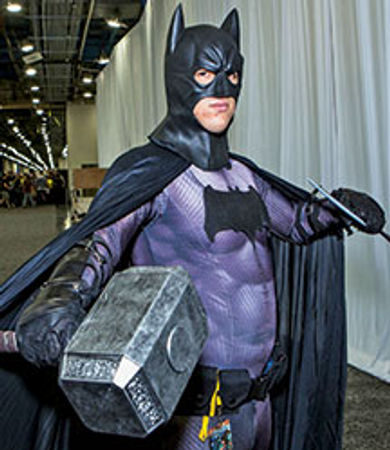 Attendance at Comicpalooza has grown from
1,500 to more than 40,000 (plus Batman)
in just five years.
Attendance at Comicpalooza has grown from
1,500 to more than 40,000 (plus Batman)
in just five years.Comicpalooza was the first show the GHCVB worked with, and other events have since been added to the bureau's portfolio. When it comes to business-to-business trade shows, the bureau strategically enters partnerships based on the city's major industries: energy, transportation, aerospace and health care. To highlight Houston's medical industry, for example, the bureau partnered with Germany's Messe Dusseldorf trade-show organization to launch Medical World Americas, which explores the future of medicine, offers a forum to present key medical research and features discussions on recent health-care policy developments.
The venture is a 50/50 proposition, meaning revenues, expenses and equity are all split down the middle. "Messe Dusseldorf has medical events all over the world, but really hadn't had one in North America," says Heckman, who notes that Messe Dusseldorf's Medica show in Germany has grown to some 130,000 attendees from 120 countries, and nearly 5,000 exhibitors. The Germans' experience and reach made them a perfect partner; plus, they already held two annual events in Houston, so a relationship was in place.
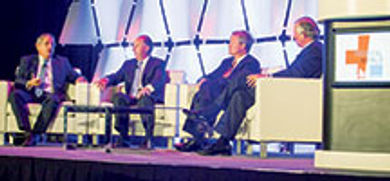 The Houston CVB partnered with German
medical-show experts Messe Dusseldorf
to launch Medical World Americas
last year.
The Houston CVB partnered with German
medical-show experts Messe Dusseldorf
to launch Medical World Americas
last year.The second annual Medical World Americas was held this April and racked up 2,300 in attendance, a 15 percent increase over the year before. Heckman and his team are applying the same model for a space-industry show called SpaceCom, which will launch in November and is expected to attract more than 1,500 attendees and 100 exhibitors. "We're always open to new ideas and new partnerships," says Heckman. "We're looking to establish long-term projects that will help fill some of our need areas and can really drive business back to our hotels and restaurants."
Atlanta: Nurturing a food show
In Atlanta, the Georgia World Congress Center Authority took an approach that didn't require any capital investment when it entered a partnership with David Audrain, president and CEO of the Exposition Development Co. and newly minted executive director of the Society of Independent Show Organizers, to launch the Atlanta Foodservice Expo. The first year, 2013, the show drew 1,740 people; 2,500 are expected this year, when revenues should exceed $700,000.
The partnership is structured to allow for minimal risk on the venue's side. "We don't have any money at stake with the show, but we do give Audrain a reduced rental rate," says Mark Adams, director of sales for the GWCC. Each year the rate escalates, and by year four Adams hopes the show will be successful enough to pay the full rack rate.
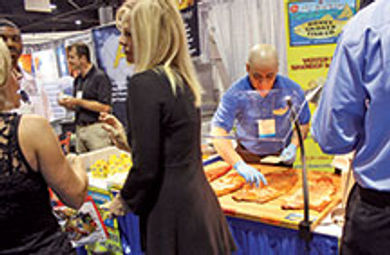 The Georgia World Congress Center partners
with the Atlanta Foodservice Expo.
The Georgia World Congress Center partners
with the Atlanta Foodservice Expo.This model is a way for the GWCCA to nurture new events that might not be able to sustain themselves in the early years. The hope is that shows will become successful and bring consistent business for years to come. The Atlanta Foodservice Expo already has dates on the books for 2016 and 2017, which is good news to Adams. "Very few shows are successful coming out of the box," he says, "so this is a way to help an organizer launch a new show and get them up and running."
When it comes to partnering, the Georgia World Congress Center Authority evaluates not only the type of show, but also the people the center will be working with. "We really look for the history of a show's management company and make sure we want to do business with them," says Adams. "We need to make sure our partner has the legs and the stamina to move forward with an event several years down the road. We don't want to get into a show, and after one year have it not make it. Then it would be all for nothing."
While several venues in recent years have formed new development teams to help identify opportunities for self-produced shows and events, none of the venues we spoke with specifically hired outside meeting planners to take on the load of producing shows. However, the idea isn't out of the question. "We are evaluating hiring additional meeting planning and marketing staff as our portfolio grows, depending upon the events we develop and our role in their execution," says Joanna Storella. "We've actually had some planners come and talk to us and offer their help. This is a really close-knit community, as long as you're not competing."
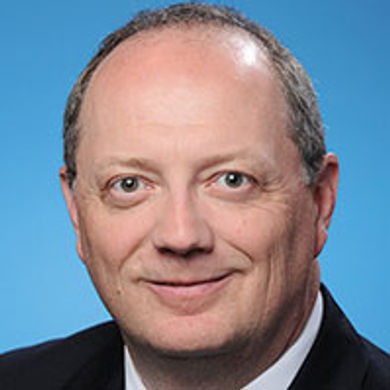 Mark Adams
Georgia World Congress Center
Mark Adams
Georgia World Congress CenterCompetition is one thing planners and show stakeholders needn't worry about, when the destination runs the show. "You're not going to see us produce anything that would take away prime convention space during a peak season," says Mark Adams. "And, most importantly, we don't want to compete with current customers or potential customers if it's a trade show."
Other sources echoed that sentiment. While venues and destinations may be building their own event portfolios, they are strictly a secondary source of revenue. "The model will never flip," says Heckman, referring to the European standard where venues produce the majority of their own shows. "We'll never take our focus off getting the business to come into Houston, but if we can build some shows that can help us fill up when our building might be empty, then terrific."