Dispatch From Dallas
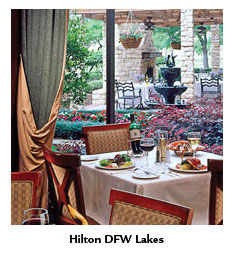
In the Metroplex, planners can choose from every property type, including the Four Seasons Resort & Club in Irving, the urban convention center hotels in Fort Worth and Dallas and the sprawl of the Gaylord Texan in Grapevine. So how does the Hilton DFW Lakes Executive Conference Center compete?
"We are working on such a short-term basis against our local competition, we have to look at our package and ask, 'Is there anywhere we can squeeze?' " says Gay Haynes, director of sales and marketing for the 393-room property. "We are customizing every single one."
Haynes says planners are shopping for later in the year but are not booking yet; every piece of business signs within a 60- to 90-day window. "We're still booking February, and it's already February," she says. "We're booking March and April, but we have nothing for May. We got one program for June -- that was exciting because it is so far out."
She notes that the conference center, which offers 63,000 square feet of space, has been dealing with tough times for a year already: "We started seeing cancellations back in April 2008. I hope that means we're going to come out of it sooner." -- S.B.
Of the big three on every meeting planner's wish list -- rates, dates and space -- the money question has dominated most negotiations these days. For conference centers, attracting business becomes a bit harder when rate is all-important.
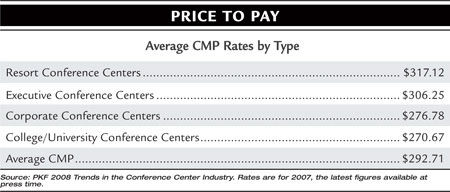
Why? The hallmark of the conference center concept, as outlined by the St. Louis-based International Association of Conference Centers, is all-inclusive pricing, wrapped up in the complete meetings package or CMP (not to be confused with the professional certification) that must be offered by all properties that are members of IACC. Therefore, when a meeting planner is comparing options strictly by rate, conference centers might not be considered because their costs look so high -- on paper.
But typically, that nightly price includes a whole lot more than what a hotel's base rate covers: all meeting space, three meals a day, continuous coffee breaks, basic A/V (including LCD projectors) and gratuities, among other pluses. And the facilities, in order to meet IACC's strict standards for membership, need to adhere to a list of requirements called the Universal Criteria. These cover a multitude of details including the percentage of a property's business that must be related to meetings (60 percent, and the meetings must average 75 attendees or fewer), the type of chairs used, the thickness of the airwalls, the kind of lighting, the available technology and the F&B setup.
Planners need to be aware of what these standards are, according to Washington, D.C.-based industry consultant and independent planner Joan Eisenstodt. "Know what you're supposed to get in the CMP, and make sure you are getting what is standard and what is strongly suggested, particularly with A/V and the furniture," she says.
General managers and directors of sales at these properties have worked diligently through the years to explain IACC's differences to their clients. In today's economic climate, centers are refocusing on what they do best and manipulating the contents of the CMP to entice planners.
Strategic thinking
IACC has been around for more than 25 years, and facility owners have fought through a number of recessions to stay relevant for clients. "I don't know that anyone has figured out how to react in a really novel way to this economy," says Dave Arnold, CEO East of PKF Consulting, whose specialty is conference centers. "They're trying to figure out how to hold rates and add value. But you don't want to do something that changes your business model." The Philadelphia-based expert warns conference centers away from selling rooms piecemeal: "If they get stupid and start selling just hotel rooms, they'll go out of business because they won't be able to support the high-quality infrastructure built for meetings. You can't have a facility designed at a 25 percent cost premium compete on the same level of a hotel that was built for 25 percent less."
 Neil Pompan, president of IACC's global board, stresses that it's more important than ever for conference centers to differentiate themselves. Pompan, who also serves as vice president for EMCVenues, a Brielle, N.J.-based site-selection company, says his message to colleagues is: "Soberly approach your market, but be happy you have a product to sell that is better and more attractive."
To remain players, conference centers should emphasize once again how they were purpose-built for meetings and that their staffs are trained specifically to help organizations get top results from events held there, says Burt Cabañas, chairman and CEO of Benchmark Hospitality, which is based in The Woodlands, Texas, and currently operates 16 centers in the United States and Japan, with two more under construction.
"What IACC always has tried to identify with is the seriousness of our meetings and creating the perfect environment for a meeting," Cabañas notes. "As we've grown, we've kind of thrown an arm over the hotel and resort business, as we should, saying you get the same serious meeting plus the four-star quality of a hotel or resort. That can cloud the issue a little bit. Conference centers need to start reintroducing the fact that we are first and foremost built for serious meetings, where you want retention to be at the highest possible level."
M&C Web Exclusive: Welcome to IACC
Words to planners
Since conference center pricing is all-inclusive, Pompan urges meeting planners to focus on the total meeting cost. "If planners ask conference centers to provide a total meeting cost vs. other meeting venues, they will likely find that conference centers will save them total dollars and provide a more productive environment."
Typically, conference centers do not play around much with the cost of the CMP, but they will adjust what comprises the package. That's where negotiating comes in for this segment. But even here, many properties already have adjusted their CMPs to accommodate the most requested change: allowing groups to spend one night off-property for dinner. The traditional package keeps the group on-site, allowing purchasers at the center to account more accurately for the number of meals the facility needs to cover.
Haggling can be accomplished, in spite of the solid look of the package. Just ask Joan Eisenstodt, who most recently has dealt with the Chaminade Resort & Spa, whose conference building on its Santa Cruz, Calif., property offers 12,000 square feet of renovated meeting space. Eisenstodt says most conference centers don't allow for comp rooms for large pickups, but that she's been asking -- and often getting -- the concession for years. "I get the comps on the rooms themselves," she adds, "not the full CMP." In other words, an attendee or VIP would get the free room, but the host organization or the individual still would pay for the meeting services that are built into the basic CMP rate.
Planners also should ask for such things as a private dinner, Eisenstodt says, and unlimited Wi-Fi in the guest rooms or comparable Internet access in the meeting rooms. "I've always asked for these before," she notes. "I've always negotiated with conference centers -- it's how you're going to customize the package for your group. But I would not necessarily expect them to lower the rate. When I calculate out everything you get in the basic conference center deal vs. a comparable package at a hotel, it's already a bargain."
Dave Arnold of PKF won't be surprised if centers start lowering their price base. "The CMP is a good deal, but by all means, if you can get a lower CMP, do it," he says. "But it doesn't pay to bust it up. If you want to do that, go to a hotel. You get what you pay for."
Making adjustments
Like all meeting properties in these times, conference centers are offering more value-adds in their deals, which show up as extras in the CMP.
"The enlightened operator will put more in the package than they usually do," says Pompan, who feels that those who simply are cutting their package prices are making a knee-jerk reaction and a mistake. "The key to success is to make the product have as much value as possible. And by ‘product,' I don't mean the CMP; I mean the meeting experience."
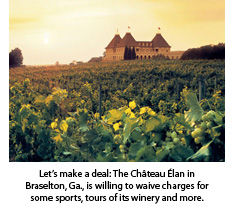
Prices are not being cut at the Château Élan in Braselton, Ga., which offers tennis and equestrian centers, a winery and 42,000 square feet of meeting space, but recreation bonuses are being put into the basic package. "We're adding golf, tennis, cooking classes and winery tours," says a spokesperson for the 275-room property, which hosts IACC's annual meeting this month. "These are all things that we normally charge for. Now we're adding it when it's necessary. And it is."
At the Airlie Center in Warrenton, Va., getting creative with the CMP means offering free wine tastings in the organic culinary garden or covering the welcome reception. "Sometimes we'll upgrade a group to private dining one night," says Kathy Van Brunt, director of sales and planning for the 150-room property, which offers more than 19,000 square feet of meeting space on a sprawling 2,000-acre campus.
Not every conference center can add recreation to the package. Many of IACC's members are day centers (offering only meeting rooms and no guest rooms) or are in urban settings. These facilities throw the extras into the meeting itself, such as web connections. "We're adding more Internet access and some A/V and staging," says David Van Etten, general manager of the Network Meeting Center at Techmart in Santa Clara, Calif., which has 14 meeting rooms plus 5,000 square feet of exhibit space.
At the Conference Center at Waltham Woods, a day center on the campus of the Massachusetts Medical Society and the New England Journal of Medicine, meeting rooms now are being rented by the hour. "Maybe instead of a full- or half-day meeting, people are doing a two-hour meeting," says Tracey Taverna, director of sales for the 9,000-square-foot facility in Waltham, Mass., which caters to the society's needs and also rents space to outside clients.
"We're also trying to encourage companies that do multiple meetings to consolidate at our property," Taverna adds. "If they are willing to contract several meetings at once, we will give further discounts."
Like most suppliers in this troubled year, Taverna is open to suggestions: "We have to be as flexible and versatile as the day dictates."