On a recent spring afternoon, John Hawley, director of sales and marketing for the 757-room Hilton Baltimore, opens his second-floor corner-office door and pulls up an extra chair. He has graciously agreed to let an M&C editor trail him for the day, providing an open window into a far more complicated role than we had ever imagined.
The property has major draws for groups. Set in downtown Baltimore's Inner Harbor, it is connected via skybridge to the Baltimore Convention Center and overlooks Oriole Park at Camden Yards, home to Major League Baseball's beloved Baltimore Orioles. The hotel has 60,000 square feet of meeting space, including two ballrooms.
Selling and promoting all of the above is an art that Hawley has down to a science. Today he turns on his computer and calls up Delphi, an online booking system. In an instant, the flat screen mounted on the wall behind his desk comes to life. While Delphi is standard technology in the hotel operations world, to the untrained eye it's an oddly captivating mélange of color-coded data. One glance gives a complete snapshot of group business on the books for any day, week or month of any particular year -- committed and tentative -- including room block and meeting space requirements, the account name and where the booking came from (in-house, corporate, another hotel, a third-party lead, etc.).
Six members of Hawley's sales team, along with Dennis Benford, director of revenue management, file into the room, eager to pitch potential business. Each rep covers a specific group market segment and territory. Unlike the typical city hotel, where groups represent 30 to 40 percent of bookings, the Hilton Baltimore's group mix is 70 percent. Fully 55 percent of that total hails from the medical and educational sectors, thanks largely to nearby Johns Hopkins University, Johns Hopkins Hospital and the University of Maryland, Baltimore.
Over the next 45 minutes or so, a widely diverse trove of recent requests for proposal is thrown on the table for discussion, involving differing configurations of resources touching on every aspect of the property. Surprisingly, the atmosphere is more collaborative than competitive. While everyone gets a chance to push his or her piece of the pie, the team's ultimate goal is always to sell out the hotel at a group mix that best maximizes revenue potential.
It's a complicated, high-stakes juggling contest, with less than a slim margin for error. As the meeting proceeds, it quickly becomes obvious that Hawley, an award-winning hospitality sales and marketing veteran who joined the property in 2009, a year after it opened, has mastered the balancing act of motivating his team to pursue the best deal possible for the hotel.
To wit: Hawley is presented with a large and potentially significant new piece of business that lacks historical data. He suggests getting back to the group to do some fact-finding. "Look and see where they have gone in the past and what rates they got." Another RFP, from a student dance group that requires hardwood floors for practicing, but no catering, wants a few days between October and May. "Show them the value they'll get by booking in December or January," advises Hawley.
Then there's the group willing to pay the quoted rate for a small block of rooms in high season, but the catch is they have a large meeting space demand. Moreover, they want the main ballroom, the 25,000-square-foot Francis Scott Key, for an awards banquet. "I need at least 400 room nights for them to get Key," counters Hawley. "But let's see what we can do to find them a home."
Also on the table are two large, high-revenue repeat groups with significant F&B demands, whose proposed dates overlap. As attractive as they are individually, bundled together they would wreak havoc on the hotel's operating efficiency. "The question is pattern, so layer it up for a better fit for us," says Hawley. "See if you can get the first one's peak nights to be Sunday, Monday and Tuesday, so we are coming out of one group and going into the other. You're only asking them to move over one day. Does everyone agree?" The team nods in assent.
As a group's dates, room needs and space requirements are considered, the Delphi screen is updated in real time, allowing the team to instantly see what business is an easy fit and what might require some tweaking.
While there is much discussion about rates and which RFP has a heavier F&B requirement or greater room pickup, nothing is rejected outright. In fact, when someone muses aloud that one of the RFPs feels "like a classic tire-kicker" due to its having been submitted to a number of other properties, Dennis Benford insists they shouldn't turn it down. "I would argue that if we move them to another week, we can make it work," he says. For a revenue manager typically known for hard-nose rate tactics, it seems an unusual comment. But when everyone in the room looks at the readjusted screen and sees it's a fit, they slot it in and move on to the next RFP. (For more insight on the decision process, read our Q&A with Dennis Benford at mcmag.com/hotel-insider.aspx.)
Hawley and his team's concerted efforts are paying off. Not only is the hotel on target this year to reach its projected goal of 130,000 group room nights, it has group business on the books through 2034, a dozen more years than the Delphi system is designed to handle. In December 2012, the team contracted 34,000 room nights, the hotel's biggest booking month since opening. More importantly for revenue-growth measurement, revenue per available room, or RevPAR, has achieved a steady year-over-year increase. "We are getting there, slowly but surely," says Hawley. "We are this close to hitting our numbers, and it feels really good."
Tour guide par excellence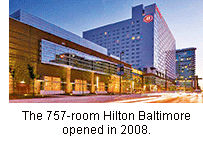 There are no shortcuts when John Hawley gives a guided site-inspection
tour of the Hilton Baltimore. It's a trip he has been known to make
multiple times per day. On this day, with a potential customer in tow,
he greets each staff member by name, chats with guests in the elevator,
lobby and hallways about their stay, and makes mental notes to call
housekeeping about a room-service tray left outside a guest room, and
conference services about a stray water jar in a meeting room.
There are no shortcuts when John Hawley gives a guided site-inspection
tour of the Hilton Baltimore. It's a trip he has been known to make
multiple times per day. On this day, with a potential customer in tow,
he greets each staff member by name, chats with guests in the elevator,
lobby and hallways about their stay, and makes mental notes to call
housekeeping about a room-service tray left outside a guest room, and
conference services about a stray water jar in a meeting room.
He points out the colorful artwork dotting the walls, all commissioned
from 30 local artists, and the fact that each meeting room is named for a
famous Baltimore native: Cab Calloway, Billie Holiday, Johns Hopkins
and Thurgood Marshall, to name just a few. At one point he stops to note
the environmental significance of the property's 32,000-square-foot
green roof in offsetting its carbon footprint, a fact, he says, that
resonates with clients who share similar concerns.
Hawley's excitement for the property and the city is infectious. It
doesn't matter if he is showing the grand ballroom, a boardroom or
pointing out the on-site UPS office -- he is a salesperson in his
element. "Gone are the days of playing golf with a client. We don't have
the luxury of that extra time anymore," he says. "Everyone wears
multiple hats, because everyone has the same goal: getting the business,
and executing it flawlessly."
Standing on the balcony of one of the suites that looks directly down on
Camden Yards' Oriole Park, home of the city's beloved Orioles, Hawley
points out other landmarks and gives a little history lesson and factoid
on each, but it's hard to ignore the stunning view of the baseball
field. It's no surprise that these rooms are coveted as hospitality
suites with baseball fans and planners alike, particularly during the
season. "We have groups who are booking business and praying there will
be a home game when they are here," he notes. "It gives us another great
speaking point when talking up the city."
Just then, a member of his sales team wanders through with an
association client who is on a repeat tour of the property. Hawley
immediately greets the client by name and asks how the planning is
coming along for her group's annual meeting. "I know 2016 is right
around the corner for you, so you must call me if you have any questions
or concerns," he tells her.
Back at the office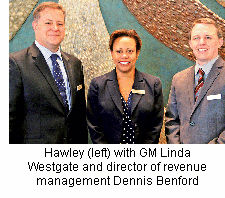 Once the tour is done, Hawley circles back to the lobby for a
late-afternoon meet-up with general manager Linda Westgate (see sidebar,
"Fulfilling a Promise to Baltimore"), and then it's
time to head back to the office to check in with the F&B director
and the catering manager.
Once the tour is done, Hawley circles back to the lobby for a
late-afternoon meet-up with general manager Linda Westgate (see sidebar,
"Fulfilling a Promise to Baltimore"), and then it's
time to head back to the office to check in with the F&B director
and the catering manager.
A group scheduled to arrive in a few days is hosting a tented outdoor
event on nearby Eutah Street, and Hawley wants to know what the setup
timing on the program will be. The trio quickly goes over the menu and
program and confirms the coordination of various in-house departments to
make sure everyone is in sync.
From there he heads to the office of his director of events, Mary
Nassar, whom, he notes, begins planning 12 to 14 months out for each
program. Together they huddle and go over what's on the books for the
next several days, confirming banquet orders, locations, staffing levels
and an eye-popping number of last-minute details that they both seem to
pull from memory.
The level of planning that goes into ensuring the execution of a simple
Continental breakfast or a meeting break is astonishing. Hawley recalls
one sell-out group that had 72 simultaneous receptions in one evening,
each for as few as five to several dozen attendees. "I was up in the
kitchen, double-checking banquet orders against the hot boxes, and
sending them out the door with the steward," he says with a laugh.
Then Hawley makes his way back to his office, taking the time to pop his
head into every cubicle along the way to say hello and ask how things
are going. By now the day is drawing to a close; the intensity of his
pace has been exhausting, but he still seems as if he can't wait to see
what's next. Finally back in his office, Hawley settles in to deal with
paperwork that seems to generate spontaneously whenever he's off on his
rounds. He quickly scans and signs off on each report, while
simultaneously answering the phone, checking text messages and
responding to emails. Just then another email request pops up, this one
from accounting, asking him to initiate wire transfers for the hotel's
next-day payroll. "It's all part of being on the management team," says
Hawley, without missing a beat.
Fulfilling a Promise to Baltimore
 Curb appeal, stunning artwork and in-house views overlooking a
major-league baseball team's home field don't typically factor in to the
average convention-center hotel's selling points, but they do at the
$301 million, city-owned Hilton Baltimore, which anchors the adjacent
Baltimore Convention Center by pedestrian skybridge.
Curb appeal, stunning artwork and in-house views overlooking a
major-league baseball team's home field don't typically factor in to the
average convention-center hotel's selling points, but they do at the
$301 million, city-owned Hilton Baltimore, which anchors the adjacent
Baltimore Convention Center by pedestrian skybridge.
The hotel opened in August 2008, just when the U.S. economy was in free
fall. Not surprisingly, there was -- and continues to be -- significant
pressure on management to prove to Baltimore's taxpayers that the heavy
financial investment will bear fruit. The intense public scrutiny, added
to corporate revenue expectations, would give any hotel executive
pause. But director of sales and marketing John Hawley and general
manager Linda Westgate view it all as a challenge, the broader mission
being to keep Baltimore on the convention map.
 One of only three female African-American general managers in the city,
Westgate is a petite, high-energy hospitality veteran with a quick
smile and a firm handshake, who has shepherded the hotel's staff of 450
right from the starting gate. The staff affectionately refers to her as
the "Queen Bee." Unlike some GMs, she prefers to be highly visible,
sitting in on pre-cons, accompanying Hawley as he escorts planners on
hotel site inspections and checking in with clients during their actual
programs. "Folks want to see that you are united, and that you care
about their expectations," she says. "My feeling is that even if they
end up giving their business to one of the other city hotels, it's still
great for Baltimore."
One of only three female African-American general managers in the city,
Westgate is a petite, high-energy hospitality veteran with a quick
smile and a firm handshake, who has shepherded the hotel's staff of 450
right from the starting gate. The staff affectionately refers to her as
the "Queen Bee." Unlike some GMs, she prefers to be highly visible,
sitting in on pre-cons, accompanying Hawley as he escorts planners on
hotel site inspections and checking in with clients during their actual
programs. "Folks want to see that you are united, and that you care
about their expectations," she says. "My feeling is that even if they
end up giving their business to one of the other city hotels, it's still
great for Baltimore."
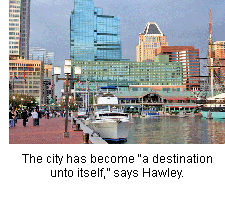
"The city used to get overflow business from Washington, D.C., and
Philadelphia," notes Hawley, a native of Kansas City, Mo., who after 18
years in residence considers himself a true Baltimorean. "If you
couldn't get your group into either location, you settled on us. Well,
not anymore. Now, it's a destination unto itself."
Sustaining both the destination's and the hotel's appeal means being
extremely responsive to guests' needs. "I want to have contact with
everyone who comes through my hotel's doors," Hawley says, "and I want
that relationship to begin even before they book rooms and meeting
space."
Throughout the day, Hawley checks in with Westgate to update her on
potential business, performance projections, upcoming events and site
inspections that could benefit from her presence.
As director of sales and marketing of a headquarters hotel, Hawley wears
many hats. In addition to working closely with Visit Baltimore, the
city's marketing arm, every third Thursday in the month he participates
in a two-hour meeting with the Baltimore Development Corp.'s board of
directors to update them on the hotel's economic progress. As of March
2013, the property's economic impact to the city stood at $384 million
-- and counting. -- C.A.S.