In recent years, hotel brands have sprung up like dandelions across the globe, making an already crowded hotel market even more confusing to navigate. Today, hospitality research firm STR puts the number of brands in the United States at 225, up from 210 in 2006. By comparison, in 1980, just 81 brands were represented in the U.S.
On the international front, it's anyone's guess. "Our data globally is spotty due to the hundreds of local and regional brands," notes Chad Church, senior director of operations for the Hendersonville, Tenn.-based STR.
Over the past three years alone, more than a dozen new brands have entered the hotel market, including Atlanta-based InterContinental Hotels Group's wellness-focused Even and China-specific Hualuxe; Chicago-based Hyatt Hotels Corp.'s new select-service brand, Hyatt House; and boutique pioneer Ian Schrager's value-oriented Public chain. Just two months ago, Bethesda, Md.-based Marriott International surprised the industry with the addition of yet another brand to its stable, Moxy, which will target "millennial global nomads."
To grasp exactly what makes a brand stand on its own, and out from competitors, M&C recently spent some time talking with the chief marketing and branding officers at five major global companies who are directly involved on a daily basis in creating the philosophy and product behind the following five brands.
Conrad Hotels & Resortsconradhotels.com
Parent chain: Hilton Worldwide
Portfolio: 23
In the pipeline: 9 opening by 2020
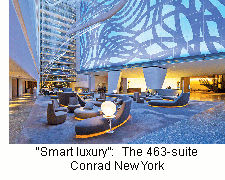 In 2012, Conrad Hotels & Resorts opened more properties than in any other year in its 30-plus-year history. And in a still-tough real estate market, the company has managed to expand its footprint with impressive new-builds in key gateway cities such as Beijing, New York City and Seoul, South Korea. The 550-room Conrad Dubai, which will feature 30 meeting rooms, is set to open later this year.
This brand has set its sights on the well-heeled global business traveler with its core brand pillars of style, service and connection with the indigenous culture of each location, all part of a philosophy summed up by the operating term "smart luxury."
"It's a new definition of luxury," says Michael Ennes, senior director, brand development, luxury and lifestyle, for Conrad. "For example, the architecture must have a dramatic, clean, sweeping style, accented with great artwork, yet also be comfortable and functional. It differentiates us from our competition."
Those concepts extend to the meeting space, which feature lots of natural light, comfortable furniture for networking, the latest technology and easy access from anywhere in the hotel. "Meeting space, even prefunction space, has to be adaptive and responsive to the meeting's needs," notes Ennes.
Indeed, Conrad's meeting space design template follows the mantra "foster collaboration and celebration." The year-old, 463-suite Conrad New York is a perfect example; its 30,000 square feet of meeting space, on the second floor, looks directly down into a soaring glass and steel atrium lobby, accessed via a central floating staircase.
Le Méridienlemeridien.com
Parent chain: Starwood Hotels & Resorts Worldwide
Portfolio: 100
In the pipeline: 9 scheduled to open by January 2014, primarily in Asia
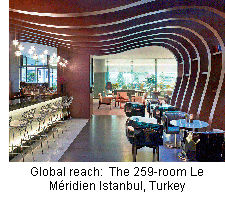 Launched in 1927 by Air France, Le Méridien has flown largely under the radar since its 2005 acquisition by Stamford, Conn.-based Starwood Hotels & Resorts Worldwide. But in the last 18 months, following a consolidation that saw 40 properties culled from the chain, the completion of a new rebranding strategy and service-culture training, not to mention some significant development deals, this brand is ready to shake things up in the upper upscale segment.
Marrying the culture of the destination to Le Méridien's European heritage is the chain's core branding message. "Location is more important than size for this brand. Each hotel has to be in the cultural heart of the city," says Brian Povinelli, global brand leader for Le Méridien and Westin Hotels.
Art is integral to Le Méridien's image. "Some of our hotels have millions of dollars of artwork just in their lobbies," says Povinelli. What's more, the brand has its own designated cultural curator, Jérôme Sans, who came up with the idea for the chain to have collectible electronic key cards designed by local artists, which double as free access passes to local museums and art galleries.
Also new to the brand concept is the Le Méridien Hub, a lobby design that will function as a social gathering place for locals and guests alike, while featuring curated displays by local artists.
"Travel time is compounded for business travelers, but they still want to get something out of their destination, even if they have just one hour," says Povinelli. "These spaces are designed to do that. They incorporate the authenticity of the destination and bring it to them."
In 2012, Starwood rolled out an aggressive expansion plan for Le Méridien, which included the opening of hotels in Arlington, Va.; Istanbul, Turkey; and Mexico City. Earlier this year, the company debuted the 275-room Le Méridien Atlanta Perimeter, with 10,000 square feet of meeting space. Another eight properties are poised to open over the next eight months, more than the chain opened in the last seven years, including two in China and one each in Bangladesh, Egypt, India and Vietnam.
Closer to home, the 172-room Le Méridien Chicago–Oakbrook Center is set to open next January, adjacent to the massive Oakbrook Center mall.
"We are doing some very exciting things," says Povinelli Indeed, Le Méridien's property owners have collectively invested some $2.5 million in recent months to bring all their hotels up to new brand standards.
Hotel Indigohotelindigo.com
Parent chain: InterContinental Hotels Group
Portfolio: 50
In the pipeline: 51 globally, including 27 in the Americas
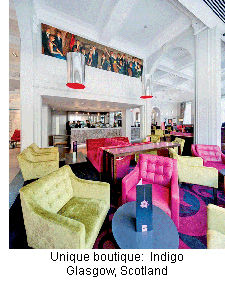 It's been a busy time for Hotel Indigo, InterContinental Hotels Group's boutique chain, which launched in 2004 with the debut of the Hotel Indigo Atlanta. Last year alone, the company opened 14 properties for a total of 50, including the 132-room Hotel Indigo New Orleans, in that city's Garden District, and its third in London, the 100-room Hotel Indigo London Kensington–Earl's Court.
While Hotel Indigo is firmly anchored with the heft of IHG, each property is a boutique entity unique to its neighborhood, right down to the décor, artwork and specialty cocktails they choose to serve, explains Mary Dogan, IHG's director of brand management for the Americas. "We give our hotels tremendous flexibility in their design and F&B programs, with one important requirement," she says. "They must use locally sourced food that showcases local cuisine. We tell a story that only the locals would know, and that is how we remain a consistent, relevant brand."
Despite its commitment to individuality, Hotel Indigo does have brand standards in place across its portfolio. For example, all hotels have spa-inspired showers, free Wi-Fi, and 24-hour fitness and business centers. "Those initiatives allow our DNA to remain consistent across the board," says Dogan.
In April, the 138-room Hotel Indigo Hong Kong Island debuted with a gold dragon wrapped around the façade and state-of-the-art sustainability within. In coming months, the brand's second Big Apple entry, the Hotel Indigo New York, will open on Manhattan's East Side, and two other key projects will break ground -- the 150-room Hotel Indigo Philadelphia and the 125-room Hotel Indigo Wilmington, N.C. -- both to open in 2014.
Marriott Hotels & Resortsmarriott.com
Parent chain: Marriott International
Portfolio: 500
In the pipeline: 40-plus by 2015
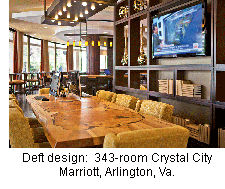 The flagship brand of Marriott International is now 55-plus years old, and still just as cutting-edge as its first property, the Twin Bridge Marriott Motor Hotel in Arlington, Va., which opened in 1957. "It remains the root of everything you see today that is Marriott, despite the purchase of Ritz-Carlton and the different brands now in our portfolio," says Paul Cahill, senior vice president, brand management, for Marriott Hotels & Resorts and JW Marriott Hotels.
Staying relevant through the decades, says Cahill, is key to Marriott's branding strength. Despite its size -- 500 hotels and counting -- the chain has been a nimble player in delivering brand consistency. Marriott has introduced new concepts, like its "Great Room" lobby design (open-plan zones for working, relaxing and dining), name-brand restaurants and new technologies to enhance its back-of-the house service delivery.
As for meeting space, last August the chain introduced Workspring at Marriott, a small-meetings concept from workplace products and services firm Steelcase that reconfigured some space into several meeting suites geared for anywhere from three to 75 attendees. Each features a common area styled with comfy sofas and great lighting, and comes fully loaded with office supplies, wireless access and a dedicated meetings coordinator, all for rent at an hourly, all-inclusive price.
This past March, Marriott teamed up with LiquidSpace to offer Workspace on Demand, a new mobile/web app that connects users in search of flexible workspace and the venues offering them. It followed that up a month later with the introduction of yet another new global brand standard: free Wi-Fi in all lobbies.
"At Marriott, meetings represent half of our business, so we can't stop focusing on the next generation of design space," says Cahill. "We have been successful because we focus not only on the people planning and paying for the meetings, but the people attending them."
By year-end 2014, the company will cement another global brand standard: Meeting planners will be able communicate with a hotel's service staff in real time, from the engineering to the F&B departments, via a custom app, even before they arrive on-site.
Loews Hotels & Resortsloewshotels.com
Portfolio: 20
In the pipeline: Plans call for doubling the brand by 2016.
New York City-based Loews Hotels & Resorts might have been relatively quiet over the past decade, but in 2012, with Paul Whetsell, founder of Capstar Hotel Co., installed as president and CEO, and former Ritz-Carlton honcho Bruce Himelstein becoming chief marketing officer, the company is on the move.
Over the past year, Loews has picked up new hotels, all conversions, in Boston; Hollywood, Calif.; and Washington, D.C., and broke ground on two significant new properties: the 400-room Loews Chicago Hotel, which will feature 25,000 square feet of meeting space, and the mammoth 1,800-room Cabana Bay Beach Resort at Universal Orlando.
"Paul Whetsell knows how to not just run a hotel, but attract deals, and we aim to double the brand in three years," says Himelstein, who adds that Loews is now looking at some major urban gateway markets, "where a lot of meetings business is going." In addition, the company has grown its national sales force to meet increased demand on the group side.
Also factoring heavily into Loews' new brand development strategy is a heavy injection of capital investment in upgrades to everything from guest room linens to signage, all in an effort to bring all hotels up to a four-star level.
Many of the company's iconic properties are embarking on major improvements, such as the 354-room Loews Regency Hotel on Park Avenue in New York City, which closed in January for a yearlong, $70 million renovation. And several exciting new F&B products will be rolled out in the coming months, such as the upscale Parisian-style bistro, La Société, in the newly renovated Loews Hotel Vogue in Montreal, which will give the brand a fresh, contemporary boost.
"We are an independent spirit tucked comfortably in the four- to five-diamond section," says Himelstein. "And this brand is going to be making a lot more noise."