Protect Your Reputation

As technology providers like Cvent and Active Network begin to chase
down planners and determine whether meetings were booked, they’re
accumulating data that could help hoteliers better gauge the viability
of leads.
“They could let us know that company X closes 95 percent of the leads
they put through their system,” says MGM’s Michael Dominguez. “So that
tells me that if it’s a lead from that organization, I’d better respond,
because they likely will book their business somewhere.” On the flip
side, the hoteliers won’t be rushing to respond to organizations that
rarely book via the platform.
Cvent is working toward such a solution, although a source notes it will
be essential to balance the needs of both hoteliers and planners.
Active Network will only share aggregate RFP conversion data with
hoteliers, a spokesperson said. -- M.J.S.
Last year, Marriott's eight sales offices in North America received a total of about 335,000 electronic leads, according to Richard Green, the chain's vice president of association sales and industry relations.
Starwood Hotels and Resorts has seen a similar deluge. The number of eRFPs the hotel company receives from just two primary channels -- Cvent and Active Network -- has grown by 35 percent each year for the past two years, according to Christie Hicks, senior vice president of sales. Since 2010, that number has grown by 99 percent.
While leads from Cvent and Active Network represent a large percentage of the growing eRFP volume, those channels are not the only sources. Electronic RFPs come from a growing range of free tools, including those offered by many hotel companies on their own websites. (M&C's hotel and facility search tool, at mcvenues.com, also has an eRFP function.)
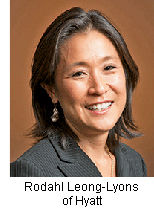 Not surprisingly, "the staffing at our hotels is not increasing," says Rodahl Leong-Lyons, Hyatt's Chicago-based vice president of sales for the Americas. "It's a one-sided, automated process that has a manual response on the other side -- and it's just not sustainable. It's not going to work in the long term."
The result on the hotel side is a form of triage, with sales representatives determining which leads require immediate attention -- and which can be back-burnered. Some large properties are hiring reps to serve as lower-level "lead catchers," whose job it is to process and route the requests. Meanwhile, hotel companies are evaluating the best approaches.
 "Salespeople are hired to book business," says Mike Mason, a former hotel sales executive who founded the eRFP platform Zentila. "And they have to spend their time on the business that is most likely to book."
What makes an RFP stand out from the rest? Following are insights into how hoteliers filter out and select the chosen ones.
Limit the playing fieldA mile-high pile of sales leads isn't in itself a problem for hotels -- it's the quality of those leads. "When a lead comes in and it's going to at least 20 different properties, or 20 different cities, hotels will look at that and go, ‘What's the likelihood I'm going to get that business?' " says Sherry Romello, senior director of meetings and product management for McLean, Va.-based Hilton Worldwide. "Sometimes, when a lead looks like it's just trying to splatter out to every space possible, it's not viewed as a viable or a likely piece of business."
The number of properties that have received a particular RFP is not always evident. Sometimes the request states so up front; other times a chain can see how many of its own properties were approached for the same business and extrapolates from there. Those that noticeably cast too wide of a net simply will get less attention, several sources admit.
"There's a direct correlation between the number of hotels you want to consider and the response time of your answers, as well as the quality of your answers," Marriott's Richard Green told attendees at a recent educational session during Destination Marketing Association International's Destinations Showcase in Washington, D.C. "If you are sourcing four hotels or fewer, we commit to getting back to you within nine hours. As the number of hotels increases, so does the promised response time."
"The whole RFP spam issue goes away when you limit the number of hotels," says Mike Mason, whose Zentila platform (which powers M&C's search tool at mcvenues.com) allows a maximum of six hotels to be contacted. When the RFP goes out to a half-dozen or fewer candidates, "that would probably put your RFP on the top of any sales manager's list," says Mason.
"Tell them how many hotels they're competing with," Mason advises. "Put that number in bold type at the top of your RFP. And, to add more credibility, let them know who they're competing against. That really energizes and motivates the salesperson."
Automating the Answers

Executives at Hyatt Hotels Corp. don't think hiring more salespeople is a good long-term solution for managing the proliferation of e-leads. "And I could never get the funding for it anyway," adds Chicago-based Rodahl Leong-Lyons, VP of sales for the Americas.
Instead, Hyatt has developed technology solutions to help manage the load, with more automation on the way. The hotel company has partnered with Active Network and Cvent to feed leads directly into Hyatt's sales system, within which sales reps already are managing contacts and meeting space, as well as pricing and inventory.
Because Hyatt has integrated its revenue management system with its sales platform, reps can get real-time live pricing and availability for meeting space in the same place. They needn't obtain special approval or log on to a separate hotel platform to get that information.
"The goal is to give time back to the sales managers to do what they should be doing," says Leong-Lyons, "which is building relationships and helping and selling to people -- not data entry."
The next step, says Leong-Lyons, is QuickBook, a technology Hyatt has developed to automatically prepopulate responses to planners with current pricing and availability, as well as meeting space details, based on the information requested in the eRFPs.
"The salesperson, instead of having to manually enter all of that information, can look at the prepopulated response and make sure that the key points that are important to the planner are adequately addressed," explains Leong-Lyons. The debut of the technology depends on implementation by the eRFP platforms.
Active Network has confirmed its participation with Hyatt on the QuickBook project, so that leads coming via its StarCite marketplace will be automated in that fashion.
"Our buyer customers have been very direct in communicating their desire for online availability of group inventory," points out Rick Binford, CMP, vice president of strategic marketplace development for the Active Network Business Solutions Group in San Diego. "While this outcome is not currently in the plan for phase one of our proposed integration with QuickBook, we do see this integration as an important step toward enabling that type of outcome for the future."
With QuickBook, Hyatt salespeople will be able to craft responses in about 15 minutes vs. the current 45.
At McLean, Va.-based Hilton Worldwide, executives are assessing whether the company's e-Events online booking tool can alleviate some of the time pressure on salespeople. Hilton's e-Events tool can be used to book meetings with 25 or fewer sleeping rooms.
"It really frees up the hotels to focus on the execution of the event," notes Sherry Romello, Hilton's director of meetings and product management. For small meetings, she says, "if you want to get out of the lead spam, just book direct online." -- M.J.S.
Request information firstOf course, the situation isn't always so cut-and-dried. "I'm not one who
necessarily beats up meeting professionals because they're looking at
multiple destinations," says Michael Dominguez, senior vice president of
corporate hotel sales for MGM Resorts International, based in Las
Vegas. "I know their bosses sometimes say, ‘We're going to look at
Chicago, Florida and Vegas. Tell me what's out there.' So what are they
supposed to do at that point?"
What's more, adds Hyatt's Leong-Lyons, the recovering economy is causing
space issues in primary cities. "Planners might have to source more
hotels -- and maybe even more cities -- because availability is
tightening up," she points out.
For those planners who have valid reasons for contacting a large number
of properties, sources suggest sending out "requests for information"
rather than requests for proposal. "The RFI can say, ‘Are you available
or not?' It's a yes or no question," says Leong-Lyons. "The planner can
get it down to a short list, and then we can get down to the details
where we start digging in."
This could really speed up the process, adds Dominguez. "If you're only
looking for whether I can do these rates, have these dates and have the
space, I can respond immediately," he notes. "This is an area where we
could mature as an industry. If we can incorporate the RFI, it will ease
the load on hotels, and it would assure meeting planners that responses
were coming quickly. They would probably be hearing back from
everybody."
Share your processStarwood's Christie Hicks stresses the importance of a realistic
deadline for a response and a time frame for the decision. "We want to
gain an understanding of how the decision will be made," she says,
"including the steps properties can anticipate in the process."
Insight into the decision-making process is crucial, agrees Mike Mason.
"Sales managers really don't care about a decision date," he says. "I've
been in this business for 25 years, and I can say it has never happened
that a contract was signed on the date they said they'd make a
decision. What's more important is when you will make a decision on your
short list. If you say, ‘I can let you know by Monday who's going to be
in and who's going to be out,' hotels know they have a shot to make
that list, and they'll work their tails off to do it."
Recognize the hotel's priorities "It's not just the human touch anymore," says Marriott's Richard Green.
"There are computer models that help us determine if your group is the
right fit and how to price it. We have a large discipline around what we
used to call revenue management; we now call it ‘group evaluation.' The
goal is ‘highest and best use.' Our computer geeks have figured out how
to optimize every component of a proposed meeting, including all
ancillary revenue." Formulas account for the ratio of guest rooms to
meeting space, history of room pickup, time of year, arrival and
departure patterns, and total revenue potential. (For more on the role
of technology in RFP evaluation, see "Automating the Answers," left.)
Be frank about date flexibilityA lot of RFPs specify that the meeting dates are not flexible, says
MGM's Dominguez. "Well, they're not flexible until nobody has the space,
and then we get the same RFP back, asking us to look at different
dates." If there's any wiggle room at all, that's more enticing to the
hotel. "If I get a lead and it says, ‘my dates aren't flexible and I
need these dates with this amount of space,' and I don't have those
dates available, why am I killing myself to respond quickly?" posits
Dominguez. "That's going to be put in the pile to be turned down. But if
you say there is some flexibility, you're going to get a good response
from all the hotels, because we're going to be telling you when we could
do the meeting."
Share meeting historyHistorical information about the meeting in question is critical in
catching hotelier attention. Key details really shed light on how
salespeople can put a value to the meeting, says Hilton's Sherry
Romello. "If you outline that you've been to these three cities and this
meeting generated this many room nights and this much revenue, the
hotels will immediately know that they're dealing with someone who knows
their business," she notes. "They tend to choose your business because
you've done enough homework to tell the hotel what will make your
business really stand out."
Note opportunities for future meetings along with that history, suggests
Romello. "I've heard this over and over again from our hotels. You
might send out a lead for one meeting, but this might be one that you do
monthly or on some regular basis. What's the opportunity for higher
volume? If you know there is that potential, make sure you say that in
the RFP."
The more detail, the betterA detailed RFP usually will get better, more prompt attention than one
that lacks information, say sources. "We would much prefer trying to
sift through a lot of information than we would trying to find you on
the phone to follow up and fill in the blanks," says Hilton's Romello.
(See "The Comprehensive RFP" here, and download a sample RFP from the National Association of School Psychologists here.)
Sales managers can respond faster if they have clear insight into what
is most important to the planner, adds Hyatt's Leong-Lyons. Armed with
that information, "the salespeople are hyper-focused on the
highest-priority items and making sure those are met. Then we can get
down to the second level of the nice-to-haves.
"I love planners who say, ‘Here's my demand list. And here's the stuff
that if you want to throw it in would get my attention.' Perfect," adds
Leong-Lyons. "That tells us exactly where we stand."
Don't keep secretsLeong-Lyons understands why some planners prefer to call everything a
"must." Why call one item less important, when the hotel otherwise might
have included it in the package? "I get that. But I don't think it's an
issue of us really wanting or not wanting to give anything. If we don't
have all the information that we need about what's most important to
you, it's difficult for us to give you back something meaningful."
It's important to hotels to return an impressive proposal, she stresses.
"You might still tell us no at the end of the day. But if it's
meaningful, you'll still trust us, and you'll still pick us the next
time you're sourcing a meeting."
Mike Mason suggests that some of the detail can be saved for phase two,
when the playing field is narrowed. "For instance, if there's a contract
addendum that's super important, put that in the RFP, along with some
of your key concessions. Then let them know there will be some more
requests if they make the short list. It's when you narrow the results
that they should really do the work," he adds.
Maintain communicationNo matter how detailed the RFP, salespeople often have questions.
Planners who can respond promptly and succinctly set the right tone for
future interactions. "Those planners tend to get the most attention,"
says Dominguez, "because they're being very responsive to the questions
and the needs of the people at the hotel."
Communication throughout the process is essential, adds Starwood's
Christie Hicks. "It builds a level of engagement that is needed to
differentiate you from the price-shopping eRFPs that our hotels are
receiving on a daily basis," she says.
This level of engagement is incredibly important for salespeople, adds
Mason, and something that many planners underestimate. "Make sure you
keep communicating with the hotel," he advises. "Communicate without
being asked."
Many salespeople meet daily with their directors of sales to review
potential business. When salespeople don't have regular updates about a
lead, the sales director stops asking about it. "They stop talking about
you," adds Mason. "When they stop talking about you, you're irrelevant
to the hotel. When that happens, you lose everything."
Reach out to tell them they're still in the running, even when you don't
have new information. "This lends itself to a much more successful
negotiation," Mason explains. "You create a relationship with the
salesperson that then engages them when you go into negotiations. You
kept them in the loop; they appreciate that and they will fight hard for
you."
Take the time to say no"More than 78 percent of the leads salespeople get today just dissolve,"
says Mason. "They never know what happened. Once you've made the
decision, tell everyone who was in the running. Make sure they know so
they can all move on. Don't leave them hanging. It's a great way to
respect their time."
Closing this loop goes beyond just the respect for a particular
salesperson; it's a way to ensure the leads coming from your
organization get attention in the future. "Some organizations never
confirm whether the meeting was booked or what happened to it,"
Dominguez notes. "That doesn't build credibility in the hotel's
perspective." Planners need only to alert the channel that the meeting
was booked, he adds, for the lead to be closed in the system.
Keep it humanMost important, remember that there is a person on the other end
assessing the RFP. As advanced and streamlined as the RFP submittal
process has become, it is a tool to facilitate interpersonal commerce.
"You have to humanize that interaction," notes Mike Mason. "And
salespeople are desperate for it. They're desperate for the connection,
for something other than adjusting the RFP fields that come through."