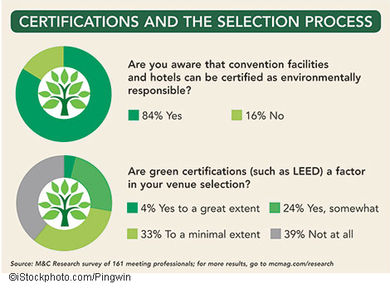
Not so long ago, getting a hotel to divulge details about its sustainability practices (if there were any to begin with) was a tall order. Planners who wanted to hold green meetings had to do a lot of legwork to make sure bottles actually would be recycled and leftover food went to the right place. Today, however, hotels have gotten into the green game with a vengeance, seeking out certifications and following rigid standards to cut their environmental footprints and get the attention of green-minded planners.
Better yet, several certification programs now do the job of verifying properties' claims regarding conservation efforts. The newest challenge for planners: understanding what the various designations really mean and the extent to which they should influence site selection.
"While certifications are important, what I feel is more important is whether the hotel has integrated sustainability into their culture," says Amy Spatrisano of the Portland, Ore.-based MeetGreen planning firm (she and her business partner, Nancy Zavada, CMP, founded the Green Meetings Industry Council; greenmeetings.info). "For example, do the bellman, front desk, banquet staff, housekeeping, restaurant staff, and sales and marketing teams know the hotel's commitment to sustainability? What does each department do toward that end?"
Spatrisano adds that certifications aren't designed to be a guarantee that sustainable practices will occur at your meeting. But a thumbs-up from one of the following entities is a great way to start the search for a facility whose sustainability objectives match those of environmentally conscious meeting hosts.
At present, three primary entities are building databases of green hotels: Green Key, Green Seal and the U.S. Green Building Council's Leadership in Energy & Environmental Design (LEED) designations. Properties pay to participate in these programs, showing a certain level of commitment from the outset, and many hotels have earned more than one certification.
greenkeyglobal.com
Developed in Canada, this certification program for hotels is growing steadily in the Lower 48. Both Hyatt Hotels Corp. and Carlson Rezidor Americas (including the Radisson and Park Plaza brands) have partnered with Green Key for their North American properties. "Their reputation in Canada is outstanding," says Brenda Schultz, director of responsible business for Carlson, who evaluated several options before going with Green Key as the company's standard.
To earn a Green Key, a hotel's sustainability representative answers 160 questions in a self-audit, in return receiving a rating from one to five keys, along with an action plan for getting to the next level. The questionnaire assesses five main operational areas (corporate environmental management, housekeeping, F&B operations, conference and meeting facilities, and engineering) and nine sustainable practices (energy conservation, water conservation, solid-waste management, hazardous-waste management, indoor air quality, community outreach, building infrastructure, land use and environmental management).
Green Key randomly audits 20 percent of the hotels in its portfolio each year, and hotels must undergo recertification every two years.
Just 55 of the more than 3,000 hotels in the program have reached the five-star level, including the Hyatt Regency in Bellevue, Wash.; Fairmont Washington, D.C., Georgetown; and, in Las Vegas, the Aria Resort & Casino, Mandalay Bay and Bellagio.
Green Key also has a meetings program, developed with the MPI Foundation Canada. Starting with a hotel's key rating, the property is then evaluated in six meetings-related areas: core (carbon, energy, waste, water and air-quality practices), communications (information and training), activities (purchasing, auditing and community outreach), people, exhibitions and audiovisual. So far, a total of 77 properties have completed this assessment, with only six receiving the five-key rating for meetings. The four in the United States are in Las Vegas: the Aria Resort & Casino, Bellagio, Mandalay Bay and MGM Grand Las Vegas. Also, two hotels in Canada have five-key ratings for meetings -- the Solara Resort & Spa in Canmore, Alberta, and the Westin Ottawa.
Setting the Bar High
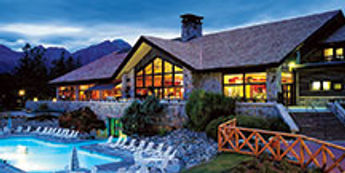
Toronto-based Fairmont Hotels & Resorts (
fairmont.com) has long recognized a connection to the land and communities where its hotels reside. In 1990, Fairmont's Canadian properties began the company's Green Partnership program, and sustainability is now a core value of the company. A range of community-outreach projects have included coral-reef protection in Hawaii and the conservation of endangered species, such as North Atlantic right whales, peregrine falcons and sea turtles.
Green Seal
greenseal.org
This program develops sustainability standards for products, services and companies, and offers third-party certification for those that meet the strict criteria. Hotels are rated gold, silver and bronze; only five in the United States have achieved gold level: the Guest House at Wingspread in Racine, Wis.; Hyatt at Olive 8 in Seattle; Sheraton San Diego Hotel & Marina; W Seattle; and Xanterra Parks and Resorts at Zion Lodge in Springdale, Utah.
To be Green Seal-certified, a hotel must adhere to stringent guidelines, including requirements in waste minimization and recycling; energy efficiency and conservation; management of freshwater resources and waste water, and reduction and handling of hazardous substances. Properties also must establish an environmentally sensitive purchasing policy. A certified property's records and procedures are evaluated, and an on-site audit is conducted every 18 months.
new.usgbc.org/leed
The USGBC's LEED designation is all about the building. The program offers third-party verification that new-builds and renovated facilities maintain energy-saving systems, and that the materials used in construction meet current environmental standards. LEED Certification is awarded on baseline, Silver, Gold and Platinum levels for new and existing buildings. Credits are given for minimizing local environmental impact, water efficiency, energy performance, materials and more. To reach the baseline level, a hotel has to earn 40-49 points on a 100-point scale; Platinum requires achieving 80 or more points.
The first property to reach the Platinum pinnacle was the 147-room Proximity Hotel in Greensboro, N.C., which opened in 2007 with 5,000 square feet of meeting space and was awarded the designation in 2008. Only 16 other properties have reached this level, three of them in the United States: the 62-room Bardessono in California's Napa Valley; Syracuse, N.Y.'s 58-room Hotel Skyler, and an upscale adventure hostel in Chattanooga, Tenn., called the Crash Pad.
In July, the membership of the USGBC adopted LEED v4, the latest update to the rating system. Launching this fall, the program allows applicants to fill out less complicated forms. Among other changes: A greater emphasis on performance will tie credit more closely to improved environmental outcomes. For example, LEED 2009 gave credit for buildings that had bike racks and changing rooms. LEED v4 requires bike racks and changing rooms, but the building also must be located in a bikeable area. Version 4 also has a focus on ongoing certification.
LEED-certified existing buildings are required to recertify every five years; new-builds are under no such requirement (it is, after all, a voluntary program), but they are encouraged to get certification under the existing-building criteria, as well.
Wait, there's more
In scouring the ranks of green hotels, planners might come across a number of other designations.
Energy Star (
www.energystar.gov), a label we are used to seeing on new appliances, helps properties track water and energy consumption. However, "their process was not created for hotels, so it has some issues with understanding our business and why we reach certain numbers," notes Carlson Rezidor's Schultz. "A hotel would get a better Energy Star rating if it was less occupied. The rating doesn't take occupancy into consideration. We'd be thrilled to be rated low!"
Many hotels, including the entire Hilton Worldwide portfolio, have met the international sustainability standards of ISO 9001 (for quality management) and ISO 14001 (for environmental management), two measurements from the International Organization for Standardization (
iso.org). Achieving compliance at Hilton was the happy result of the company's LightStay sustainability program, which tracks more than 200 measurements across the brand. "We felt that ISO 9001 and 14001 were more globally recognized," says Randy Gaines, vice president of engineering, housekeeping and laundry operations, Americas.
Meanwhile, the list of certifying entities is long and growing. Aside from LEED, Green Key, Green Seal and Energy Star designations, a Starwood Hotels & Resorts representative says the hospitality company also encourages its hotels that work toward recognition from Green Globe (
greenglobe.com), the Green Tourism Business Scheme (
green-tourism.com), the Rainforest Alliance (
rainforest-alliance.org) and the Florida Green Lodging Program (
dep.state.fl.us/greenlodging).