(Pictured) New brand in town: The 230-room CitizenM New York Times Square
There's a new wave of European immigration arriving on our shores -- one comprising hotels, not people. These brands straddle the segments of design-driven lifestyle and business travel; they are stylish, they prize affordability over luxury and, while not loaded up with meeting space, they are very big on small meetings, offering space that seeks to inspire and foster creative collaboration.
Of these newcomers, the one with the biggest footprint is, not surprisingly, the one that now enjoys the backing of the world's largest hotel company. Marriott partnered with Spain-based AC Hotels in 2010, with the aim of growing the design-focused brand worldwide. In the past two years, the flag has debuted nine properties in the U.S. and three more in Latin America.
"After starting the joint venture with AC, we realized that this focus on design in this service level and price tier is really unique and something that would resonate very well with consumers in the U.S.," notes Toni Stoeckl, global vice president of lifestyle brands for Bethesda, Md.-based Marriott International. "That's where we have focused our growth." At the end of the second quarter this year, 81 of the 91 open AC Hotels were in Europe -- but a remarkable 91 of the 96 hotels in the pipeline were set to open in the Americas.
PURPOSEFUL DESIGN
The AC Hotels brand is about unpretentious style and "purposeful design" -- "It's the stripping away of the unnecessary, the clutter," says Stoeckl. "It leaves more room for the beauty, for the essential elements."
The less-is-more approach is a common theme in the marketing of many new lifestyle brands, particularly the new limited-service, Millennial-focused entries stateside. Which is not to say details are ignored, says Stoeckl about AC's hotels. "Everything you see has a why," he notes, "everything is motivated. The location of the light switches, for example, is something we obsess over to a strange degree -- how you can access them conveniently, without strain and without thinking about them. But it all makes sense, because we want to understand how you use the room. These little things are important, and they carry through the entire DNA of the brand."
Similarly, adds Stoeckl, AC properties are designed with local art pieces in mind, with such works naturally integrated into the building's design. The idea is to create an aesthetically pleasing, creatively stimulating space, but with no element of the design calling too much attention to itself.
British-born photographer/media personality Nigel Barker, an AC Hotels "ambassador" who collaborates with the brand on some design elements and whose artwork appears in some properties, says there is something uniquely European about that approach. For him, the ideal hotel needn't be entertaining, but rather "a sanctuary that incorporates art and design into an environment where you can focus and concentrate."
EUROPEAN STATE OF MIND
That European mindset is appearing in some other brands as well. In June, Spanish hotel company Meliá debuted its first Innside property in the Americas, the 313-room Innside by Meliá New York NoMad. The new hotel's stylish approach to a lifestyle business property is very similar to the AC Hotels look -- particularly in the guest rooms, featuring uncarpeted floors, a muted color scheme, thoughtfully designed charging stations, and contemporary furniture and details.
The Innside brand has a pedigree similar to AC's: It was first launched in the 1990s (as was AC Hotels), with its roots in Germany. In 2007 it was purchased by Spanish hotel giant Meliá and has since grown to 16 properties. While most of those are in Germany, there is speculation that the brand could be a good fit for the urban expansion Meliá has publicly discussed for cities like Miami and Los Angeles.
The Innside New York lobby vibe is young and the chill-out music in the elevators loud enough to be noticeable, but the clientele represents a wide mix of demographics, says director of sales and marketing Michael Newman. "We draw different types," he says. "We get a lot of business travelers, due to our location, and from a variety of age groups." The hotel is close enough to Javits Center that a lot of groups book blocks during conventions, he adds. The hotel has two meeting rooms of its own, totaling 1,170 square feet of space.
Two years ago and slightly uptown, the Dutch hotelier CitizenM opened its first U.S. outpost, the 230-room CitizenM New York Times Square. While the style here is considerably more whimsical than that of other brands mentioned above, it likewise prizes affordability and technological necessity (such as free WiFi, a hallmark of every one of these brands) over unnecessary luxuries. Its guest rooms are pod-size, but the common areas are large, comfortable and conducive to networking. CitizenM has a few developments in the works stateside, according to a spokesperson; the only one that's been announced to date is a property on the Bowery in Downtown New York, set to open in the second quarter of 2017.
MORE NEW LIFESTYLE BRANDS
The number of new hotel brands launched over the past several years is enough to make a planner's head spin. The "affordable lifestyle" segment in particular is seeing explosive growth. New and soon-to-debut options in this category, including Best Western's Vib, Canopy by Hilton, Tru by Hilton, Marriott's Moxy and Radisson Red, among others, encourage networking with open-lobby concepts. They typically don't have meeting space, but they might appeal to planners as lodging outside of actual meeting venues -- places where the networking can continue.
PLACES TO MEET
All of these brands are classified as upscale on STR's chain-scale listings. As is typical for that level, they don't promise lots of traditional meeting space. Yet all promote creativity and collaboration, and market themselves as stimulating places in which to meet.
The majority of AC Hotels have an average of 2,000 to 10,000 square feet of meeting space, according to Toni Stoeckl. And every AC Hotel offers a media salon, a small, rentable semiprivate space with A/V equipment and room for at least six to eight people, enclosed by windows and just off the main lounge.
For Stoeckl, it's important that AC's purposeful design is carried through to the meeting spaces. "If people are inspired by their environment, they actually retain more information," he says. "So the more senses are engaged when you're in a meeting, the more you retain the information and the more productive that meeting is."
At AC, that division between meeting and public spaces is not always clearly delineated. The AC Lounge -- the public area outside the windowed media salon -- is meant to be a productive workspace in itself: Hotels encourage not only guests but also the local community to spend the day there working, ordering beverages from the European-style café menu and enjoying the free WiFi.
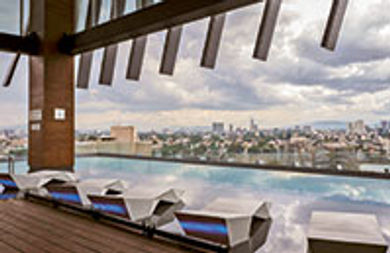 The Sky Deck at AC Hotel Guadalajara in
Mexico can host up to 80 for a reception.
The Sky Deck at AC Hotel Guadalajara in
Mexico can host up to 80 for a reception.To further promote their properties as local meeting spaces, AC Hotels has partnered with Startup Grind, a worldwide network of entrepreneurs. Startup Grind chapters arrange regular meetings in AC Lounge locations, and members get certain perks, such as a complimentary cocktail at the end of every work day. Some properties allow members to use the media salon or other meeting space for free if it isn't already booked.
Both the Innside New York and CitizenM's European locations pride themselves on small meeting spaces built to foster collaboration and creative inspiration. The meeting rooms are intimate and well-lit, with easily movable furniture and technology such as smart boards. Walls, in many cases, can be scribbled on (and easily erased) when inspiration strikes.
The Innside New York likewise has created a European-flavored common space within its lobby, courtesy of celebrity chef Scott Conant, who also runs the Impero Caffé, the hotel's signature restaurant. The lobby lounge and the patio are extensions of Conant's Italian restaurant, offering a casual breakfast and early evening draw for the local community as well.
The result is an inviting, intimate and sharing experience -- what small meetings are all about.