(Pictured) The end results of this wheelchair-build competition are donated to charity.
Whether attendees are colleagues or strangers, simple team-building exercises can foster collaboration and fuel creative energy that sets the stage for more effective gatherings.
Following are some easy, low-cost activities for small groups.
Charity Wheelchair-Build
Time needed: 2-3 hours
Rob Fletcher, founder of Quixote Consulting in Erving, Mass., is a fan of activities that create something for charity. "We do a lot of work partnering with multiple-sclerosis organizations, building wheelchairs for people with the disease," he says. Each team is presented with a set of challenges, such as questions about their work, people in the company, or questions based on meeting's content, to reinforce learning. For each correct answer, the team earns one part to build their wheelchair. To foster collaboration, teams are encouraged to share tools and information with each other.
"When there's a charity component like this, the event is not just about the team building itself, and people just don't get as competitive as they do under other circumstances," Fletcher notes. "Instead, they focus more on sharing information and helping each other out."
A group of 100 people should be able to construct about 25 wheelchairs during the activity.
Sing-Along
Time needed: 2-3 hours
In the meadow at the Trapp Family Lodge in Stowe, Vt., sits an elegant outdoor stage, ideal for group performances. The 96-room lodge, which features 4,000 square feet of meeting space, often hosts a cappella singing competitions, where groups of up to 30 pick a leader, choose a song from the Sound of Music, rehearse on the stage for an hour, and then perform in front of a panel of judges for laughs and nominal prizes.
This event can be woven into any meeting, with any musical genre. For instance, rehearsals might be scheduled throughout the day, followed by an evening of performances (and cocktails).
Picture This
Time needed: 45-60 minutes
This exercise, led by Quixote Consulting, gets people to connect and test their brain power; it can be a competition or just an hour of fun.
To begin, a facilitator distributes one picture to each participant, who may not show it the others. When placed in the proper order, the pictures tell a story. Participants describe their pictures to one another, which inevitably leads to the formation of small groups whose images seem similar or sequential. Gradually a pattern emerges until the group is ready to place all the pictures face down in sequential order. The facilitator reveals the results and tells participants how close they came to solving the challenge.
As an example, images of the planet Mars, Earth, a bird's-eye view of a city, a crowd of frightened people, explosions and cheering crowds could be assembled to spell out an attack from-Mars that was thwarted.
"The groups have a certain amount of time to complete the project," says Quixote's Rob Fletcher. "If you give too much information, you take up too much time. Everyone's voice needs to be heard, and there needs to be clear leadership to guide how everyone interacts. There is a wealth of information the participants can find out about each other. When no leader is delineated, who steps up? Will they keep their eyes on the end result, or will they get caught up in the details?"
Team Pursuit
Time needed: 1-3 hours
American Outback Adventures & Events recently launched this activity, in which groups solve tasks in four categories (mental, physical, skill and mystery) using their smartphones. The goal is to challenge minds while also encouraging the participants to move around and get to know each other.
Team Pursuit can be run with one of American Outback's event coordinators, or the activity can be self-hosted (cost: $450), in which the company provides everything the host needs to run the event, including the American Outback Adventures & Events App.
Fifteen challenges in each of the four categories are presented on the app. Each team submits photo, video and text responses. The correct answers earn points for the team, and points are tracked in the app.
Following are examples of each type of challenge:
Mental. You throw away the outside and cook the inside, then eat the outside and throw away the inside. What is it? (Answer: An ear of corn.)
Physical. Devise a unique handshake and submit a video of at least two people performing it.
Skill. Build a structure at least six feet tall out of anything in the room. Submit a photo with your teammates hiding behind the structure.
Mystery. Who in the room has traveled more than 100 miles to see a music festival? Take a photo of this person jamming out to the music, with his/her name in the caption space.
3 Team-Building Trends
1. Pre-set teams. Organizers increasingly are aiming for maximum mixing, e.g., no two friends on the same team. The trend is to have the roster already set up by the planner before anyone arrives.
2. In-room activities. Groups are using their existing space rather than going off-site or moving participants to another meeting room.
3. Dual benefits. Event organizers are getting extra oomph from their fun (and their dollars) by combining activities that foster communication and camaraderie with another goal, such as making a meal for the group or creating something for a charity.
Source: Rob Fletcher, Quixote Consulting
Build a Pizza
Time needed: 2 hours
Designed by Eagle Ridge Resort & Spa in Galena, Ill., this fun activity fosters communication among groups of 25 to 40 people, in teams of three to five.
"We put together every ingredient you could think about putting on a pizza and set up tables with crusts and toppings," says Colin Sanderson, director of sales and marketing for the property, which offers 15,000 square feet of function space, 80 rooms in its inn and courtyard, and more than 200 homes for rent.
"We tell them to choose one person to build the pizza, who is then blindfolded. Then you choose someone to explain to the builder how to make the pizza. The builder cannot talk. The explainer has to communicate very carefully where the ingredients are and where the crust is; the rest of the group is tasked with collaborating on how best to communicate."
Judging criteria might include how well the teams communicated, cleanest prep area at the end of the event, best-looking pizza and -- as judged by all -- the best-tasting pizza.
Icebreaker Obstacle Course
Time needed: 40 minutes
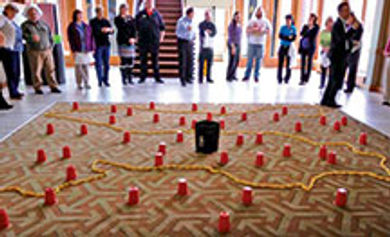 A simple obstacle course breaks the
ice at Eagle Ridge Resort & Spa.
A simple obstacle course breaks the
ice at Eagle Ridge Resort & Spa.At the Eagle Ridge Resort & Spa, a 20-by-20-foot obstacle course is set up in one of the foyers or in a meeting room using chains and red Solo cups. The group is broken into teams of two; one person in each pair is blindfolded, and their partner has to talk them through the obstacle course.
Sanderson says that the activity works best for a group of 25 to 30 people. "Participants really need to focus on how they're communicating. Should your partner take baby steps? Giant steps? It's great to do before the meeting begins, as it gets people talking right away."
Garbage Golf
Time needed: 1 hour
Eagle Ridge creates another event in an empty ballroom, where teams are challenged to create a putt-putt golf course. Each team is given different materials to work with, such as tablecloths, blankets, cups, bowls of water, sticks, rocks, PVC pipes and Astroturf. When the course is ready, the teams play through; the team with the lowest score wins.
Groups of about 40 people can build nine par-2 holes; larger groups of about 72 can build an 18-hole course.
Paparazzi
Time needed: 1-2 hours
This photo scavenger hunt, another favorite at Eagle Ridge, is designed to tap into and boost creativity and resourcefulness. Each team is given a camera (or uses a cell phone) and is charged with taking pictures for a "newspaper."
The publication's name can be related to the theme of the meeting, an industry or a generic idea such as a celebrity tabloid. Typically, participants run around the property taking photographs that fit the theme (or set the scenes themselves) and then come up with headlines for their work. The whole group judges the photographs on criteria such as most creative headline, most informative shot and most innovative way to tie a photo into current events.