Specialty Foods of the Moment
What's hot in the specialty-food industry often parallels trends in dining -- and the products often double as gifts. Here are some of the hottest trends for 2013, according to the National Association for the Specialty Food Trade, based in New York City.
Beyond the pickled cuke. Gourmets seem to be pickling everything these days: beets, okra, raisins and figs, to name a few. Perhaps it's because of their powerful flavor and low calorie count.
Gluten-free and good. Gluten-free cookies and other products are not only popping up everywhere, they don't taste like sawdust anymore.
Chocolate with a kick. What's the logical next step after adding salt to chocolate and caramel? Adding pepper, of course. Try it before you knock it.
"Banquet" is no longer a bad word, even to foodies. Planners are asking hotel chefs and caterers for sustainable, healthful, restaurant-quality meals -- and venues are delivering. These requests aren't new, but after years of merely scratching the surface -- fruit alongside the Danishes at a "healthy" breakfast, or a factory-farmed meal served on disposable bamboo plates at an "eco-friendly" event -- they finally are being addressed in a meaningful way.
Top chefs and catering teams are pleasing planners' palates and priorities via a combination of careful sourcing of ingredients, forward-thinking menu planning, modern cooking techniques and, of course, unwavering attention to the client.
"We're focused on being extremely flexible in everything planners ask for," says Guy Rigby, vice president of food and beverage, the Americas, for Four Seasons Hotels and Resorts. "Otherwise we're not being guest-centric."
TREND #1
Green grows up For years, planners have tried to bring an eco-friendly element to group dining, but most efforts have been scattershot, resulting in merely a patina of green. After all, it's no easy feat to source and cook sustainably for 1,000 attendees at a time. Nowadays, sustainability is being taken more seriously, and it's coming from a hunger for food that's tastier, more humane and gentler on our planet. The result is that meeting planners don't always have to ask for a sustainable menu; a growing number of hotels and catering businesses now provide one automatically.
Hyatt Hotels and Resorts has set a gold standard in green with its new global food-and-beverage philosophy, "Food. Thoughtfully Sourced. Carefully Served." That means, in part, focusing on sustainable farming practices for the foods each hotel sources.
"We were hearing from planners that the hotel company that can figure out how to infuse healthy, sustainable food practices into its banquet operations will gain their business," says Susan Santiago, Hyatt's vice president of F&B operations for North America.
To that end, the chain now uses cage-free eggs, responsibly harvested seafood, and all-natural chicken and beef in its banquet operations, and each hotel buys from local artisanal ranchers, farmers, cheesemakers, bakers, brewers and vintners. The philosophy seeps down into the fabrics in employee uniforms and the materials in to-go containers.
Hyatt also now offers seasonal banquet menus that differ based on region. And most North American hotels feature a "100-mile menu," in which just about every ingredient is sourced locally.
The hotel company also is working on communicating these advances to guests. New menus released this autumn share the new philosophy and annotate where the products are sourced. Labeling on buffet tables is clear and descriptive, especially when allergens are concerned. Also, local purveyors often are invited to talk about their products with attendees.
Of course, Hyatt is far from the only hotel brand focused on sustainability.
"Almost every business now has a green initiative," notes Tom Elder, executive chef of the 458-room Hilton McLean Tysons Corner in Virginia. "When they plan meetings, they're looking for a hotel with the same mindset." Elder, whose father was a veterinarian, buys goods for the hotel only from farms he's visited, to make sure the animals are treated well and to investigate agricultural practices. Organic and sustainable are two separate things, he explains. Organic is a governmental certification, and it's a start, but it doesn't necessarily mean the farming is sustainable.
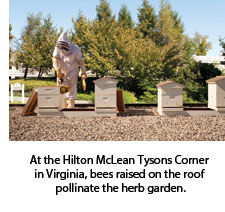 Elder also cultivates bees on the hotel's rooftop, not so much for the honey but to help pollinate the surrounding area -- including the hotel's herb garden -- in an effort to be a good neighbor to nearby farms.
Most chefs also are concerned with serving seasonally appropriate meals. "Right now it's not even an option not to be seasonal," says John Harenda, director of operations at New York City-based Union Square Events, the exclusive caterer for the 463-room Conrad New York in Lower Manhattan. "If you're serving certain vegetables in the wrong season, the client is so well-educated, they'll scratch their head and say, 'What are you guys doing?'"
At the 800-room Deloitte University Hotel & Conference Center in Westlake, Texas, managed by Benchmark Hospitality, executive chef Mike Jackson not only sources from local artisans, but he also has brought some of that artisan production in-house. At the center's new training facility, employees smoke bacon, cure pastrami, make fresh cheeses, and grow herbs and peppers on-site. The chefs also serve different parts of freshly butchered animals at different action stations; e.g., a lamb's legs and ribs could be served at a carving station, its tenderloins could be smoked and used as charcuterie, and other cuts might be braised for a stew or tagine.
Other properties managed by Benchmark Hospitality employ foragers to collect wild greens and mushrooms to use in the kitchen.
Four Trends in Cocktails
By definition, F&B isn't just food. Here's what caterers are seeing in the world of beverages.
Champagne is no longer restricted to toasts. Sparkling wines pair well with seafood and desserts, says Mike Jackson, executive chef at the Deloitte University Hotel & Conference Center in Westlake, Texas. Sherry, too, is used with foods traditionally difficult to pair: gorgonzola, game meats and asparagus, for example.
The herb garden spices up drinks. Lisa Hopkins, CPCE, CMP, president of the National Association for Catering and Events and director of catering for the Houstonian Hotel in Texas, has seen cocktails with basil, oregano, sage, rosemary, clove, star anise and, especially, ginger and lemon.
Local brews are big. Hotels are looking for any opportunity to bring in local beers, wines and spirits being produced everywhere in the country.
Cocktails are getting juicy. Hyatt Hotels and Resorts, for one, is using more natural syrups and fresh-squeezed juices in cocktails, and fewer mixes.
TREND #2
Good for you
Eating well throughout a multiple-day meeting is notoriously difficult
-- but hotel chains and other caterers are making it easier.
"Our
customers eat healthfully at home, and they don't want their momentum
interrupted when they're on the road," Hyatt's Santiago says.
As
part of its new philosophy, Hyatt is providing more reduced-calorie and
vegetarian or vegan options, curbing the use of processed ingredients,
adding fruits and vegetables in place of refined carbohydrates, and
shrinking portions.
 Hyatt's
breaks are getting healthier, too. "Everyone's familiar with the
chocoholic break," says Steve Enselein, the chain's vice president of
catering and convention services. "Now you'll see a break that's focused
on superfoods -- blueberries, turkey and salmon. Or one that's all
vegetarian or gluten-free."
Hyatt's
breaks are getting healthier, too. "Everyone's familiar with the
chocoholic break," says Steve Enselein, the chain's vice president of
catering and convention services. "Now you'll see a break that's focused
on superfoods -- blueberries, turkey and salmon. Or one that's all
vegetarian or gluten-free."
"Our new breaks are focused on the
nutrition the attendee needs, vs. the traditional 'let's give them a
sugar high at 3 p.m. to get them through the rest of the day,'" Santiago
adds.
Lisa Hopkins, CPCE (certified professional catering
executive), CMP, president of the National Association for Catering and
Events and director of catering for the 289-room Houstonian Hotel in
Houston, is seeing a major push toward portion control that is sensitive
to guest opinion, such as one customer who looked at the standard rib
eye offered at in-house meals and told her it was too much meat.
She's
now seeing a lot of items in miniature, like chocolate lollipops and
tiny cupcakes (she describes them as "a little piece of sin"). And the
Houstonian's new chicken-and-waffles appetizer is a small piece of
chicken on a stick with a waffle coating, dipped in tabasco maple syrup.
Smaller
portioning benefits not just the waistline but the bottom line, too.
During the recession, many planners eschewed seafood because of its
price and perceived luxury. Now shrimp, oysters and scallops are all
back, but served in shot glasses. "We're not doing the old-school
shrimp-on-ice, where you take 25 shrimp and walk away," Hopkins says.
Four
Seasons has tackled the continental breakfast, offering a broader range
of choices within a category that typically centers around starches and
sugars. New menus include yogurt, housemade granola and items made with
bran.
At the Hilton McLean Tysons Corner, chef Elder brings in a
juice bar into breakfast buffets. Making "juice martinis" with mango
and strawberry purees and passion fruit and pineapple juices is a
festive way to make breakfast healthier.
Meanwhile, the biggest
thing since sliced bread seems to be gluten-free bread -- and other
products. "The number of people who for medical or dietary reasons are
avoiding gluten has skyrocketed," chef Jackson says.
One things
caterers aren't doing to please people with dietary restrictions is
offering two choices on the same plate. "Gone are the days of the duos,"
Hopkins says. "Instead, people are letting planners know what their
requirements are, and we'll make sure we have enough options to suit
everyone's needs."
Eating Your Emotions
Great food can surprise, delight and bewilder diners. At the New York Marriott Marquis, executive chef Armando Monterroso and executive pastry chef Steve Evetts are pioneering a concept called Emotional Cuisine, in which dishes are engineered to evoke feelings of curiosity, comfort and even a little guilt.
"Before I create a menu, I ask the customer, how do you want the event to feel?" he says. "Do you want it to be a fun party or something more formal?"
The chefs also designed the menu out of the belief that avant-garde cuisine belongs even in a big-box hotel. Here are some of their most interesting creations.
Amused: Bleu cheese, honeycomb and walnut, served in a spoon
Comfortable: Aged New York steak with truffled polenta fries and bacon creamed spinach
Confused: Line-caught sea bass and raw vegetable salad served on a plate made of Himalayan sea salt, cooked tableside on a hot stone
Guilty: Pacific halibut poached in olive oil, atop sweet potato puree
Curious: Parsnip cake with "tea air" -- aka foam.
Photographs: Lara Kastner
TREND #3
Restaurant quality
In the past, serving groups all at once has prevented banquet chefs
from maintaining the level of innovation found in the kitchens of top
restaurants. But thanks to technology and increasing flexibility,
banquets are getting better at emulating the finest dining experience.
At
the Hilton McLean Tysons Corner, for example, the dishes served in the
property's restaurant, Härth, are essentially the same as what's on the
banquet menu. The trick to mass-producing intricate recipes: "It's a
mindset more than a technique," Elder says. "Now we cook in small
batches, and the food isn't sitting in a hotbox somewhere waiting to be
served. Even for 1,000 guests, I'm not cooking two days in advance."
One technique perfected in top restaurants that helps catering teams cook a flexible menu for large groups is called sous vide,
French for "under vacuum." Meats, sealed in plastic bags, are cooked
slowly in a hot-water bath. The hotel or caterer can prepare a variety
of entrées; if some are not ordered, those can be refrigerated for the
next event without loss of flavor.
"In the old days, we'd give
people a choice for their plated dinner," Guy Rigby of Four Seasons
says, "and we'd have three or four courses in advance to get things
prepared. Today, the technology in kitchens lets us turn around the menu
much faster."
Molecular gastronomy, cooking techniques that rely
on chemistry and physics to create new textures and flavors, has been
used in restaurants since the 1990s. Now it's appearing in banquets for
1,000 or more guests. Jackson, for example, sets up a Champagne station
with a selection of "stable foams" -- aka decorative bubbles -- in
fruity flavors such as peach and raspberry to float atop the beverage.
Also, by jelling droplets of watermelon juice, he makes "caviar," which
gives a sweet kick to ceviche.
"When molecular gastronomy got
hot, the techniques were closely guarded by chefs, and you'd have a hard
time getting the chemicals you needed," Jackson explains. "Now you can
find the cooking technique displayed on YouTube and buy the ingredients
from broadline food providers."
Banquet menus are getting more
adventurous in response to the expanding palates of many meeting-goers.
Hopkins sees Korean food as a trend; the Houstonian recently introduced a
Korean short rib on kimchee, the fermented cabbage that is becoming
popular, largely thanks to its health benefits.
Caterers aren't
borrowing only from fine-dining restaurants. Just as the trendiest
casual lunch spots do one thing really well, whether meatballs or
lobster rolls, Four Seasons is stripping away the excess options on the
lunch buffet and focusing on, for example, a carefully prepared
sandwich. That one item can be far more appetizing, Rigby says, than a
line of chafing dishes.
Street food is hot right now, according
to Rigby. People aren't eating traditional American lunches at work
anymore, instead picking up takeout from an ethnic restaurant or a food
truck. When they come to a meeting, then, sitting down to a three-course
lunch feels anachronistic. Instead, a Four Seasons hotel might serve up
fish tacos or Thai street food that attendees can eat while walking.
"When
people break out of a meeting, the first thing they do is take out
their phone and return e-mails," Rigby notes. "They're happy to pick up
food and go off into a corner. There's a much greater blending of work
and eat."
Mobile munching is most prevalent at breakfast, when
latecomers will bring a muffin and coffee into the meeting room.
Sometimes they'll dodge the breakfast setup entirely and pick up a latte
at a nearby Starbucks. In response, Four Seasons has begun staffing
prefunction space with baristas. If attendees want an espresso drink,
they can duck out of the session for a moment and get their pick-me-up.
"In
the office, people tend to gather around the water cooler or
photocopier and chat," Rigby says. "Off-site, people like to chat around
a coffee bar."