Defining SMM
In 2009, the National Business Travel Association and Meeting
Professionals International, in an attempt to get everyone in the
industry on the same page, agreed on the following definition:
"Strategic meetings management (SMM) is a disciplined approach to
managing enterprise-wide meeting and event activities, processes,
suppliers and data in order to achieve measurable business objectives
aligned with the organization's strategic goals and vision, and deliver
value in the form of quantitative savings, risk mitigation and service
quality."
Misuse and misunderstanding of the term was frustrating to its creators
and champions, among them Kari Kesler Wendel, SMMC, now senior director
of SMM Strategy + Solutions for CWT Meetings & Events. Outside of
NBTA, SMM sessions at conferences often focused only on planning a
strategic meeting, rather than the concept of developing an
enterprise-wide strategy for all meeting activity.
"Today, the discipline is becoming more inclusive and broad-based," says Kesler Wendel, "and I think that's good."
Some have said the 2009 definition isn't inclusive enough. "Then the
definition needs to change," Kesler Wendel says. "It's a discipline that
should continue to evolve. Evolution is critical to it getting more
traction and allowing more companies to achieve the benefits. We have to
be open to it not being what we thought it was five years ago." --
M.J.S.
"I think the industry itself is still a little bit befuddled by the concept of strategic meetings management programs," admits Steve O'Malley, senior vice president of St. Louis-based Maritz Travel. When he speaks about SMMP at industry gatherings, generally only about a quarter of the participants report that they have such a program in place, and just a handful describe their programs as mature. "Everybody in the audience wants one," O'Malley says, "but they don't know where to start."
Part of the problem: "We, as an industry, have made this too complex," says O'Malley. "We have said that you have to have all of these different puzzle pieces to constitute a complete SMMP, and that is just not a comfortable place for clients who are just beginning their journey to even know where to step in."
In response, Maritz and other suppliers of SMM services have taken a step back to reassess their approach to a confused client base. Here's a look at key factors driving the evolution of strategic meetings management.
Beyond Maxvantage Several years ago, SMM experts led a movement to shine a light on the discipline, and to ramp up education efforts. The National (now Global) Business Travel Association, from which the first SMMP white paper originated, teamed up with Meeting Professionals International to publish an official definition of the term. The definition, like the practice itself, was far-reaching and somewhat driven by procurement terminology. SMM involved managing the processes, suppliers and data for meetings across an entire enterprise, and aligning those efforts with business objectives (see related sidebar, "Defining SMM," left).
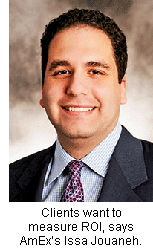 Around that time, Maritz Travel and New York City-based American Express Meetings & Events joined to launch Maxvantage, an alliance offering strategic meetings management services. Maxvantage's aim was "to serve clients who were largely focused on end-to-end strategic meetings management," explains Issa Jouaneh, vice president and general manager of American Express Meetings & Events. As a growing number of people in the industry learned about the benefits of SMM, Maxvantage was marketed as a company that could provide any and all of the services required to implement and maintain an SMM program.
This past May, however, Maxvantage was discontinued. The reason, in part, was due to organizational changes within the two founding companies since 2009. American Express Meetings & Events has since consolidated its global business, and Maritz acquired the meetings management company Experient last year and, with it, additional SMM accounts and expertise. But an evolving SMM marketplace also played a significant role in the decision, according to both companies. Simply put, there isn't much of a demand for end-to-end solutions, and there is a clear need for simplification and accessibility.
According to Jouaneh, who had served as a Maxvantage's vice president, "Today, our customers want more options to buy solutions tailored to their individual needs across the full meetings management spectrum, from sourcing only to end-to-end programs."
Finding a reasonable way to begin an SMM program was sometimes difficult -- even overwhelming -- for Maxvantage clients, according to Maritz's Steve O'Malley, a former Maxvantage general manager. "We ran into multiple situations where it became untenable to find the right starting point for clients," he acknowledges. "Maxvantage was a construct that was not as flexible as what the marketplace now needs. Now we're going to come up with the right starting point for any client, regardless of where they are in their journey." Maritz will provide a flexible and scalable approach, O'Malley stresses.
The intimidation of launching an SMMP was a huge hurdle for companies just starting out, affirms Cindy D'Aoust, chief operating officer of Meeting Professionals International in Dallas (also a former Maxvantage vice president). "They felt it was for other companies, for companies bigger than theirs, or that they had to have a technology product or they needed a third-party supplier -- when in fact, none of those things is really true. You can implement basic, fundamental elements to take your program to the next level regardless of where you are and what your objectives are."
More on SMM
For a look at research on how planners are embracing the ideas behind SMM, click
here. And for an update on industry education efforts,
see "
Strategic Education."
Adjusting to the Market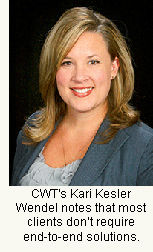 Shifting priorities are not unique to American Express and Maritz. But
the changing approach might be more about suppliers' perceptions than
customers' needs, suggests SMM expert Kari Kesler Wendel, SMMC, senior
director of SMM Strategy + Solutions for CWT Meetings & Events in
Minneapolis. A primary issue driving this supplier shift is that there
are limited opportunities to manage an already successful program, she
adds.
Shifting priorities are not unique to American Express and Maritz. But
the changing approach might be more about suppliers' perceptions than
customers' needs, suggests SMM expert Kari Kesler Wendel, SMMC, senior
director of SMM Strategy + Solutions for CWT Meetings & Events in
Minneapolis. A primary issue driving this supplier shift is that there
are limited opportunities to manage an already successful program, she
adds.
"There are some companies that have forged the path in SMM, that have a
program and team in place," Kesler Wendel explains. Those companies with
mature programs are essentially the ones that would require end-to-end
management services, she says. They might put that business out for bid,
but only once every three to five years at the most. "So those
opportunities are few and far between. There are a lot more companies
that don't have those programs than those that do."
Like O'Malley, Kesler Wendel believes the suppliers' challenge -- and
industry's need -- is getting more companies started on the SMM path.
"How do we help companies successfully start their programs, when most
still fail at them?" she posits. "How do we provide solutions that are
easy to understand and easy for a client to say yes to, to get started?
It's almost never an end-to-end solution that they need."
In response, suppliers are working out how best to package and market
simplified solutions for an inherently complex undertaking that really
requires a consultative, customized service.
"It has always been a building-block approach," points out Debi Scholar,
GLP, CMP, CMM, CTE, founder of The Scholar Consulting Group in Scotch
Plains, N.J. "As always, companies are buying the services they need.
But maybe once they have those in place, they stop because that's what
works for them." (Scholar joined American Express Meetings & Events
as director, managed meeting strategies, just before press time.)
Due to economic constraints, corporate culture or a host of other
factors, some organizations simply might not have the drive or need to
develop the more mature SMM programs in place in other companies or
other industries.
Making Meetings MatterOne significant trend, note suppliers, is an increased emphasis on the
success of the meetings themselves. While meeting content and design
have always been part of SMM, says Debi Scholar, "there are more clients
now interested in demonstrating the value of meetings."
The focus five years ago was really on consolidation, says Issa Jouaneh:
"Clients were consolidating spend to provide transparency into the
organization's investment in meetings and events, having full visibility
into that through the reporting, tracking and sourcing of that spend.
In the last two to three years, we've seen more focus in terms of how
you manage the program, how you drive the effectiveness of the meeting
and how you can measure the return on investment from those programs."
The cost savings and visibility offered by SMMPs are still crucial, says
Maritz's O'Malley. "But you also have to have excellent delivery and
design of your programs in order to have the outcomes that you're
looking for as a business."
This is an important trend for meeting professionals, particularly as
planners have occasionally been at odds with those in procurement or
travel management who were driving SMMP implementation. A greater focus
on strategic planning and outcomes represents an opportunity for
planners to demonstrate their expertise and gain recognition.
At CWT M&E, Kesler Wendel is seeing much greater SMM involvement
from sales, marketing and meeting professionals. "Four out of the last
five potential customers I spoke to were very seasoned meeting
professionals," she recounts. "Now, procurement is involved, but things
are actually being driven by those whose own careers are about the
excellence of meetings, and I think that's exciting. And that's
different, really different, from how it used to be."
MPI's Cindy D'Aoust also observes and applauds that change. In the past,
she notes, an SMMP's focus was often on procurement and reducing costs.
"Certainly, you want to have the meeting in the most cost-effective
way, but that's not the primary purpose or the value of conducting
meetings. The shift now is to focus on enhancing value and delivering
results."
Getting StartedSuppliers understand full well the potential obstacles posed by SMMP
implementation, notes O'Malley, citing change management and funding as
two primary concerns. To start, the companies must begin gathering data,
generally through site selection and meeting registration.
Centralized vendor sourcing and contracting makes a great leaping-off
point, says Kari Kesler Wendel, as that alone drives 60 percent of an
SMMP's typical cost savings. "You get the maximum savings with a single
activity," she says, "and you're off to a running start."
The crucial prerequisite, adds D'Aoust, is understanding your corporate
culture and the business objectives of the company. "You have the
ability to design your program based on the priorities of the
organization," she says. And a good grasp on the culture will provide
valuable insight into the successes and challenges you'll likely
encounter along the way.