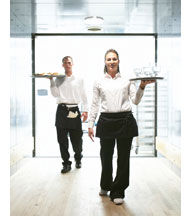
 Many hotels are hungry for meetings business these days, which gives planners a good deal of negotiating leverage. But ask for too much, and the property will have a hard time delivering. Margins are tighter than ever, so it's helpful to know where properties have room to negotiate. Here's where meeting planners can help the hotel -- and help themselves.
"The largest cost for any hotel is labor," explains Michael Dominguez, vice president of global sales for New York City-based Loews Hotels. "If you can save us in labor, then I'm able to be a little more flexible with you."
Of course, hoteliers can tailor their offerings to meet a group's particular whims and desires. But if a client needs to watch costs, it's a lot easier for a hotel to reduce the number of people required to serve a meal, for example, than it is to lower the cost of the food.
A good working relationship, says Dominguez, means understanding each other's needs and limitations. "It's never been more critical in our industry that we have a true partnership and are working together through this," he adds.
With that in mind, what follows are simple ways planners can help hotels cost-effectively meet a group's needs. What's less costly for the hotel should, in turn, be less costly for the planner.
Food and beverage
Stay in one place. That outdoor reception preceding dinner in the grand ballroom might come with a great view, but it also requires a significant amount in set-up costs. "Realize," says Dominguez, "I've had to set up two different bars, I've had to set up two different function areas. So the staff is almost doubled from the bar standpoint and from my setup standpoint. And, most importantly, I have to break down two different areas."
What's more, the transportation of the banquet equipment, which is often stored near the ballrooms, is a lot easier at some hotels than others. At some properties, says Dominguez, "I have to lug it up 2,500 feet to get it where it needs to go."
Take advantage of the setting. While some hotels find it difficult to move equipment outdoors, others, by nature of their locale, prefer to do just that. "Here on St. Maarten, everyone wants to be outside, of course, and do things on the pool deck and the beach," points out Christopher Polak, director of catering at the Westin St. Maarten Dawn Beach Resort & Spa. That's what the resort encourages planners to do, he adds, because the setup is fairly minimal. "We don't need grand flowers and grand entertainment, because the ambience is already out there -- you're right on the ocean, right on the beach."
 Go for buffet-style. "A lot of people -- some caterers, even -- don't get it because they focus on the possibility that the food costs might be higher," says Don Ross, vice president of catering, conventions and events, for Las Vegas Meetings by Harrah's Entertainment. "But it's all about labor nowadays. As much as food cost is, labor costs and benefits and all those things are more than the actual food cost itself. So when people say, ‘I can't believe you're charging me $3 dollars for a cookie -- I can go down to the 7-11 and get it for 99 cents,' I say, ‘It's not about that cookie. It's about all of the people that have to touch the product before it gets to you.' "
While some buffets do entail elaborate setups, the labor required to create them is miniscule compared to the number of people needed to set up each plate in the kitchen and then serve the meals individually.
Centralize break sites. Find a convenient spot for a large group coffee break, advises Bob Moore, vice president of conference management for Gaylord Hotels in National Harbor, Md., rather than setting up in each meeting room. In addition to slashing labor set-up costs, it will produce much less waste. "Especially for coffee," Moore points out. "Instead of putting a gallon in each room, you can probably just do four gallons in one spot to satisfy the entire group."
Stick to the menu. "If someone tells us exactly what they want and it's not on the menu, that also adds to our costs," explains Michael Harrison, director of conference operations at the Four Seasons Resort & Club in Irving, Texas. "We have to source those items and bring them in, and a lot of times do prep on them that we don't normally do."
Have what they're having. "Communicate with the catering manager about what else is going on in the hotel," suggests Moore. "See if you can menu match. If a company's willing to do a menu that we're already using, we'll look at it and give them some sort of a cost break. Because now I don't have to put the pressure on the kitchen to produce a whole different type of menu."
This approach often is formalized as a package meeting deal, as is the case at the Four Seasons in Irving. "It lets us enjoy some economies of scale so that we can pass those savings on to the customer," notes Michael Harrison. "They buy a package from us, and the chef chooses the lunch menu. It's always a buffet and has three entrées. It's a very elaborate buffet, but he chooses the menu. So for everybody who's here on that package, the chef just has to make one type of meal, instead of putting together all these different things, and that saves us money on food and saves us money on labor in the kitchen."
Use the restaurant. "If you are organizing a meeting of 10 to 12 people," says Michael Dominguez, "it's much easier to have you meet in my restaurant than for me to set up a banquet room for your lunch. My staff and my restaurant are there whether you're coming or not."
Another smart option is to consider an on-site restaurant that otherwise is closed for breakfast or lunch but would be perfect for a private function. These venues require less labor to set up than a meeting room. Furthermore, adds Bob Moore, "If we don't have to dedicate another meeting room to a lunch, we can sell more rooms."
Eat where you work. To really minimize set-up costs, roll a buffet table into the meeting room. "A lot of people are doing that now because they're trying to be more time-efficient," says Harrison. "But that also saves us money that we can pass on to the client."
Meeting setup
Minimize room turnover. "If you want to be in the meeting room until 5 p.m.," says the Four Seasons' Harrison, "and then you want to have a dinner in there at 6:30 with round tables, we have to turn the same room over. That really drives our labor costs up." One solution: Set up the meeting room using crescent rounds instead of a classroom setup. "If the rounds are already there, we can just come in and set them for dinner," adds Harrison. "Things like that really help us a lot."
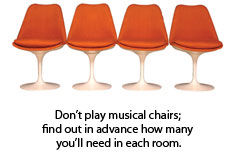 Know how many chairs you'll need. "We get a lot of groups that don't really know how many people are going to be in a given session," explains Don Ross. "You might have a customer who has a general session scheduled for 2,000 people and 10 breakouts, and they'll ask us to set every room to capacity. They have no clue of what the interests of their attendees are and where they're going to sit. What that sometimes does is totally extinguish our inventory of equipment."
Ross' staff might have to scramble to move chairs from general sessions and lunch to breakout and other session rooms, just to make sure each room is properly set to capacity. That translates to a lot of unnecessary labor.
Reuse room setups. This holds true whether it be for a morning and afternoon breakout in the same room or for a meeting room from one day to the next. If you can use the same audiovisual setups, that's even better, says Moore. Strategically plan the meeting with this in mind, he suggests. "Talk to the presenters; see if you can just tweak a few things in order to not have to turn the room. It's a big savings for the hotel, and it can be for the meeting planner, too."
Stage back-to-back registration. Is another group coming in just before or just after yours? Maybe you can use the same registration area they do, suggests Moore. "You might only have to change the headers to brand your group or association. If the setup is very similar to what was just in front of you or is coming in behind you, you can probably save a lot of money." Essentially the same principle applies for exhibit hall setups.
PHOTOGRAPH (Chairs): BRASIL2 -- ISTOCKPHOTO.COM
Will Standards Suffer?
 Hotels are pressed
 to cut costs without sacrificing brand standards. At New York University's International Hospitality Industry Investment Conference in June, hotel executives addressed that challenge.
"I don't think about it in terms of cutting back, but in terms of listening," said Eric Danziger, CEO of Wyndham Hotel Group. "We shouldn't get rid of our brand standards, but maybe we need to give our owners a little more time or flexibility to meet them."
"Certain standards are untouchable. Others we might relax for a period of time," said Robert Gaymer-Jones, COO, Soluxury HMC – Sofitel WorldWide. "For example, we use Hermès products in all of our properties. We might say, for a certain period of time, we will use Hermès only in our suites."
At Hyatt, "In some cases, we cut 50 percent of our staff and closed 50 percent of the rooms," said Rakesh Sarna, COO – International, Hyatt Hotels Corp. "We have two simple criteria: to make sure the owner has the cash he or she needs, and to make sure the customer who has been loyal to us doesn't think we are no longer loyal to our customers."
"Some brands have relaxed their standards permanently," noted Gary M. Mendell, chairman and CEO, HEI Hotels & Resorts (which owns 30 properties). "Instead of giving two newspapers to every guest, they're asking if they would like a daily newspaper, and if so, which one. That's a small thing that will save a lot of money -- and it's also better for the environment."
-- Loren G. Edelstein
Guest rooms
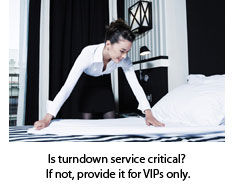 Cut turndown service. There are some labor-intensive amenities that just might not be missed. "We are always going to have turndown service for VIPs," allows Dominguez, but is it really necessary to have that amenity for every guest room? "Is it something that's critical to the group?" Dominguez asks. "Because for me to do turndown service, basically I have to have a larger housekeeping staff in the evening."
Have attendees share rooms. "When I started, this was pretty much the norm," says Christopher Polak. "But when things were going good, everyone pretty much got the king bed and to be by themselves. That's fine and dandy. But now? This saves them on the room nights and it saves us on labor. I see that trend making a comeback."
Other cost-cuttersShare manifest and arrival times. Doing so allows the hotel to adjust staff levels throughout the property. "If I realize that 90 percent of your 300-room group is arriving after 1 p.m.," says Dominguez, "I'm not going to have all my front-desk staff on duty at 8 a.m. sharp. Neither am I going to have my bellmen fully staffed at 8 a.m. It saves me a half day in labor and shifts for half my staff by knowing exactly when you guys are coming."
 Consider shipping your meeting materials to a third party.
 "It can be very costly to ship directly to a hotel," cautions Bob Moore. "Your decorator might be able to do the same job at a better price for you."
In addition, consider printing materials locally -- or even on-site, if there's a Kinko's or similar establishment on the premises -- to save transit fees and handling charges.
Send the SOS early. Effective and ongoing communication between meeting planner and hotel is essential, stresses Dominguez. "Openly discuss attrition and cancellation," he advises -- and do as soon as you suspect there might be a problem. "If you're calling me 60 days out and you think your attendance is going to be really bad and you want to try to do something about it, I have less flexibility than when you call me six months out and say, ‘You know, I'm a little bit concerned.' Let's see what we can do to help alleviate some of this so that we all win here."
PHOTOGRAPHS (Housekeeping): OSTILL -- ISTOCKPHOTO.COM; (hand cart): MIPAN -- ISTOCKPHOTO.COM