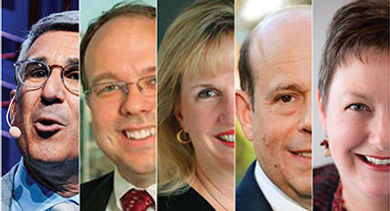
Our Panelists
Steve Adelman, a sports and entertainment lawyer, is head of Adelman Law Group PLLC in Scottsdale, Ariz., and vice president of the Event Safety Alliance. He focuses on risk management and litigation regarding safety and security at live events.
Nathan Breen, Esq., is a partner with Howe & Hutton Ltd. in Chicago, concentrating on association intellectual property, contracts and hospitality law. He teaches courses in hospitality law as an adjunct professor at Kendall College.
Lisa Sommer Devlin, based in Phoenix, has concentrated on hospitality law since the early 1990s, working on standardized contracts and meetings-related litigation for major hotel chains.
Joshua Grimes, Esq., runs the Grimes Law Offices in Philadelphia, focusing primarily on the association, nonprofit, meeting and hospitality industries.
Tyra Hilliard, PhD, JD, CMP, an attorney, professor and speaker, is on the faculty of the College of Coastal Georgia, where she teaches courses in business, hospitality and event management.
With a new presidential administration, heightened concern about security, global health scares and other factors, meeting contracts are becoming increasingly complex as planners attempt to mitigate worries in their agreements. In view of this challenging time for the U.S., and a world in flux, M&C asked several industry attorneys for their insights and opinions on issues affecting the meetings industry.
For a "reader roundtable" of concerns, visit our Research column at mcmag.com/research.
> How will the Trump Administration affect the meetings industry?
TYRA HILLIARD: Any new administration has an effect on business, and the meetings industry is like any business in that sense. Where I think Donald Trump's administration will have a more significant impact than prior administrations is in the radical conservatism that Trump espouses and the Republican-majority Congress that might amplify this. In addition to the alleged Muslim registry that Trump keeps talking about, I am concerned that we will see more discriminatory laws like HB2 in North Carolina or the so-called "religious freedom" act that passed in Indiana and nearly passed in Georgia. These laws might find more traction than they have to date, given the overall conservative bent in the federal administration.
I also worry about what Trump, with his lack of foreign-policy experience, might get the U.S. involved in, and whether international meetings could be affected by other countries' inability or unwillingness to do business with the U.S. under the current administration. I worry about the value of the U.S. dollar. I worry that a great number of U.S. citizens and residents are going to feel disenfranchised and the effects that might have on the meetings industry.
LISA SOMMER DEVLIN: The obvious possibility is that if his administration and policies impact the economy, that will ripple into the meetings industry. Beyond that, it is impossible to say until there is more clarity on exactly what he will try to do, and whether he can get the support of Congress to do any of it.
NATHAN BREEN: I expect that the uncertainty about how the administration will handle such a wide variety of issues will be a positive development for the meetings industry. Each industry is uniquely grappling with the future impact of the Trump administration. In light of this, there's much to discuss, and meetings can serve as a means of sorting out these developments across all industries.
JOSHUA GRIMES: Because Trump is in the hotel industry, one would expect that he would be sensitive to laws and trends affecting hospitality and avoid decisions that would hurt that industry. Given his statements to date, I would expect a tightening of visa requirements and stricter scrutiny of persons traveling to the U.S. from abroad, positions that could hurt attendance at meetings here. There could also be reduced travel by Americans to certain countries that have been targeted by the president-elect as hurting American interests, thereby helping the domestic meetings industry as well as meetings in countries that are close U.S. allies.
In addition, the new administration's policies of restricting immigration could cut down on the number of non-Americans working in hotels, restaurants and on farms, thereby increasing some costs for products and services integral to meetings.
> Are you seeing risk management and security addressed in contracts?
STEVE ADELMAN: As a result of actual attacks and greater coverage of security issues generally, both real and perceived, security is a more prominent concern than ever in the U.S. But I am not seeing a change in contracts so much as a greater focus during negotiations on issues such as whether people can bring weapons into a meeting, sign-age regarding concealed and open carry, number and placement of security guards, and when and how exterior doors are secured in large venues.
HILLIARD: I don't think most meeting planners are addressing this issue enough in their contracts. The changes I have seen are broader force majeure clauses, which allow a planner to terminate the contract without liability in
the event of not just an occurrence of terrorism where the hotel is located or where the meeting planner's office is, but also if there is an "atmosphere of violence" such as bombings, active-shooter scenarios and/or snipers in the city where the meeting is to be held. It bears repeating that what we are often battling is fear caused by something that has already happened. Fear is not a force majeure issue, so it's something that has to be put into the contract -- as it has been with the Zika virus -- to be a valid reason for terminating the contract without liability.
What I would like to see in contracts are more proactive questions regarding safety and security. Some years ago, I had a client who would send a security questionnaire to a hotel along with her RFP. She would not consider a proposal until the director of security had completed the questionnaire and signed it. It asked things like: How many security personnel are on each shift? What kind of training do security personnel have in regard to CPR, first aid, automated external def ibrillators, etc.? Are there AEDs on-site at the hotel? If so, where are they located and who is allowed to use them? Does the hotel have a shelter-in-place plan? What is the procedure for evacuating persons with disabilities? And so on.
Questions could be added to address any number of current-day issues --
active-shooter protocol, procedures for suspicious packages found on property and contact information for the local emergency-management agency.
DEVLIN: I don't see a lot of changes in contracts on these particular issues. Hotels are being more vigilant in requiring groups whose meetings might create security risks to provide additional security. Otherwise, the obligations of the hotel to protect guests are pretty well established under the law, and hotels take it very seriously.
Groups also have potential liability for their activities within the hotel that cause injury or damage. There has been a trend for a few years for groups to request "mutual indemnification," which I feel is not helpful to either side. Almost all lawsuits settle without a trial or determination of which party is at fault, so there is no determination of which party has to indemnify.
BREEN: It seems like each side is digging their heels in on risk-management issues. I'm seeing pushback on some clauses like mutual indemnification, which used to be taken for granted. Insurance requirements are expanding, and minimum amounts are increasing. Entities with substantial negotiation leverage are attempting to extract substantial risk-management concessions.
GRIMES: There is an increasing focus on shifting responsibility for risks from one party to another, sometimes irrespective of which party has the most control over a situation that could cause injury or damage to occur. For example, even though hotels might have ultimate control over what happens within their properties, they try to shift responsibility for anything that happens onto the group.
Also, we are increasingly seeing attempts to cap liability to some low amount. It is incumbent on planners and suppliers to discuss risk management and security during the contracting phase, and to make sure that all risks are assumed by the party best able to handle a situation. It is also essential to make certain that all risks will be covered by adequate insurance. And if attendees are asked to sign waivers, it should be done properly so the waivers will be effective.
> How are controversial political or health issues making their way into contracts? HILLIARD: Groups with a minority focus have got to be concerned with the overall climate created by Trump and his supporters. If Trump follows through with his racially charged plans for a Muslim registry or a wall across the Mexican border, I fear there will be backlash both from minority groups and at minority groups.
As for health issues, we discovered with the Zika virus that there can be a real threat to health and it still might not legally amount to force majeure. The CDC and WHO never issued a travel warning against areas affected by Zika. They just advised "advanced precautions." Fortunately, hotels in Zika-
stricken areas were as generous as they could be in allowing groups to reschedule or relocate, but they can't do that indefinitely.
DEVLIN: While many groups want to have an option to cancel an event if they disagree with the politics in the place where it is booked, the question becomes whether the group should have to pay cancellation damages for exercising its political position, or whether the hotel should bear that loss even though the hotel had nothing to do with (and perhaps opposed) the "offensive" law or policy. Groups can certainly ask a hotel to agree that the group may cancel without payment due to politics, but they should understand why the hotel might be reluctant to do so.
As to health concerns, unless there is a CDC warning to avoid all nonessential travel to a specific location, groups probably will not be able to cancel a contract without payment due to a perceived health risk.
BREEN: While there is a push on the part of groups for language that would more easily allow for cancellation due to political or health developments, meeting facilities are justifiably reluctant to agree to clauses that give the group broad leeway to cancel for such reasons. The most workable approach for now entails focusing narrowly on the concerns of a particular group. The American Pregnancy Association, for example, is more likely to have success negotiating a Zika-related cancellation clause, and a group that supports transgender rights is more likely to negotiate successfully with respect to political developments that might target their attendees.
GRIMES: More groups are concerned about political changes that might make a meeting destination undesirable for their attendees. Recent examples include state law changes that discriminated against same-sex couples and transgender persons, which caused some groups to cancel their meetings in the enacting state, or to refuse to consider that state for future meetings. It is now essential for groups sensitive to political concerns to craft an appropriate clause into their contracts to deal with future legal changes.
In terms of health issues, recent health crises such as the Zika virus remind us that health concerns should always be covered in a force majeure/excuse of performance contract clause. If health concerns would objectively cause a meeting's attendees to cancel their attendance, there should be some way for the group to cancel without paying significant damages. Again, the challenge is to create a reasonable clause that is fair to both planner and venue, and would allow cancellation or a room-block reduction in the event of a health crisis.
> Which typical contract clause is causing the most headaches?ADELMAN: The right to carry a weapon is problematic in lots of cities, and I anticipate that it will continue to challenge industry professionals who want to be inclusive while at the same time assuring planners and patrons that their meeting will not devolve into a gunfight at the O.K. Corral.
HILLIARD: Planners often want to throw the kitchen sink into their force majeure clause, leaving hotels -- especially international hotels -- feeling like they are just looking for a reason to bolt. As mentioned before, people want fear to be a force majeure, and it really isn't. But if 60 percent of your attendees say they aren't coming to a meeting in an area where there has recently been violence, or a disturbingly discriminatory law has been enacted or a health risk like the Zika virus has erupted, the threat of paying attrition or cancellation fees is very real. It is up to the planner and supplier to apportion the risk, given today's climate.
DEVLIN: Cancellation and attrition clauses are always contentious, of course, but the last few years have brought a wave of confidentiality clauses that place sweeping obligations on the hotel to protect information that it neither needs nor wants to receive to host the event. The group relies on the clause for security of its confidential information, rather than taking practical steps to protect it, like making sure attendees do not take the secret information out of the meeting room and discard it where it can be found by competitors.
BREEN: Force majeure has been the biggest hot button of late. With the Zika virus and government regulation of social issues concerning so many in the meetings industry, many groups are looking for an out if their meeting locale is affected. Meeting venues are understandably hesitant to provide leverage for the group to cancel.
GRIMES: I find that both attrition- and cancellation-damages clauses in hotel contracts are frequently not calculated correctly. A proper liquidated-damages clause should be a reasonable estimate of the property's losses if cancellation occurs or if the group fails to meet its contractual rooms obligation. However, the amounts in many contracts exceed those losses. It is incumbent on the parties to review the risks and negotiate reasonable damages amounts.