New Brand for Hilton?
Hilton Hotels has dropped a few hints at a new lifestyle brand of their own, but for the most part are keeping mum on details. One thing is clear: While the company is interested in appealing to the Millennial traveler, they're also taking aim at a broader range of customers. "It's misguided to think there is a silver bullet and there is a Millennial brand that will solve any of a company's problems," Chris Nassetta, president and CEO of Hilton told Hotel News Now in March. "The lifestyle brand, when we eventually do it, will have a different perspective. It will be a perspective that will try to capture a broader base of demand."
Part of that decision comes from the understanding that what Millennials may want now, can be very different down the road. "We understand that needs change, not only with time but also with each vacation or trip you take," says Andrew Flack, vice president, product marketing solutions, for the chain. "While some Millennial customers may be looking for a brand with incredible Wi-Fi bandwidth now, another 10 years down the road they may be seeking a high-end experience with luxury amenities, or a beach resort that caters to the needs of a family with kids." -- M.C.L.
There's no denying it: The Millennials are coming. Those born between the early 1980s and 1999, known as Millennials or Generation Y, already account for some 30 percent of U.S. business travelers today, but by 2020 that number could increase to 50 percent, according to several research reports.
Major hotel brands are ready for the shift in demographics, anticipating an influx of future guests who are characterized as creative, tech-savvy, fiercely independent and highly social. The following hospitality brands specifically target the coveted Millennial market. And more, you can be sure, are on the way.
Andaz
Launched in 2007 and since growing to nearly a dozen properties around the world, Hyatt's Andaz brand, above, generally is grouped in with those that appeal to Millennials because it targets what it calls the "creative class." This is "a rapidly growing group of professionals who are interested in getting to know the places they travel to more intimately and are motivated and inspired by the surrounding culture," says Megan Eakins, senior brand manager for Andaz Hotels.
To that end, each property is designed to reflect the spirit of its locale. At the Andaz 5th Avenue in New York City, a muted palette and exposed-pipe ceilings channel an industrial Big Apple, while dining outlets at the Andaz Napa take inspiration and source products from surrounding Northern California ranches, orchards, mills and farms. "We live and breathe to deliver to our guests a local, transformative and inspired experience," says Eakins.
Programs are available for both travelers and area residents that showcase emerging local talent in areas such as music, fashion, food and film. The events are known as Andaz Salons, a nod to the Paris Salons from the 18th and 19th centuries, where the social elite gathered to discuss art and culture.
"The goal is to provide a way for like-minded individuals to share their passions, become inspired and connect with up-and-coming cultural insiders," says Eakins. At one recent event at the Andaz 5th Avenue, guests watched a local graffiti artist spray-paint a door in appropriately gaudy street-style, followed by drinks and a discussion.
Meeting spaces and guest rooms also take inspiration from their destinations. The Chancery at the Andaz Liverpool Street in London features ornate chandeliers and classical-style cornices and fireplaces to delight guests at receptions for up to 100, while Apartment 2E at the Andaz 5th Avenue channels a swanky downtown loft apartment with an open kitchen and modern living room-style lounge areas.
Other Andaz elements that appeal to the Millennial mindset include a roaming, iPad-armed check-in staff that offers guests wine or other beverages upon arrival.
Aloft
Starwood Hotels & Resorts launched Aloft Hotels in 2008, one of the earliest chains created specifically with the new generation of traveler in mind. The brand is growing fast and will have more than 100 properties in 14 countries by the end of this year, with new hotels in Atlanta; Oklahoma; and Calgary, Alberta, debuting just last month.
The Aloft experience begins with the lobby, a decked-out social space optimal for mixing and mingling or hunkering down and doing work. With an open loft-style layout, a typical Aloft lobby is furnished with bright, swanky furniture, pool tables, board games and big windows for lots of natural light to draw guests from their rooms and into the communal hub.
"Travel can be lonely, so we designed the lobby to be an energetic space where you can socialize and meet people, or sit back and just people-watch," says Brian McGuinness, senior vice president of Starwood's specialty select brands, which include Aloft, Element and Four Points by Sheraton.
Aloft's signature W XYZ bars are an extension of the lobby, adding their own hip, lounge-like ambience, with neon lights, seasonal cocktails and live music from local up-and-coming artists.
The type of guests Aloft attracts "are not wallflowers," says McGuinness. "They're accustomed to being connected all the time and being out there." Indeed, they're a generation that grew up hanging out at a Starbucks in a caf• culture, so doing their thing among other people is comforting.
Guest rooms are efficient and airy, with big windows to maximize natural light, high ceilings and contemporary furniture.
Although the brand puts a premium on social interaction, Aloft also caters to the highly independent guest. "This crowd has wheels on their luggage and a smartphone in their hand," notes •McGuinness. "They're mobile, on-the-move and prefer high-tech solutions over hand-holding."
In 2011, Aloft launched Smart Check-In in five of its U.S. hotels, which eliminates the check-in process and allows guests to enter the property and head straight to their rooms. Starwood Preferred Guest members who opt in are given an Aloft-branded RFID keycard that serves as their room key. On the first day of a planned stay, the hotel sends a text with the guest's room number. Aloft is now piloting a program that lets a smartphone serve as the room key, doing away with the keycard altogether.
Such seamless simplicity carries over to the meeting room. Typical Aloft meeting spaces are pre-outfitted with chairs, tables, a TV and a DVD player. The goal is to create spaces that allow guests to roll in and connect their laptops or tablets and broadcast presentations with ease. According to McGuinness, "We wanted to create a space that was ready to go."
Moxy
In September, Marriott will launch its own Millennial entry dubbed Moxy, a nod to the new brand's self-proclaimed vibrant design aesthetics and bold character. "Moxy hotels are going to attract people who are into traveling and exploring, so locations can be expected near major transportation hubs and in urban downtowns," says Indy Adenaw, vice president of marketing for Marriott International.
The first Moxy will be a 162-room property at Terminal Two of the Malpensa Airport in Milan, Italy, and the next five hotels also will be near large airports or train stations around Europe, including four in Germany (two in Berlin, one in Munich and one in Frankfurt) and one in Oslo, Norway.
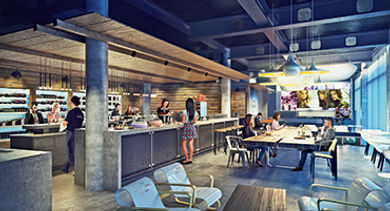
Moxy's mixed-use lobbies will be segmented into four zones, beginning with a quiet area for relaxing or working and transitioning progressively into more social, interactive spaces. "Zone Four has a very active bar, a TV wall, a small DJ booth and communal seating space," says Adenaw. "We wanted to create a space that was flexible. We realize that even the most outgoing people don't always want to socialize."
From the start, designing Moxy has been all about choice. Brand developers wanted a to offer a quality hotel with a sense of style, but at a budget-friendly price point. "You might not get everything you would at a full-service, but the things you do get are thoughtful, high quality and curated around the needs of our travelers," says Adenaw. "Our research found that the type of guests we're targeting want some things done incredibly well, but they're willing to make trade-offs." For instance, self-service food is OK as long as guests also can head to the bar and get a really good drink. Free high-speed Internet is important; the gym is not. "We're picking a few things and doing them really well," Adenaw notes.
Current plans do not call for dedicated meeting spaces, although informal areas will be available for groups to spontaneously pull up a few chairs and get down to business. These "Plug and Meet" spaces, dotted throughout the public areas, will have ergonomic seating, writing walls and large TV screens to hook up laptops for projection. They're meant to feel so informal that reservations won't be needed, and if patrons want to use the space just to eat lunch or check messages, that's OK, too.
Adenaw stresses that the young brand will have a culture of experimentation as hoteliers observe how visitors interact and engage with the brand's features. Moxy's Milan property will have just two Meet and Plug spaces, but the next hotel, in Munich, will have four, "so we might experiment with renting out some of them," says Adenaw. "There will be a lot of learning involved. We're happy and willing to adjust."
As with Aloft, Moxy's guest rooms are not the brand's focal point, but they will feature meticulous design with 42-inch TVs, queen-size beds, and leather recliner chairs and ottomans. LED lights under the bed will pop on when they sense motion, and a full wall will be dedicated to lifestyle-oriented art reflective of the local area.
"Even though the public space is the most amazing part of the hotel, the rooms will be spectacular for the sector," says Adenaw.
Tommie
Early next year, Commune Hotels & Resorts will launch its new "value-conscious" lifestyle brand called Tommie, with the first two hotels in Manhattan. The concept will combine the "savvy and aesthetic sophistication of Thompson Hotels with the playful approachability of Joie de Vivre," says Audra Tuskes, vice president of design for Commune Hotels & Resorts, referencing the company's two other brands.
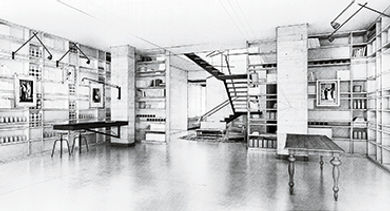
Efficiency and functionality are prioritized over decadence and excess. Guest rooms have been "stripped down to essentials without sacrificing design quality, comfort or functionality," says Tuskes. That means traditional elements like minibars and room service have been eliminated to focus resources on items more in tune with the interests of the Millennial generation, like social communal spaces with games, public programming and intriguing F&B.
"We're going to offer great bath products, artisanal-quality food options and various creature comforts to allow guests to tailor their own experience," says Tuskes. Among those comforts will be a choice of shampoos, fresh flowers and cookies for guests to select at check-in. "Instead of setting up the room ourselves, we let the traveler choose," Tuskes notes. "Having the ability to appropriate one's environment, with attractive options, at a reasonable price-point -- that's the essence of affordable luxury."
Dedicated meeting space will generally not be a part of the brand offering, although meeting spaces embedded in public areas will be available for rental on request. The lounge-like spaces will offer comfortable furniture and communal tables, and will be divisible so that groups of various sizes can block off the space they need.
Radisson Red
While locations for Carlson Rezidor's forthcoming Millennial offering, Radisson Red, were still under wraps at press time, company officials say the brand will highlight the latest technologies and offer a high level of personalization when it launches worldwide in 2015.
"This generation is used to having everything at their fingertips and the ability to customize things exactly how they want them," says Rose Anderson, vice president of branding for Radisson Red and Carlson Rezidor's more upscale Radisson Blu hotels. "The more personalized we can make it, the more unique an experience we can create."
One concept in the works is the Red App, which will let guests create and update personal profiles that could include their interests as well as hotel preferences. "If we know you're a huge baseball fan and there's a baseball game going on while you're at one of our properties, we might have discount tickets that we can offer you," says Anderson. "The benefit of creating and maintaining profiles will be a customized experience in the local area."
Radisson Red staff will be able to use app profiles to greet travelers personally and cater to their interests in real time, while guests can use it to check in, check out, order from the bar or access local news. In addition, says Anderson, before they enter their rooms, guests will be able to set the temperature, choose which music is playing and even upload personal photos that will stream to the in-room TV.
Properties will offer dedicated meeting space referred to as "event studios," designed to be "very multifunctional," says Anderson. "They're intentionally bare because we want them to be completely flexible, whether you need to use a space as a photo studio, boardroom or art gallery." While details are yet to be finalized, the latest technologies and flexible lighting solutions are to be expected.
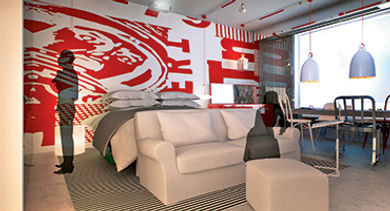
Another theme: "Art everywhere. The whole space is a gallery, even on the outside," the Radisson Red website promises. From the hotel entrance to the lobby to the guest rooms themselves, art will be central to the design.
"This generation is really hungry for learning and seeing new things," says Anderson. "Thought-provoking and inspiring art is a great way to make that connection."