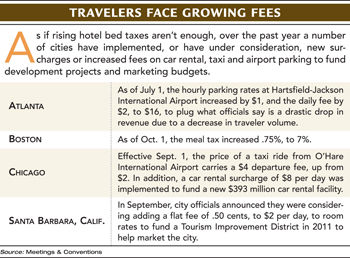
The prolonged economic downturn has wreaked havoc on municipalities across the country, leaving cities both big and small struggling with depleted revenues. Among the measures being used to prop up teetering budgets, one of the most common -- and controversial -- has been to hike hotel bed taxes, some by as much as 3 percent. In response, opponents are howling their disapproval, claiming the additional levies will cost them lucrative group business.
Nowhere is the fight more contentious than in San Francisco, where the Hotel Fairness Initiative, or Proposition J, comes to a vote this month. The measure would increase the city's hotel tax by 2 percent, to 16 percent beginning in January 2011, and last for four years. In addition, visitors to the city would continue to pay an established 1.5 percent tourism-marketing fee, bringing the city's total daily hotel tax bill to 17.5 percent.
A number of important city agencies are against the hike, including the San Francisco Convention & Visitors Bureau, the San Francisco Chamber of Commerce and the Hotel Council, along with Mayor Gavin Newsom and a coalition of local business leaders. In support are various community groups and Unite Here Local 2, the hotel workers union.
 "This increase will make San Francisco's hotel tax rate the highest in the country and take us out of the competitive bidding process, especially for large groups that are price-sensitive," warns Steven Falk, president and chief executive officer of the SFCOC and one of the founders of Economic Recovery San Francisco, a growing alliance of local business groups that have banded together to fight the ballot initiative. "If you're a planner looking to book 5,000 rooms for an event, and your choices are San Diego or San Francisco, that higher tax is going to make a big difference in where you go," he adds.
Martin D. Balogh, director of meetings and travel for the Chicago-based American Bar Association, is in full agreement with Falk's assessment. "San Francisco, already perceived by planners and attendees as a very expensive destination, is heading toward particularly dangerous waters with this possible tax increase," he says. "Becoming known as also having the highest bed taxes in the country will not be viewed as a positive by decision makers when considering the city as the site for a meeting."
Indeed, the looming possibility of higher taxes already might be costing the city potential meetings business, according to Joe D'Alessandro, president and chief executive officer of the SFCVB. "Five groups that were completely sold on us have told me they would have to take a second look now, because higher taxes will make us that much more expensive for them," says D'Alessandro, who put the groups' combined worth to the city at $120 million. "Obviously, this increase, which we at the CVB are totally opposed to, is not in the city's best interest."
Economics of bed taxes Among major
meetings destinations that have recently raised their bed taxes are
Boston; Indianapolis; Las Vegas; New York City; Scottsdale, Ariz.;
Oakland, Calif., and the state of Hawaii. Other cities, including
Baltimore; Birmingham, Ala.; Cleveland, and Los Angeles, are considering
following suit. And unless the economy makes a strong, sustained
comeback, say industry watchers, many more municipalities likely will
turn to bed tax increases to bolster their bottom lines.
According to the most recent nationwide data available (found in Room Taxes and Economic Impact on the Lodging Industry by
the Washington, D.C.-based American Economics Group and published in
June 2008 by the American Hotel & Lodging Educational Foundation),
room taxes at U.S. hotels averaged 13.4 percent, up from 12.4 percent in
2003. In many of the top 25 markets, however, combined bed taxes are
higher than the industry average. Atlanta, Chicago, Dallas, Philadelphia
and Seattle currently charge 15 percent or higher; San Antonio's tax is
nearly 17 percent.
In 2009, when the struggling hotel industry
dropped its rates to unprecedented levels as a means of survival, the
bed tax portion of a hotel bill might not have raised many eyebrows. But
as the industry rebounds and rates begin to inch back up, says Joe
McInerney, president and CEO of the Washington, D.C.-based American
Hotel & Lodging Association, taxes will become a lightning rod in
the competition for group business. "Our industry is fighting these
increases, because when the rates rise -- and they are going to -- those
same taxes will take cities who raised them out of the competition with
other destinations," McInerney says.
It's an argument being
repeated from city to city, but it seems to fall on deaf ears as
lawmakers pass the burden of additional taxes on to visitors, rather
than their constituents.
Case in point: In New York, legislators
increased the city's portion of the hotel tax in March 2009 from 5
percent to 5.875 percent, bringing the total bed tax to 14.75 percent.
The additional levy was expected to generate $100 million by June 2010
and help plug a $4 billion budget deficit. But Mayor Michael Bloomberg,
the Hotel Association of New York City and other agencies argued that
the tax would drive groups and visitors away and hurt the city's tourism
industry. (As it is, New York also charges guests a $2 per night
occupancy tax and a $1.50 surcharge, which had been earmarked to fund
the recently completed expansion of the Jacob K. Javits Convention
Center.)
"We felt that is was counterproductive to add any
additional room taxes to what was already in place," says Joseph E.
Spinnato, president and CEO of the HANYC. "It has been proven time and
time again that exorbitant hotel taxes deter visitors. That's what
occurred in the early 1990s, when the total combined taxes on New York
City hotel rooms peaked at more than 21 percent, which caused outraged
convention planners to boycott New York City."
As it turns out,
the Big Apple welcomed some 23.5 million tourists in the first half of
2010, an 8.75 percent increase over 2009, according to NYC &
Company, the city's marketing agency. While those numbers are
impressive, New York City's hotel room rates remain low. Smith Travel
Research reports that the average daily rate in the city for the first
half of 2010 was $209.42, a 5.4 percent increase over the same period in
2009, yet that figure represents a dramatic 24.4 percent drop from the
same period in 2008, when the average rate stood at around $259. The
city, therefore, still has a lot of ground to make up when it comes to
guest room pricing.
Farther north, Boston's City Council, which
was struggling with $90 million in state aid cuts, last year approved a
2 percent increase in the hotel occupancy tax, to 14.45 percent. In
announcing the hike, which became effective Oct. 1, 2009, Mayor Thomas
M. Menino noted in a statement that the city's convention business
remained strong and that with the increase, "Boston still ranks lower
than many other comparable cities, such as San Francisco, Chicago and
New York, for meals and hotel taxes."
But Deene Alongi, director
of meetings and conferences for the Chicago-based American Planning
Association, predicts repercussions when the APA holds its annual
meeting at Boston's Hynes Convention Center in April 2011. "High bed
taxes on top of high room rates at a headquarters hotel make a big
difference to attendees whose employer will only pay their registration
to attend our convention. To soften the blow, I expect attendees will
now skirt the CVB, which handles our housing, and book cheaper rooms
outside our block. We'll take an indirect hit."
In San
Francisco, where hotel bed taxes last year brought in close to $147
million for the city's coffers, supporters of the proposed 2 percent
increase claim it will generate an additional $25 million in revenue.
Not so, counters the SFCOC, which cites the American Economics Group's
estimate that the hike likely will kill more than 2,000 jobs and
eliminate $75.5 million in taxable wages. According to the most recent
data from the California Labor Market, on average the state's hotel
sector lost 143 jobs per month in 2009 as a result of the faltering
economy.
Even more vexing, says chamber CEO Steven Falk, is the
fact that the city has already passed a balanced budget, making the new
tax unnecessary. "We no longer have a budget shortfall," he notes. "What
these backers want is some kind of assurance -- a fallback plan. They
are just looking at ways to raise revenue without looking at the entire
economic impact to the city. We are in the tail end of a deep recession,
and increasing the tax rate will only hurt our chances of a strong
recovery."
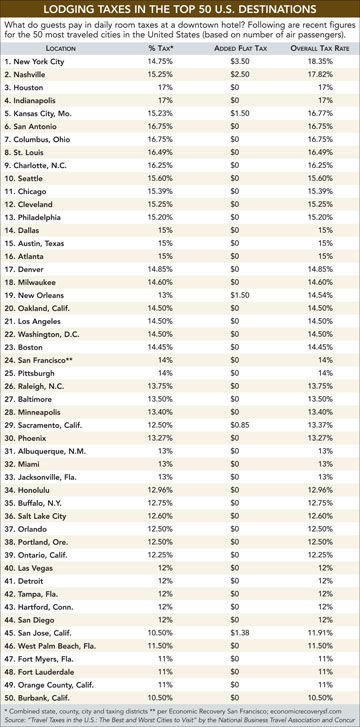
Where it all goes In
2008, according to the American Economics Group, a total of $13.8
billion in revenue was generated by U.S. room taxes, yet only $3.7
billion -- just 27 percent -- went to fund tourism-specific initiatives
such as operations by destination marketing organizations, advertising,
promotion and other travel-related purposes. The balance went directly
into state and local general funds to finance everything from road
repair and school districts to the building of stadiums.
 "It
is where the taxes go that is maddening to hoteliers," says lodging
analyst Sean Hennessey, CEO of New York City-based Lodging Advisors, who
has compiled bed tax data for various hotel associations. "The
distinction is they are against it when it goes toward general revenues
as opposed to something that supports tourism, which is considered
beneficial, like the renovation of a historical venue such as an opera
house or a new bicycle path through a city park."
"It
is where the taxes go that is maddening to hoteliers," says lodging
analyst Sean Hennessey, CEO of New York City-based Lodging Advisors, who
has compiled bed tax data for various hotel associations. "The
distinction is they are against it when it goes toward general revenues
as opposed to something that supports tourism, which is considered
beneficial, like the renovation of a historical venue such as an opera
house or a new bicycle path through a city park."
Every city has
its own priorities. In Dallas, for example, 2 percent of the 15 percent
hotel tax is earmarked to fund the American Airline Center; and in New
Orleans, a breakdown of the 13 percent room tax includes 1.5 percent for
the New Orleans school system and 4 percent to help pay for operations
at the Louisiana Superdome.
More than a quarter of the state
budget of Nevada comes from revenues generated by the travel industry.
In Clark County, Nev., which includes Las Vegas, the bed tax increased
by 3 percent, to 12 percent, on July 1, 2009, after voters supported a
ballot measure guaranteeing that all monies raised would go directly to
educational programs. The measure is supposed to expire in 2015, but
already there is talk of extending it.
While the Las Vegas
Convention & Visitors Authority declined to comment on the increase,
Jim Murren, chairman and CEO of MGM Resorts International, in an Aug.
29, 2010, column for the Las Vegas Sun, voiced his concern that rising
bed taxes were hurting the city's tourism recovery and warned that more
increases might be on the horizon. In referencing an upcoming
legislative meeting set for February 2011, when Nevada's $3 billion
state budget shortfall will be addressed, Murren wrote: "Gone are the
days when we can assume the tourist-based taxes have no effect on
visitors and spending. We have some of the highest hotel room taxes in
the nation. Now is not the time to raise them even further."
While
other cities have channeled the revenues generated by increased bed
taxes to nontourism directives, Oakland, Calif., has taken the opposite
tack. In July 2009, voters overwhelmingly supported an increase of 3
percent, bringing the city's bed tax to 14.5 percent, effective Jan. 1,
2010, with 100 percent of the estimated $3 million of revenue it will
generate obligated to support specific tourism-based initiatives. Fifty
percent will go to the Oakland Convention & Visitors Bureau, and
three 12.5 percent increments will go to the Oakland Zoo, the Oakland
Museum of California, and the Chabot Space and Science Center. The
remainder will support various cultural arts programs and festivals.
In
pressing for a "yes" vote on the ballot, Oakland's city leaders
promised that the additional revenues raised would "be invested in our
tourism attractions and services," and that "this money will be used
right here and cannot be taken away by Sacramento."
That's a
stance Hawaiian hoteliers would like to see. On July 1, 2010, Hawaii,
which did not have a bed tax until 1993 (when it began imposing a 5
percent tax), increased its so-called Transient Accommodations Tax
another 1 percent, to 9.25 percent, in an effort to close an almost $2
billion budget deficit. It became the state's second such increase in as
many years.
A June 30, 2010, story that appeared in the Maui News noted
that critics do not bemoan how high the tax has become, because it
still is relatively low compared to other destinations, but rather where
the revenues will go. "From the beginning, the counties and the
hoteliers insisted that most of the money be returned to the
jurisdiction where it was raised," the paper said.
Yet,
according to Mike McCartney, president and CEO of the Hawaii Tourism
Authority, just 12.5 percent of the revenues derived from the TAT will
go to the Tourism Special Fund, which is used for tourism promotion,
market development, tourism research and statistics, and other
activities related to the visitor industry. "As it is now," McCartney
says, "a portion of the TAT goes to the state's general fund, which
helps to fund a range of programs including education, transportation
and public safety initiatives that contribute to making Hawaii a great
place to live, work and visit." He also notes that while the current tax
rate is 9.25 percent, "it will be repealed on June 30, 2015, returning
to 7.25 percent."
Meanwhile, opponents of San Francisco's bed tax
increase say they are prepared to battle hard to defeat Proposition J.
To draw the issue away from the hotel industry and into the larger
economic arena, they began running some compelling local TV campaign ads
from the perspective of blue-collar workers on the detrimental nature
of the increase to ordinary citizens. In one, a taxi driver plaintively
states, "I know who will end up paying for this tax -- we will pay for
it with fewer conventions and less economic activity."
"This tax
increase goes well beyond the hotel industry. It is about the bigger
economic picture," says Jim Lazarus, senior vice president of public
policy for the SFCOC. "The vote will be close, very close. But polling
of San Francisco voters indicates people don't have an appetite for any
taxes."