Do It Yourself
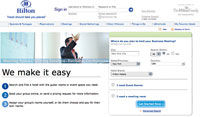 |
| A done deal: Hilton's online e-Events |
In recent years, some hotel chains have taken the RFP process out of the equation altogether by unveiling online booking tools that allow planners to find a hotel that meets their needs, book their meeting and get an immediate confirmation. For example:
• Hilton Hotels Corp.'s e-Events program, introduced in March 2007, allows groups of up to 25 to book a block of rooms, meeting space, A/V, and food and beverage in one nonnegotiable package at any of the chain's 2,300 North American properties. hilton.com
• Marriott International's QuickGroup, launched in June 2008, lets planners with groups requiring 10 to 25 rooms compare dates, rates and meeting space options (using online diagrams) at participating Marriott properties in a chosen location or region. The program also can be used to make a selection and book the event. marriottmeetings.com -- C.A.S.
 One of the more challenging tasks for planners is to decide which destinations or venues to invite to bid on their meetings business. There are so many choices to be had, even within a single city, that to narrow the playing field takes an inordinate amount of expertise, research and time. Today, however, a number of planners are showing up at industry trade shows, requests for proposal in hand, and also posting their specs online at their organizations' websites -- two moves that come with surprising benefits.
Planners who hit trade shows intent on returning home with bids, rather than giveaways, find hotels equally eager to cut through the clutter and begin negotiations. Similarly, those who have taken their RFPs online have found that industrious suppliers are mining the web for potential meetings business and reaching out with enticing offers.
"Data mining on the web is a very smart use of time for salespeople -- it's how we uncover new leads today," notes Mike Williams, vice president, brand performance and sales, for Beverly Hills, Calif.-based Hilton Hotels Corp. He adds, "We want to see as much information as possible in the RFP so we can make a meaningful match."
Up and running
It's a tactic that's proven effective for planners such as Pauline Minhinnett, CMP, director of meetings for the Bethesda, Md.-based American Society of Human Genetics. Eight years ago, tired of calls from suppliers asking for her meeting specs and looking to cut down on the time it took away from her planning duties to respond to them individually, Minhinnett decided to post the society's annual meeting RFP on its website.
Mission accomplished. "The sales folks have commented that they have everything they need at their fingertips now, and they no longer have to come back and ask me question after question," says Minhinnett.
From her perspective, Katrin Madayag, convention sales research coordinator for the Greater Madison Convention & Visitors Bureau in Madison, Wis., says online meeting specs are great for web prospecting. "I can filter through accounts that are a better fit for Madison, which saves me time searching out details," she says. This year, while researching online, she discovered that several U.S. Olympic teams had their RFPs posted on their websites, and some seemed a potential fit for Madison -- valuable information she was able to pass along to the bureau's sales team. At press time, the bureau was bidding on business from USA Badminton to host a future Junior Nationals event.
Laurie Lee Dovey, executive director of the Johnstown, Pa.-based Professional Outdoor Media Association, began posting POMA's annual meeting RFP online just 18 months ago as a means to save time and money. "We're still in the toddler process," says Dovey. "We didn't promote it, but already people are happening upon it and calling us."
POMA's online RFP has two versions, a PDF and a Word document that can be opened up, filled out and then submitted. Essential to this request are requirements for a host city, which are listed up front, before any meeting-specific details such as number of attendees, meeting space or transportation requirements.
"Our conferences are unique in that any site that ends up getting our bid gets close to 200 journalists who specialize in outdoor sports, who will end up writing about their destination," says Dovey. The RFP is valuable for potential bidders, she adds, because it lists required host-site facilities, such as a shooting range, and access to water for various product demonstrations. "I put those musts right up front, because I don't want to waste any CVB's time in responding," Dovey notes.
"We also request services from the host city, such as a welcome event and a daylong event showcasing a local park or facility," she adds. "Yes, it helps our budget, but they get to tell their story and have their day in the sun. The benefit to them is we have the potential to drive outdoor recreation travel to their region." This year's meeting was hosted by Sioux Falls, S.D., and next year's is set for Erie, Pa. Dovey now is soliciting bids for 2011.
Dovey says she is constantly tweaking the RFP and hopes one day to have the technology in place to have it be a completely interactive document, where she and suppliers can work together in real time.
Points to Propose
The request for proposal is the must-have tool in any planner’s belt. Not only does it describe the purpose and needs of an event, it is an effective way to manage the complex process of soliciting and evaluating bids.
Beyond the obvious — meeting dates, space requirements, number of attendees, and food and beverage needs — avoid generalities and include as many absolutes as possible that are critical for the event’s success.
Following are other key points provided by the professionals interviewed for this article.
• Outline the decision-making process, and include both the deadline for vendor submission and the selection notification date.
• Request specifics on any critical items that could be deal-breakers. These factors include proximity to airport and convention center; exhibit space specifications; whether the hotel is unionized; other events taking place in-house over the same dates; number of parking spaces, and ADA requirements.
• Don’t forget to include any financial responsibilities expected of the host site, such as for signage, security and a welcome reception, as well as how such sponsorship will be acknowledged during the event.
For more advice, see this month’s Back to Basics column, "How to Craft a Better RFP." -- C.A.S.
The payoff
Jim Mallory, CAE, executive
director of the Park Ridge, Ill.-based Non-Ferrous Founders' Society,
started handing out his association's annual meeting specs at industry
trade shows, such as the American Society of Association Executives,
because he thought it "would make the whole process of talking to
exhibitors at trade shows easier." For the most part, it has.
Unlike
POMA's 17-page online RFP, Mallory's meeting specs are compressed into
a double-sided one-pager that includes exact dates through 2010, number
of hotel rooms and amount of meeting space required, a sample itinerary
and the group's meeting history for the past three years.
"We
no longer have to repeat the same answers to the same questions dozens
of times as we go around the exhibit hall," says Mallory. "And the
proposals we get back do seem to have a better understanding of our
meeting, our attendees and our requirements."
However, Mallory
adds, the reaction he gets from booth vendors when handing out his
specs has revealed to him that doing so on a trade show floor is
definitely not a common practice.
That's a fact that Mike
Williams of Hilton regrets. "Trade shows are now mostly grip-and-grin
events," says Williams. "We realize planners are still shopping around,
but they stand to make good, solid deals if they come on to the floor
aiming to do business. After all, that's what we are there for."
Three
years ago, when attendance at the Washington, D.C.-based National
Postdoctoral Association's annual meeting reached more than 200,
program manager Kenetia Thompson decided it was time to put the
association's RFP online to get the word out to its 45,000 members and
give their member institutions a chance of bidding on hosting the
meeting.
She quickly discovered that NPA's members weren't the
only ones logging on to the organization's website. "Hotels are
scouring the web and calling us," says Thompson. "CVBs, too."
Now
that Houston is listed online as site of the 2009 annual meeting, which
is expected to draw upward of 350 attendees, Thompson has been fielding
calls from the Houston CVB offering her group tours of the city and
other perks while they're in town. Since putting the RFP online,
Thompson says she has wrapped up bids through 2011.
"We are an
East Coast association, so we primarily meet here," she notes. "But
putting the RFP online has given our West Coast constituents the
opportunity to host a meeting on their end." The association's 2007
meeting was held in Berkeley, Calif.